Stories from the floor
Dhahran, 9:42 in the morning, day two of the expo. A man in a grey thobe and a hard-hat sticker on his lanyard slows down three steps before the PWS stand. He is not looking at the banner. He is looking at a 30-tonne excavator that is not there. It floats inside a transparent column, two metres tall, and it is slowly turning. He stops. He lifts a hand, half joking, and the boom follows him. He stays for four minutes and forty seconds. He is one of 4,187 people who did that over three days.
That stop is the whole business. Everything FAIM builds is in service of the three seconds in which a visitor decides to slow down, the minutes in which they decide to stay, and the one moment afterwards in which they decide to remember you. This is the story of how we build for those moments, told through the work that has already stood on real floors.
Our thesis, in one line. An event is not a place to show things. It is a place where people decide, in minutes, whether your company is worth their attention. We engineer those minutes.
It starts with a conversation, not a catalogue
Nobody has ever called us and asked for a cylindrical hologram. They call and say: we have a 30-tonne excavator, a stand on the fourth floor, and three days to make engineers care. Or: our safety training is a slide deck and nobody remembers it. Or: the port opens in six weeks and the Minister will be in the room for one minute.
So the first thing we do is listen for the real job. What should a visitor know, feel or do when they walk away? Once that sentence exists, the technology chooses itself. We write it into a scope with line-item pricing, so a client can take out a screen or add a day and see the number move. Bundled quotes hide decisions. We would rather show them.
Then we build the thing, and we mean build
FAIM is one studio in Manama that writes the software, produces the film, specifies the hardware and sends a person to stand beside the installation while the event is live. That sounds like four companies. On most projects it is, and that is usually where things go wrong: the stand builder, the AV supplier and the content agency each do their part, and nothing talks to anything.

We keep it in one room. The engineer who wrote the touch interface is the one who will calibrate it under venue light. The editor who cut the launch film is the one who will preview it on the real wall at rehearsal. It is slower to run a company this way. It is faster to deliver an event this way.
Five moments, five floors
Every event we have ever delivered comes down to the same five moments. Here is each one, anchored to a project you can watch.

01. The moment they stop: Interactive Hologram at HEC Dhahran Expo
PWS needed to show excavators and crawler cranes without shipping them. We deployed a 2.1 metre transparent cylindrical hologram, viewable from 360 degrees with no headset. Engineers pinched to rotate the boom, air-tapped to explode assemblies and hovered a palm for live telemetry, using Ultraleap hand tracking. The CAD models were optimised into real-time meshes in Unity and rendered locally on NVIDIA Jetson hardware. No cloud, no venue internet, nothing to fail.
The system logged 4,187 interactions across 72 hours. Average session: 4 minutes 42 seconds. 83 percent of sessions completed the full component drill-down. The stand captured 217 qualified leads. Those are the client’s own numbers from the deployment, and they are the reason we log everything.
02. The moment they find their way: Wayfinder at Aramco iktva
A busy event is a place where people get lost politely. At iktva we built touchscreen content and custom wayfinder applications that let visitors find halls, sessions and stands, and explore the programme at their own pace. A wayfinder is judged by one question: can a visitor find the thing in two taps. We design the map from the venue plan, not from a template, and we test it on the real screen size for fingers, glare and distance.
03. The moment they take part: Aramco TeraPOWERS and the EXPEC HUB
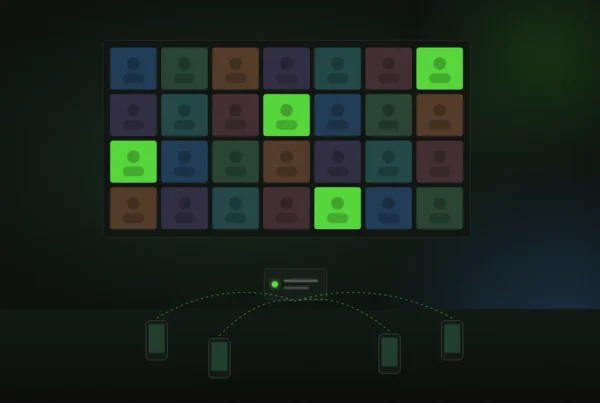
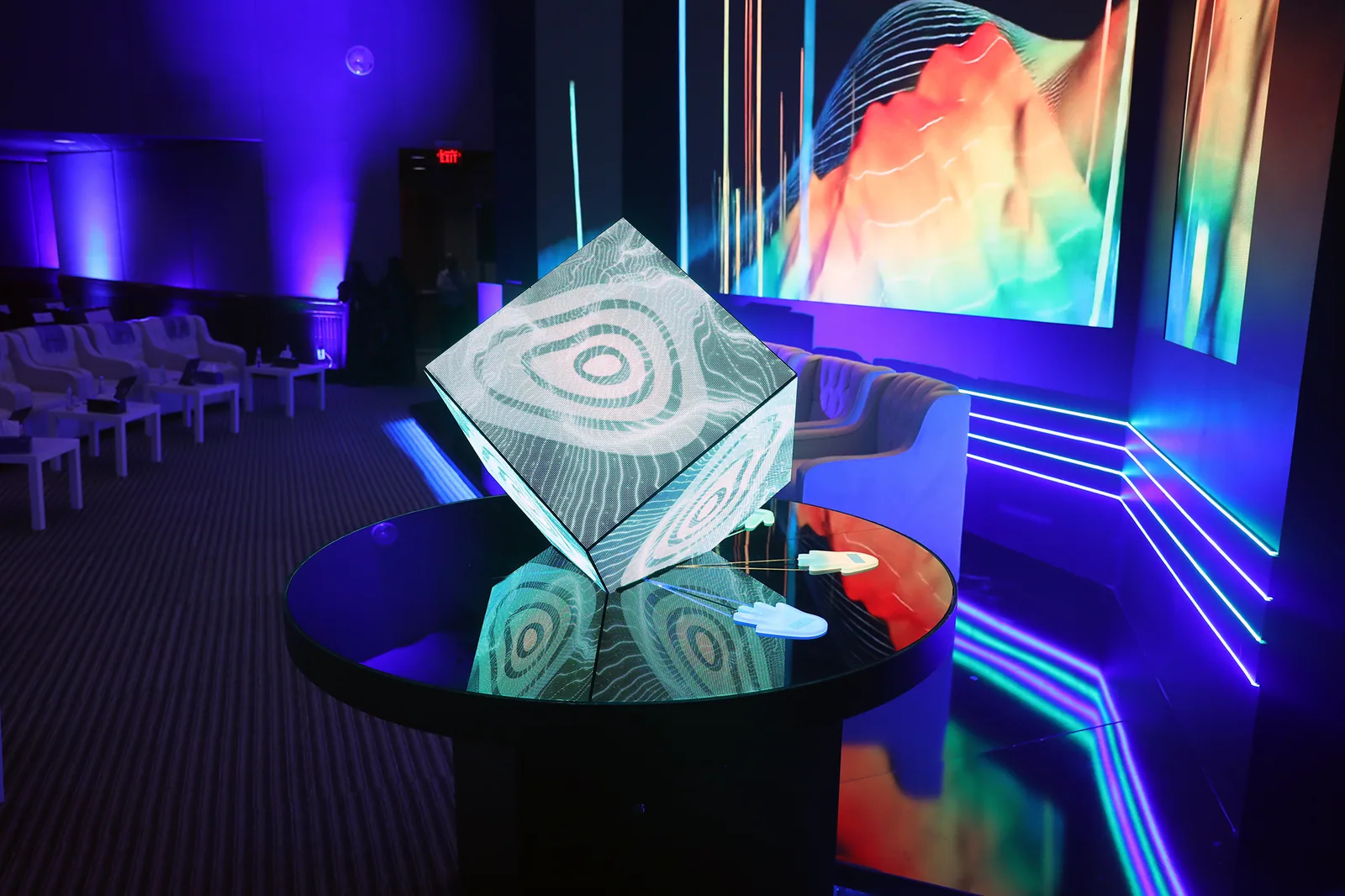
At TeraPOWERS we brought reservoir innovation to life with immersive VR journeys, responsive LED touch walls that turned real-time data into stories, holographic cubes and 4K film. At the EXPEC ARC Technology Show in February 2026 we delivered a multiscreen interactive HUB with content, data and media synced across displays and a touch-native interface, working with our Saudi partners Flash Diamond and Tactic Establishment on installation and hardware integration.
The lesson from both: a screen that plays a loop is furniture. A screen that answers a visitor’s touch is a conversation. We build the second kind.
Watch TeraPOWERS · Watch the EXPEC HUB
04. The moment they learn something: VR Safety Training at TASNEE
Safety training usually asks people to sit still. We built a Working at Height simulation in Unity for standalone Meta Quest headsets, with equipment checks, harness inspections and safe movement at elevation. The system tracked decision accuracy and reaction time for every participant. More than 200 people completed it at Tasnee’s Safety and Operational Excellence event, wireless, with no PC on the floor.
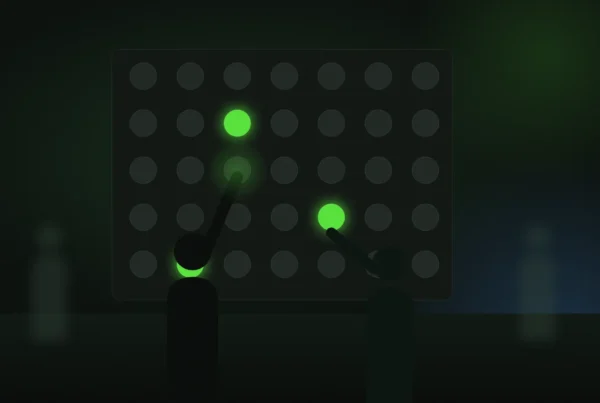
The same scoring idea runs through our reaction game for Al Salam Bank: lights blink in sequence, players hit the right buttons inside a one-minute countdown, and a dedicated screen shows the live score. Unity, custom electronic circuits, physical controls. A queue forms because people want to beat the number on the screen.
05. The moment that plays once: Jubail Commercial Port and the myhome SuperApp launch
An inauguration film plays once, in a room, to people who already know the business. For Saudi Global Port’s Jubail Commercial Port inauguration we made a film that keeps returning to what the infrastructure enables, so the audience reads capability rather than scenery, with Saudi Vision 2030 underneath the story rather than on top of it. Pacing, contrast and audio were built for a large screen in a room, not for a phone.
For the Saudi Aramco myhome SuperApp launch we gave a digital platform a physical front door: a custom touch application covering every service module, three vertical device displays and screen content across the full stand, with a Touch to Explore call to action that pulled visitors from the walkway to the screen.
Watch the film story · Watch the launch
What we measure, so clients do not have to guess
Satisfaction is not a feeling we hope for at the end. It is a set of numbers we agree on at the start. Depending on the project, our installations log some or all of the following, and the client gets the export the same day.
- Engagement time. How long a visitor stayed with the experience. At HEC Dhahran it was 4 minutes 42 seconds on average.
- Completion. How many sessions went all the way through. 83 percent at HEC Dhahran.
- Interactions per hour. The pulse of a stand across the day, so you know when the crowd came and when it thinned.
- Qualified leads. Consent-based capture tagged with what the visitor explored, not a pile of business cards.
- Decision accuracy and reaction time. For training, the proof that people learned something rather than attended something.
Where a project has no numbers yet, we say so, and we build the logging in. We do not publish figures we did not measure.
Why one studio, and why Bahrain
Hardware and software on a stand are composed like music. The sensor has to know when the screen is ready; the screen has to know when the printer is done; the film has to land on the exact pixel map of the wall it will play on. When those parts are built by one team that also stands on the floor, the composition holds. When they are bought from four suppliers, somebody is always waiting for somebody.
Our studio is in Manama, a short drive from the Eastern Province, and most of our delivery takes place in Saudi Arabia. Arabic and English are built into every interface from the first screen, with right-to-left layouts and bilingual hosts, because a translation bolted on at the end always shows. We take premium, customised requests, the ones that start with “we have never seen this done”, and we would rather tell you a real timeline at the brief than a comfortable one.
Engineered with care in Bahrain, deployed across the Gulf.
Completed works proven on real floors. Every project above links to its full case study and, where one exists, the film of it running. We would rather you watch the case than read our opinion of it.
How a FAIM project runs
- Conversation. You tell us the event, the venue and what visitors should leave with.
- Written scope. Line-item pricing you can adjust. We do not send bundled numbers.
- Build. Software, content and hardware built and tested in the studio, in Arabic and English.
- Install and rehearse. Commissioned on the venue hardware and run through the full visitor path before doors.
- Run and report. A member of FAIM on site. Interactions and leads exported at close.
Minimum build is five to ten working days from approval and advance. Interactive stand builds typically run four to six weeks. Films, three to five. The client owns the delivered assets, including the data.
Explore what we build
- AI-powered reception and registration desk
- AI-powered exhibition booth
- Smart event technology solutions
- Holographic displays
- Immersive AR and VR experiences
- Innovative inauguration and launch experiences
- Interactive games and audience engagement
- Premium media and content production
- Intelligent web and application development
16 PRODUCTS · ONE STUDIO · FAIM
The core of our catalogue is sixteen floor-proven prototypes, grouped in three families. 100% interactive. 1 tap to experience. No brochures, no PDFs. Don’t read it. Play it.
Event & Exhibition Technology
PHANTOM F-7085 holographic displays · VAULT F-3042 secure data capture · BLADE F-6019 games and challenges · IGNITION F-1028 launch and reveal · CONCIERGE F-8091 digital reception · COMPASS F-2073 wayfinding · WALL F-4056 interactive video walls · NEXUS F-6041 multi-user touch tables
Interactive Media & Games
PORTAL F-5037 AR and VR · REFLEX F-9064 motion and gesture · PRISM F-7053 projection mapping · PULSE F-8017 live audience engagement
AI SOLUTIONS & WEB / APPS
CORTEX F-4029 intelligent interactions · FORGE F-9031 custom fabrication · REEL F-3098 event media and capture · COMMIT F-0019 event software and platforms
Not sure which one fits your floor? Ask JARVIS to choose. Jarvis · FAIM Concierge walks you through the catalogue in your browser.
More technical stories
- How a cylindrical hologram works: from CAD file to exhibition floor
- Designing touchscreens for an exhibition floor: glare, gloves and the two-tap rule
- Offline first: how we build event applications that survive the venue Wi-Fi
- Hand tracking on a stand: when touchless beats touch, and when it does not
- VR safety training that scores decisions: inside the Tasnee working-at-height build
- Lead capture on a stand: the architecture behind 217 qualified leads
- Multiscreen sync: driving every display on a stand from one content panel
- Show control for launches: one trigger, a countdown that waits, no second take
- Rendering for the wall: pixel maps, anamorphic corners and why 16:9 is not a plan
- Building a physical reaction game: Unity, custom circuits and a one-minute clock
Start with a conversation
Send the event date, the venue and what you want visitors to remember. Open the Experience Library or message us on WhatsApp.
Joby Thuruthel / FAIM
Creative Technologist, FAIM Digital W.L.L
Found this useful?