Holograms
Holographic displays for events and exhibitions
A hologram earns its place on a stand when it shows something visitors cannot otherwise see: a machine too big to ship, a product from every side, a presenter who is not in the room. FAIM builds holographic displays as working interfaces with gesture control and live data, not as a spinning logo.
At HEC Dhahran Expo our hologram logged 4,187 interactions in 72 hours and captured 217 qualified leads.
Home / Solutions / Holographic Displays for Events and Exhibitions
The problems we solve
-
The product is 30 tonnes and the venue is on the fourth floor.
A 2.1 metre cylindrical hologram shows it from 360 degrees, at scale, with every component in place.
-
A video on a screen gets glanced at. Nobody stops.
A floating object in a transparent column stops people from across the hall. Then gesture control keeps them there.
-
Engineers want to look inside, not watch a loop.
Pinch to rotate, air-tap to explode the assembly, hover for live telemetry. Built with hand tracking, no touch surface.
-
Hologram rentals arrive with a generic animation and no way to change it.
Your CAD models, optimised into real-time meshes and rendered locally. Content is yours and editable.
-
The spectacle captured nothing.
The HEC Dhahran display ended sessions with capture. 217 qualified leads from one column.
Why FAIM
- Our holograms are interactive systems with scoring and capture, not display rentals.
- Measured results: 4,187 interactions, 4 minutes 42 seconds average session, 83 percent full drill-down completion at HEC Dhahran Expo.
- CAD to hologram in studio: your engineering models, optimised and rendered locally with no cloud dependency.
- AI hologram concierges that speak Arabic and English.
- A FAIM technician commissions and stands by the column for the whole show.
The technical space
Every FAIM system has the same four parts. What the visitor touches, the FAIM application that runs it, what comes out, and the panel your team controls it from. Data moves along the connectors in both directions, on a local network, with no dependency on venue internet.
Visitor inputHand tracking, proximity sensing, voice, touch panel.
FAIM hologram engineUnity real-time render, CAD meshes, AI host, capture rules.
Hologram outputTransparent cylinder, LED fan array, volumetric or presenter stage.
Admin and dataContent panel, interaction logs, lead export.
How it works, step by step
- Brief
What should float, who is looking at it and what they should be able to do with it.
- Model prep
Your CAD, BIM or product files are cleaned and optimised into real-time meshes that render smoothly.
- Interaction design
Rotate, explode, section, telemetry. Each gesture is mapped and tested with people in gloves and suits.
- Build
Unity scene, content, AI host script if any, and the capture flow, rendered locally on the column's compute.
- Install
Column assembled, calibrated for the venue light, hand tracking aligned, run through before doors.
- Run and report
Technician on site. Interactions and leads exported at the end of each day.
What a working hologram looks like
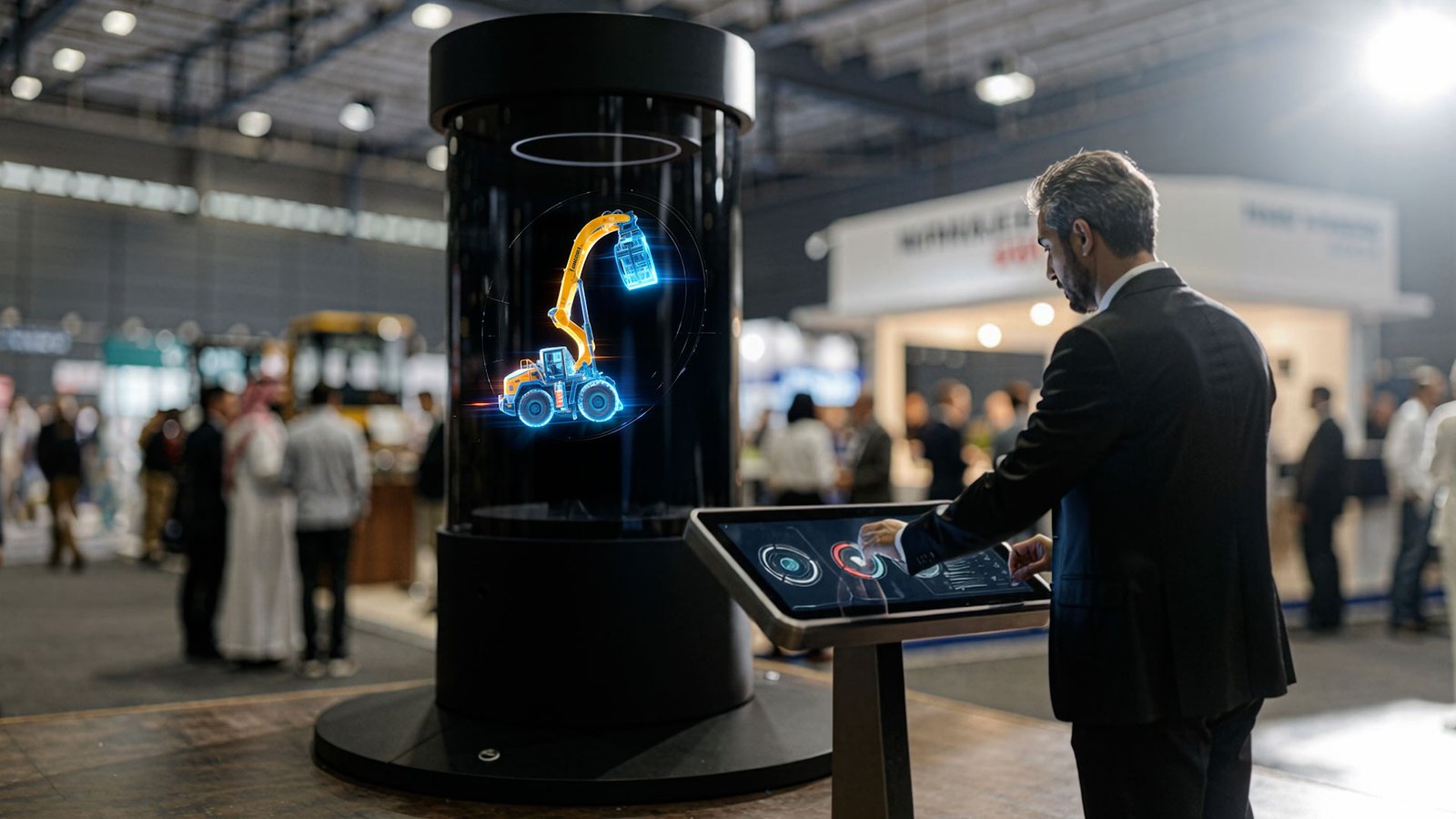
Our reference project is the interactive hologram at HEC Dhahran Expo. PWS needed to show 30-tonne excavators and crawler cranes without shipping them to the site. We deployed a 2.1 metre tall cylindrical holographic display, viewable from 360 degrees with no headset.
- Engineers pinched to rotate the boom, air-tapped to explode assemblies and hovered a palm for live telemetry, using Ultraleap hand tracking.
- CAD models were optimised into real-time meshes in Unity and rendered locally on NVIDIA Jetson hardware, with no cloud dependency.
- The system logged 4,187 interactions across 72 hours, with an average session of 4 minutes 42 seconds.
- 83 percent of sessions completed the full component drill-down, and the stand captured 217 qualified leads.
Holographic cubes also featured in the Aramco TeraPOWERS experience.
Who it is built for
- Heavy equipment, energy and manufacturing exhibitors whose product does not fit in the hall.
- Developers and master planners showing a tower, a district or a port as a floating model.
- Consumer and luxury brands that want a product to float in the entrance.
- Organisers who want a holographic presenter or concierge at the door.
Our holographic display solutions
- ECLIPSE: a 360 degree transparent cylinder with content floating at its core.
- PHANTOM: holographic displays that float a product or presenter in mid-air.
- SERAPH: a life-size holographic presenter delivering your message on loop or on cue.
- SIBYL: a life-size AI hologram concierge answering questions in multiple languages.
- LUMEN: a proximity hologram welcome that greets each arrival.
- ORACLE: physical objects placed on a table summon holographic responses above it.
- NEBULA: a volumetric 3D screen with true depth and no glasses.
- VERTIGO and ZENITH: naked-eye 3D LED and anamorphic screens for the big wall.
Features
- No headset, no glasses. Cylindrical and volumetric formats are viewable from all sides by a crowd.
- Gesture control. Hand tracking lets a visitor rotate, explode and section a model in mid-air.
- Your models. CAD, BIM and product files optimised into real-time meshes in studio.
- Live data. Telemetry, status and figures overlaid on the model from your feed.
- AI hologram host. A life-size concierge that answers questions by voice in Arabic and English.
- Local rendering. No cloud dependency; the column runs on its own compute on a local network.
- Capture built in. Sessions can end in a consent-based lead form on a companion screen.
- Measured. Interactions, dwell, completion and leads logged per session.
Technical specification
SpecFAIM standard
01Formats
Transparent cylindrical columns 1.8 to 2.1 metres; LED fan arrays; volumetric displays; holographic presenter stages; naked-eye 3D LED walls.
02Rendering
Unity real-time render on local compute such as NVIDIA Jetson or a small PC in the base of the column.
03Input
Ultraleap hand tracking, depth cameras for proximity, voice for AI hosts, optional touch panel.
04Content
Client CAD, BIM or product models optimised in studio; animated presenters filmed or generated; AI host scripts trained on your material.
05Data
Per-session interaction logs and lead capture, exported to CSV, Excel or CRM.
06Languages
Arabic and English standard.
07Environment
Best in controlled light. We calibrate on site; direct sun on a transparent column reduces contrast and we will say so at the plan stage.
08Power and footprint
Standard 220V. A 2.1 metre column needs about 1.2 by 1.2 metres plus a clear approach zone for gesture.
09Lead time
Minimum five to ten working days from approval and advance for existing content. New CAD-based interactive builds typically run four to six weeks.
On-site support
A hologram is calibrated to the room it stands in. We assemble the column, set the contrast for the venue light, align hand tracking to the approach zone and run every gesture before doors. A FAIM technician stays by the column for the show, keeps the content current and exports the day’s interactions.
- Assembly, calibration and gesture alignment before the event.
- Technician on site for the full run.
- Spare compute and tracking unit on hand.
- Daily interaction and lead export, final report at close.
How a FAIM project runs
- Conversation. You tell us what should float and who is looking at it.
- Written scope. A scope with line-item pricing you can adjust: column, content, AI host, days on site.
- Build. Models optimised, interactions built and tested, in Arabic and English.
- On site. A member of FAIM commissions and stands by the installation.
The client owns the delivered assets. FAIM retains its own underlying tools, frameworks and reusable systems.
Questions clients ask
Do visitors need glasses or a headset?
Not for our cylindrical and volumetric holograms. The HEC Dhahran display was viewable from 360 degrees with no headset.
Can we use our own CAD?
Yes. We optimise CAD and BIM into real-time meshes. Confidential models stay on FAIM hardware and are removed after delivery on request.
Does it need internet?
No. Rendering is local, with no cloud dependency.
Can the hologram talk?
Yes. SIBYL is a life-size AI hologram concierge that answers by voice in Arabic and English.
Do you attend on site?
Always. A member of FAIM commissions and stands by every installation we deliver.
Related solutions
- AI-powered exhibition booth, the stand around the column.
- AI reception and registration desk, where the hologram greets guests.
- AR and VR experiences, when the visitor should step inside the model.
Technical stories
How we build it, in detail, with the case studies and a small interactive lab in each.
- How a cylindrical hologram works: from CAD file to exhibition floor
- Hand tracking on a stand: when touchless beats touch, and when it does not
- From the floor to the memory: the FAIM story
Insights
Where this kind of work is heading, and how we would approach it.
- Ship the hologram, not the machine: interactive product demos on the show floor
- Keep the room: why mixed reality suits corporate events better than full VR
- Mirror, mirror: digital installations that turn guests into art
Start with a conversation
Send the event date, the venue and what you want to float. Message us on WhatsApp or email info@faimglobal.com. You can also open working demos in our Experience Library before you commit.