Exhibition booth
AI-powered exhibition booth
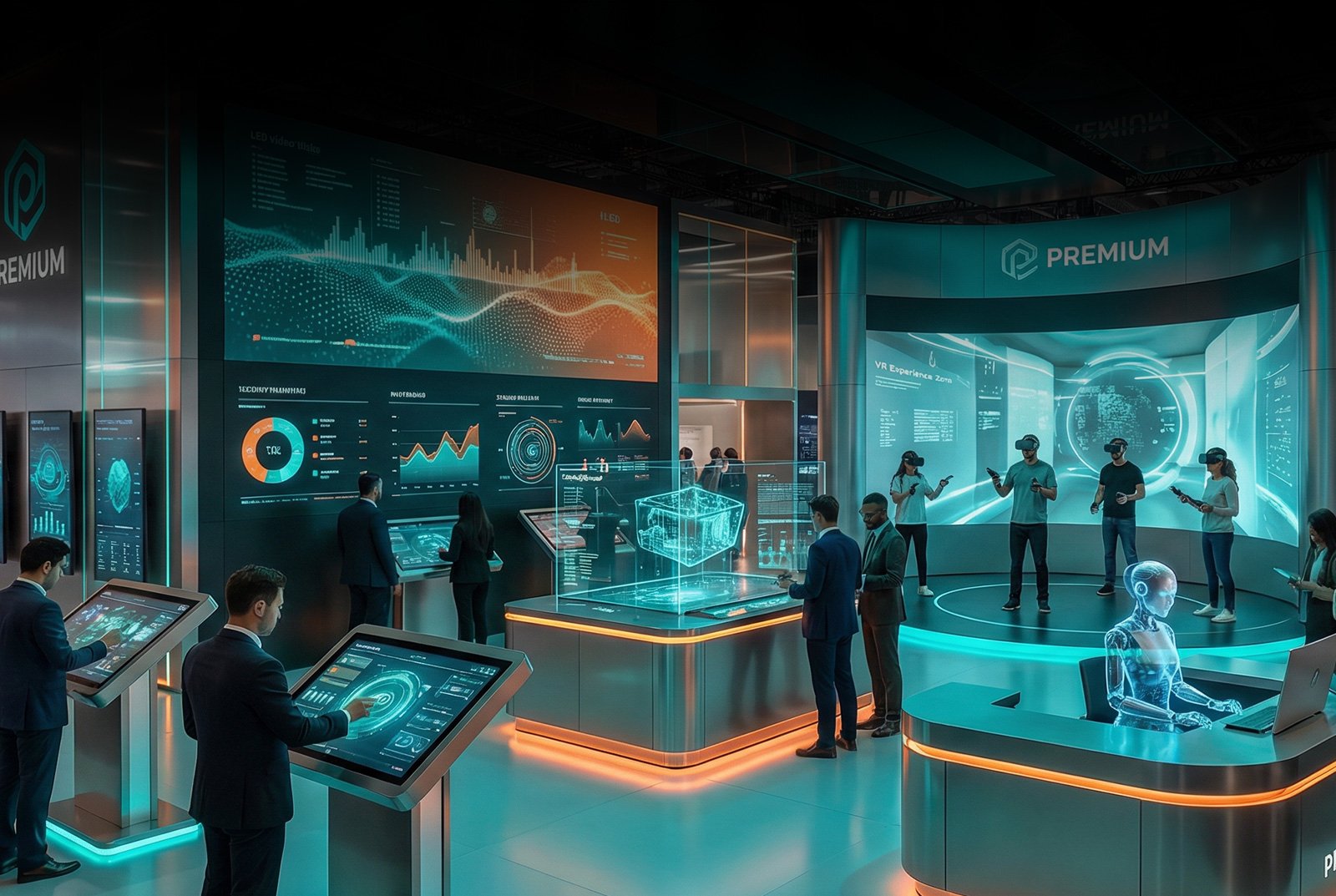
A booth is a machine for three things: stopping people, holding them and remembering them. Most stands do the first with a big logo and fail the other two. FAIM designs the booth as one interactive system, with walls that react, holograms that explain, an AI desk that answers and a capture layer that turns every visit into a record you can follow up.
At HEC Dhahran Expo one FAIM hologram alone held visitors for an average of 4 minutes 42 seconds and captured 217 qualified leads.
Home / Solutions / AI-Powered Exhibition Booth
The problems we solve
-
People walk past. The stand is beautiful and empty.
Motion, light and sound that respond to a passer-by: a wall that wakes, a hologram that turns, a floor that lights under their feet. Attention is earned at the aisle edge.
-
Visitors stop, look for twenty seconds and leave.
Touch, gesture and object-driven content give people something to do. Average dwell on our HEC hologram was over four and a half minutes.
-
Your team cannot be at every corner of the stand at once.
An AI information desk answers product questions in Arabic and English, by voice, and hands hot leads to a human.
-
The lead list is a stack of business cards and a dead tablet.
Every interaction can end in consent-based capture. Leads are timestamped, tagged by the product they explored and exported the same day.
-
The stand builder, the AV supplier and the content agency never spoke to each other.
One team designs the experience, builds the software and content, specifies the hardware and runs it on site.
Why FAIM
- We design the booth as a system, not as a shell with screens added later.
- Real numbers from real stands: 4,187 interactions and 217 qualified leads from one hologram over 72 hours at HEC Dhahran Expo.
- Every element is built for the brief: content, interface, scoring, capture. Nothing is a stock loop.
- Arabic and English on every screen and in every AI host.
- A FAIM team member is on the stand for the whole run, from commissioning to the final export.
The technical space
Every FAIM system has the same four parts. What the visitor touches, the FAIM application that runs it, what comes out, and the panel your team controls it from. Data moves along the connectors in both directions, on a local network, with no dependency on venue internet.
Attraction layerPresence sensors, reactive walls, holograms, LED floor.
FAIM booth engineContent, AI host, games, scoring, capture rules.
OutputWalls, kiosks, hologram columns, mirror screens, prints.
Admin and dataContent panel, lead database, live dashboard, exports.
How it works, step by step
- Stand plan
We take the stand drawing and mark the aisle edge, the stop points and the conversation zones.
- Experience design
Each zone gets a job: attract, explain, play, capture. The visitor path is designed end to end.
- Content and software
Walls, holograms, AI host and games are built as one content system with one capture layer.
- Hardware
Screens, sensors, hologram columns and compute specified for the stand and the venue power.
- Install and rehearse
Built and run through the full visitor path the day before, with your sales team briefed.
- Run, capture, report
A FAIM technician on the stand. Leads and interaction data exported daily and at close.
Interactive walls that earn attention
The edge of the aisle is where a booth wins or loses. We put the reactive layer there: LED or projection walls that wake when someone walks past, respond to touch and gesture, and give a passer-by a reason to step in. Behind the wall, the content is yours, products, projects, stories, built as a touch-native interface rather than a looping video.
Holographic displays that explain
Some things cannot be brought to a venue: a 30-tonne excavator, a reservoir, a turbine. A cylindrical hologram shows them from 360 degrees with no headset, and gesture control lets an engineer rotate a boom or explode an assembly in mid-air. Our holographic displays page covers the formats in detail.
AI-powered information desk
An AI information desk is a digital host on the stand that answers product questions in Arabic and English, by voice, all day. It is trained on your catalogue, specifications and FAQs, hands a visitor to a human when the conversation gets serious, and logs every question asked, which is its own kind of market research. The reception version of this is on our AI reception and registration page.
Who it is built for
- Energy, industrial and infrastructure exhibitors at the Kingdom’s major shows.
- Banks, telcos and consumer brands that need a stand people queue for.
- Government and semi-government pavilions presenting programmes and vision to a wide public.
- Agencies and stand builders who need a technology partner that owns the software and the on-site run.
Our exhibition booth solutions
- WALL: interactive video walls that react to touch and presence.
- ECLIPSE: a 360 degree cylindrical transparent hologram.
- SIBYL: a life-size AI digital human concierge for the information desk.
- MUSE and VOGUE: AI and robotic-arm photo booths that send a branded image to the visitor’s phone.
- TALISMAN and ORACLE: object-recognition tables where picking up a product summons its story.
- LEVIATHAN and LUMINA: large-format interactive and laser-projected site models.
- VAULT: the secure lead capture system behind every zone.
- MONARCH and FORGE: exhibition stands, scale models and custom fabrication.
Features
- Attract, explain, play, capture. Every zone on the stand has one of these jobs and the path between them is designed.
- Presence and gesture. Depth cameras and hand tracking so screens respond before anyone touches them.
- No-headset 3D. Cylindrical holograms viewable from all sides, with gesture control for the engineer who wants to look inside.
- AI host on the stand. Voice answers in Arabic and English, trained on your catalogue, with human handover.
- Branded take-aways. AI photo booth images and QR journeys that leave with the visitor and carry the brand.
- One capture layer. Every zone can end in consent-based lead capture, tagged with what the visitor explored.
- Live dashboard. Footfall, dwell, interactions and leads per zone, visible to your team during the show.
- One content panel. Every screen and host on the stand managed from a single admin interface.
Technical specification
SpecFAIM standard
01Attraction hardware
LED walls, projection, interactive LED floor tiles, depth cameras and presence sensors at the aisle edge.
02Hologram hardware
Cylindrical transparent hologram columns, typically 1.8 to 2.1 metres tall, with hand tracking and local real-time rendering so there is no cloud dependency.
03AI desk
Life-size vertical display or hologram column, directional microphone and speaker, local content index for offline answers.
04Software
FAIM-built content, game and host applications with separate interaction and output screens, synced across the stand, with an admin panel.
05Data
Lead and interaction database on the stand, consent captured on screen, exports to CSV, Excel or CRM; data wiped from hardware after handover.
06Languages
Arabic and English standard.
07Connectivity
The whole stand runs on a local network. Nothing a visitor touches depends on venue internet.
08Lead time
Interactive stand builds typically run four to six weeks from approval and advance. Smaller activations from five to ten working days.
On-site support
We build and commission the stand, run the full visitor path the day before, and brief your sales team on how each zone hands a visitor to them. During the show a FAIM technician is on the stand: adjusting content, fixing a sensor, pulling the midday lead export, swapping a cable before anyone notices it. At close we hand over leads, interaction data and a short report.
- Build, calibration and full rehearsal before doors.
- Technician on the stand for the whole show.
- Spare compute and critical hardware on site.
- Daily lead export and a final interaction report.
Proof from real stands
- Interactive hologram at HEC Dhahran Expo: 4,187 interactions across 72 hours, average session 4 minutes 42 seconds, 83 percent of sessions completed the full component drill-down, 217 qualified leads.
- Aramco TeraPOWERS: VR journeys, LED touch walls, holographic cubes and AI-powered interactions on one stand.
- myhome SuperApp launch: touch application, three vertical device displays and screen content across the full stand.
- Interactive HUB at Aramco EXPEC: a multiscreen interactive system for EXPEC ARC’s technology show.
How a FAIM project runs
- Conversation. You send the stand drawing, the show dates and what a visitor should leave knowing.
- Written scope. A scope with line-item pricing per zone that you can adjust. We do not send bundled numbers.
- Build. Content, software and hardware built together, in Arabic and English, rehearsed before the show.
- On site. A member of FAIM commissions the stand and stays on it.
The client owns the delivered assets. FAIM retains its own underlying tools, frameworks and reusable systems.
Questions clients ask
Do you build the physical stand too?
We can, through MONARCH and FORGE, or we work with your stand builder and own the technology, content and on-site run.
How do we know it worked?
Every zone logs interactions and dwell, and every capture is tagged. You get a report with footfall, engagement per zone and the lead list.
Can the AI desk answer technical product questions?
Yes, if we train it on your catalogue and specifications before the show. It hands over to a human when a conversation needs one.
Do you deliver in Arabic?
Yes. Bilingual Arabic and English delivery is standard.
How long does a stand build take?
Interactive stand builds typically run four to six weeks from approval and advance. Smaller activations from five to ten working days.
Related solutions
- Holographic displays, the formats and the HEC numbers in detail.
- Interactive games, the play zone of the stand.
- AR and VR experiences, for the thing you cannot ship to the venue.
Technical stories
How we build it, in detail, with the case studies and a small interactive lab in each.
- Lead capture on a stand: the architecture behind 217 qualified leads
- Hand tracking on a stand: when touchless beats touch, and when it does not
- How a cylindrical hologram works: from CAD file to exhibition floor
- From the floor to the memory: the FAIM story
Insights
Where this kind of work is heading, and how we would approach it.
- No more brochures: multiscreen applications for interactive exhibition stands
- Smaller rooms, better deals: micro-events and invite-only workshops at trade shows
- Build once, show many times: sustainable showcases without losing the wow
- Your guests are your broadcasters: live content zones done properly
Start with a conversation
Send the stand drawing, the show dates and what you want visitors to remember. Message us on WhatsApp or email info@faimglobal.com. You can also open working demos in our Experience Library before you commit.