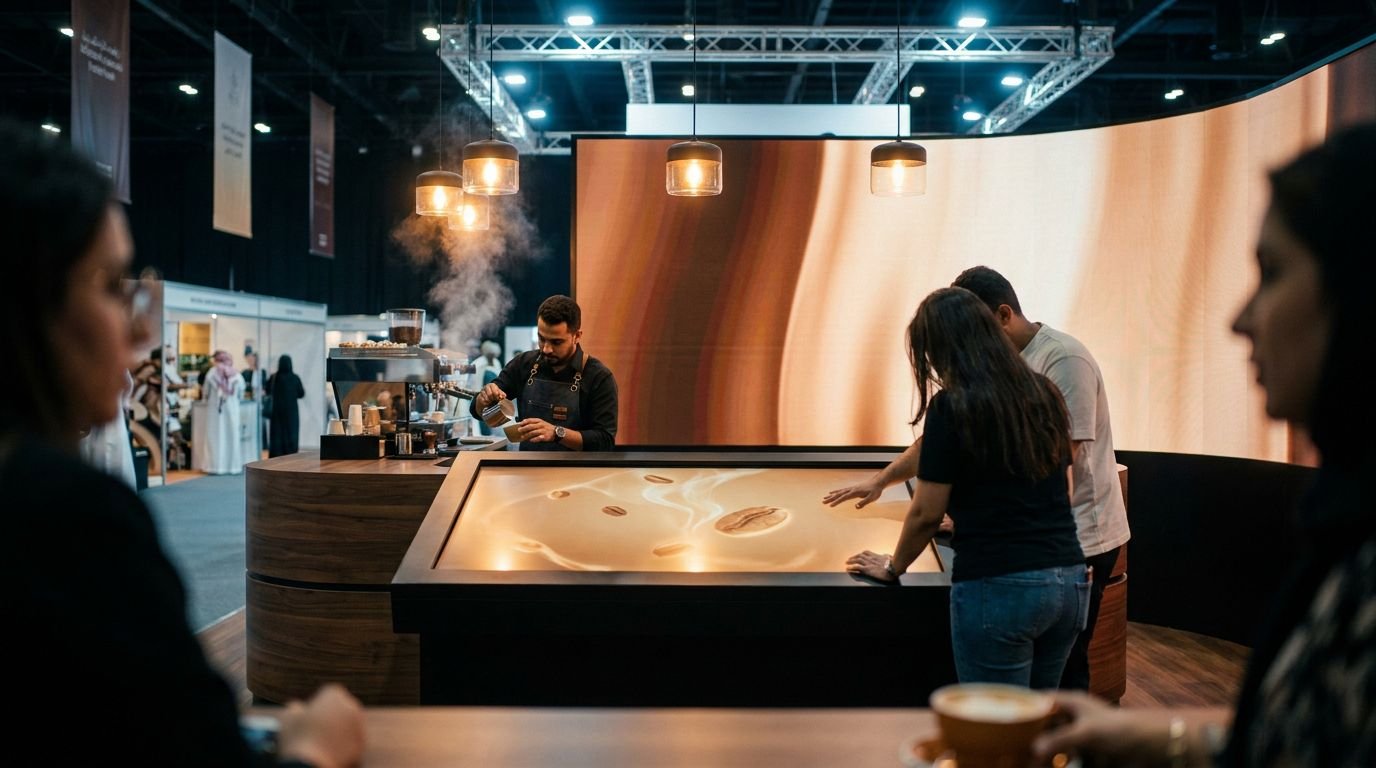
People ask us what actually happens once FAIM takes on their event. This is the honest answer, told through one coffee festival stand in Bahrain. Six steps, drawn as an espresso machine you can play with below: listen, survey, design, build, commission, show day. Each step exists because of something that once went wrong on somebody’s stand.
The roaster brought samples to the first meeting. Three small brown bags, folded at the top, a handwritten origin on each one.
He runs a specialty roastery in Manama. He had booked a stand at the coffee festival that Exhibition World Bahrain hosts in December, the one where roasters, baristas and machine dealers share a hall with families who came for a good cup and a day out. He put the bags on the table and asked the question we hear more than any other.
“If you do this for us, what do you actually do?”
It is a fair question. Most people have bought event technology before and received a screen, a cable and a phone number that nobody answered on the second day. So we tried something different. We drew him a machine.
The machine on the napkin
An espresso machine is a good picture of how we work, because nothing in it is decoration. Beans go in at the top. They are ground to suit the day. The portafilter locks in. Pressure builds. Only then does anything pour.
Skip a stage and the cup tells you straight away. Events are the same, just slower to taste.
Here is that machine, drawn properly this time. It runs on its own. Tap any step to hold it. Further down, each step gets its own working model, so you can watch what actually happens at that stage.
01. Listen: beans in the hopper
We did not talk about screens for the first forty minutes. We talked about his customers.
Cafés buy from him. Home brewers buy from him. At the festival he wanted both, but what he really wanted was for a few café owners to taste his new washed origin and leave a number. Everything else was nice to have.
That one sentence shaped the whole stand. The idea we sketched was a round touch table where visitors build a blend by dragging virtual beans into a cup, and the table tells them which of his real coffees comes closest. Families would play it for fun. Café owners would get a tasting card and a reason to talk.
He wrote that sentence on the back of one of the coffee bags and left the bag with us.
02. Survey: dialling in the grinder
A grinder is set for the beans and the weather. We set the stand for the hall.
Our survey list is not glamorous. Where does power come from, and how much is there? What does the venue allow on the network? Where do the overhead lights land on a horizontal screen? How close are the neighbours, and what are they running?
The answer to that last question caught our attention. Every stand around him would be pulling shots all day. Espresso machines draw a lot of power, and his own stand had a machine for tastings. If the table shared a circuit with that machine, a busy hour could trip a breaker and take the game down with it.
We asked for a separate supply for the technology and put a UPS under the table either way. It was one line in an email in October. In December it would matter.
The other thing we noted was steam. Warm, damp air drifting over a cold glass touch surface leaves a film, and a film makes touch frames behave strangely. So the tasting bar moved to the other side of the stand, away from the table.
03. Design: the portafilter locks in
Within the first week he had a prototype he could touch. Not a video, not a slide. The actual game, running on a screen the same size as the table, in Arabic and in English.
That is where the first real problem showed up. In Arabic, each bean carried a short name and a roast number, and the numbers drifted to the wrong side of the names when the layout flipped right to left. On a laptop it looked fine. On the real screen, with the real font size, it read like a different coffee. We fixed the layout so each name and its number stay together, then checked every screen again in both languages.
He asked for one more change: could players see their names on a leaderboard? Yes, we said, but only if they choose to. The leaderboard shows a nickname the player types, and a plain line on screen explains it. Nobody’s full name goes up on a wall without asking.
04. Build: pressure up to nine bar
Espresso is brewed at around nine bar. Below that it is thin. Our builds have their own pressure test.
Every build we deliver is offline-first, with redundant inputs and automatic recovery. In practice that meant the game and the leaderboard lived on a computer inside the table, not in the cloud. Tasting card requests waited in a local queue and sent themselves only when a connection was there. If the venue network vanished, nobody playing would notice.
Then we tried to break it. Five hands on the table at once. A child tapping the same spot as fast as possible. Pulling the power mid-game to make sure the table came back on its own, at the start screen, without anyone touching a keyboard. It did, in well under a minute. We pulled it again anyway.
Interactive stand builds like this typically take us four to six weeks, and a good part of that is spent on this kind of testing.
05. Commission: the green light
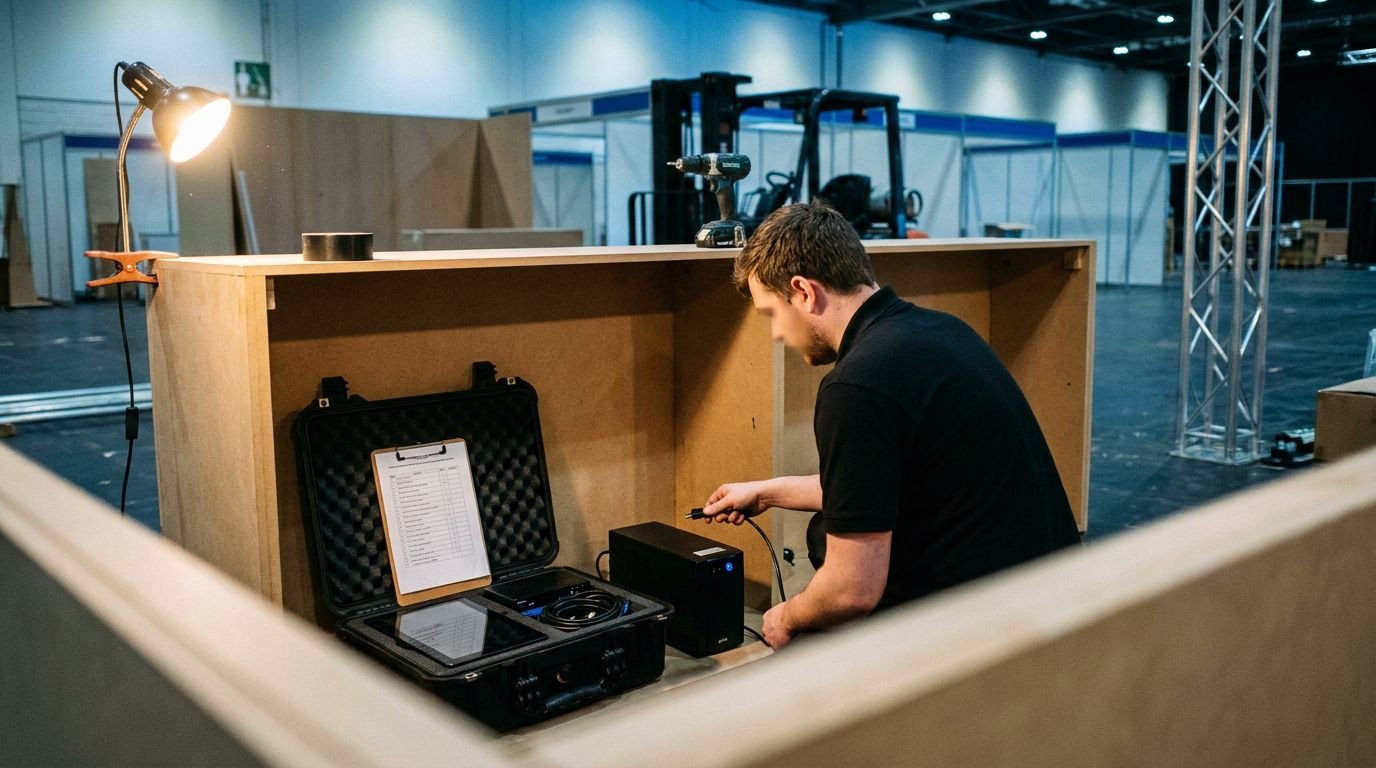
On build day our technician arrived with two hard cases. One held a spare touch frame and a spare media player. The other held cables, the UPS and a 4G router for anything that truly needed the internet.
A member of FAIM commissions and stands by every installation we deliver. Here that meant three unglamorous hours: calibrating touch with the hall lights at show level rather than work lights, and playing full rounds in Arabic and English, switching language halfway to see what broke.
The separate supply had been forgotten. It happens. The stand builder had run everything from one board, so the tasting machine and the table sat on the same circuit after all. Late in the afternoon, during a test pour, the breaker went.
The table stayed on. The UPS carried it while the electrician split the circuit. The roaster, who had been watching from the counter, did not say anything for a moment. Then he asked whether he could keep the UPS after the show.
06. Show day: the pour
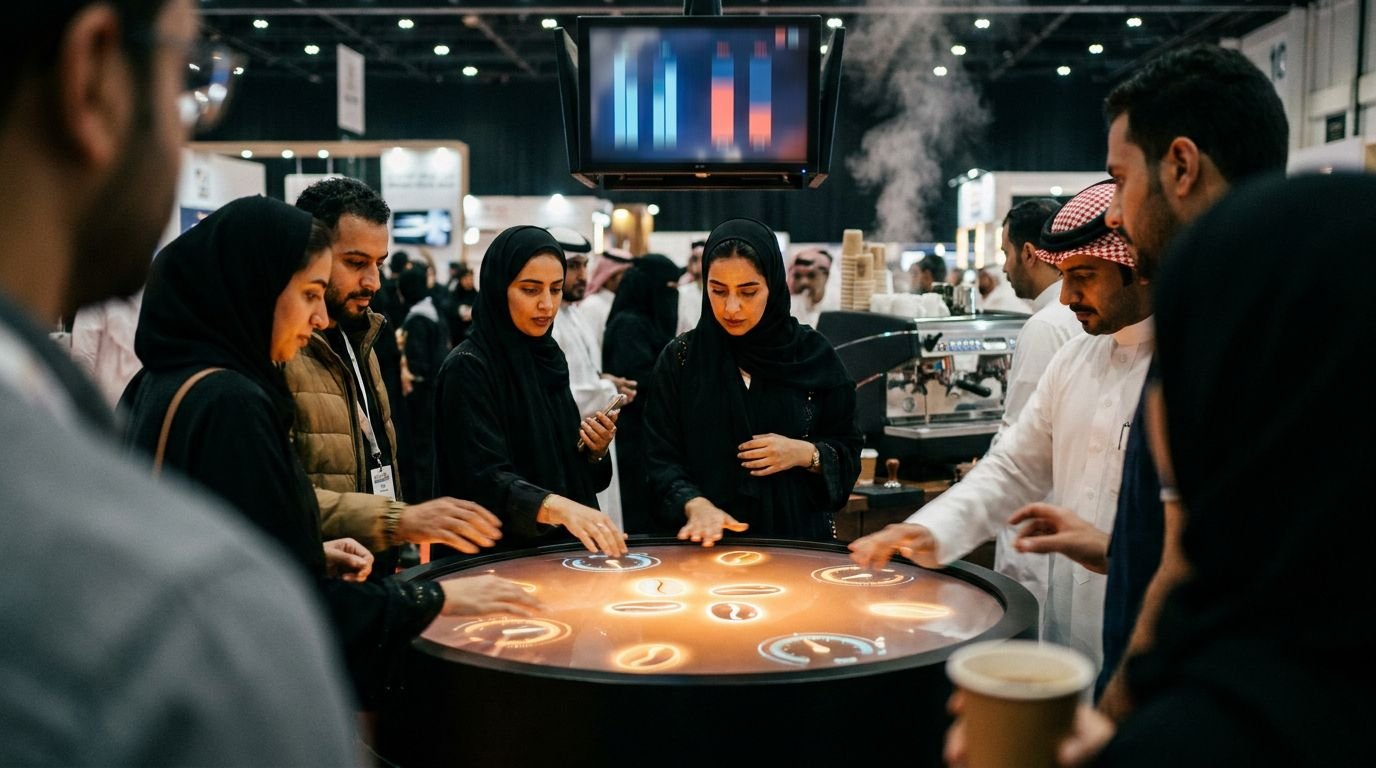
The first weekend morning was louder than we had planned for. Families arrived together, and children found the table before their parents found the coffee.
We had a short game ready for busy hours, about a minute long, and a longer one for café owners when the aisle went quiet. Our technician switched modes from a small tablet without walking over. A queue formed anyway, so he moved the tasting cups to the end of the line. People waited happily with something warm in their hands.
On the third day the roaster called us at seven in the morning. He had decided overnight to add a fourth origin, a natural process coffee that had arrived early. Could it go in the game? It was a new bean, a new name in two languages and a new tasting note. Our content panel took the change in a few minutes. We checked it on the table before the doors opened.
That afternoon a café owner played the long game slowly, picked the new origin, took a tasting card and stayed at the counter talking for a long time.
When the doors closed on the last night, the report went out the side of the machine, so to speak: what was played, when the busy hours fell and which coffees people chose, so the roaster had something to plan next year with.
Our spare touch frame never left its case.
This story is a composite drawn from common situations we see on stands and events in Bahrain and Saudi Arabia, not a single client project.
What else the machine can pour
The six steps stay the same. What comes out of the spout changes with the event. For a festival, a launch or a busy exhibition hall, it might be:
- A physical or touch game with a live leaderboard, built for crowds and families.
- A holographic display that shows a product you cannot put on the counter.
- An intelligent reception desk or wayfinder that greets visitors in Arabic and English.
- An AR or VR experience that takes people somewhere a stand cannot.
- A launch or inauguration moment with one trigger and no second take.
- Film and content made to play on the screens you already have.
Buyer checklist before you hire anyone for your event
- Ask what the supplier needs to know about your goal before they show you any technology.
- Ask for a written survey of power, network, lighting and neighbours, and who is responsible for each.
- Insist on a working prototype on the real screen size, in both languages, early.
- Find out what happens when the venue Wi-Fi or the power fails, and ask to see it happen.
- Agree how late content changes are made on site and how long they take.
- Check how visitor names and details are shown or stored, and that people choose to share them.
- Ask who will be in the room on build day and show days, and what spares they bring.
Planning an event in Bahrain or Saudi Arabia?
Tell us the venue, the dates and what you want people to remember, and we will walk you through the six steps for your event, plainly, with what fits the time you have. Interactive stand builds typically take four to six weeks, and a member of our team commissions and stands by every installation.
Start the conversationWhatsApp us+973 3557 7062
Or email info@faimglobal.com.
Related reading: how we build event applications that survive the venue Wi-Fi, designing touchscreens for an exhibition floor and how leaderboards make networking easier.
Questions buyers ask
What does FAIM do first when we hire you for an event?
We listen. Before any technology is chosen, we agree what the event has to achieve, who the visitors are and what they should leave with. Then we survey the venue.
How long does an interactive stand take to build?
Our interactive stand builds typically take four to six weeks. The minimum for one focused experience is five to ten working days from approval and advance payment.
What happens if the power or Wi-Fi fails during the event?
Our builds are offline-first, with redundant inputs and automatic recovery. We also plan power with the stand builder and bring backup where it is needed.
Will someone from FAIM be at the event?
Yes. A member of FAIM commissions and stands by every installation we deliver, and we carry spares.
Can the content change during the show?
Yes. We plan a content panel so text, products and languages can be updated on site without rebuilding the application.
Do you work in Arabic and English?
Bilingual Arabic and English is standard across our interactive applications, and we test both languages on the real screen.
Sources
- Bahrain Tourism: Bahrain Coffee Festival (held at Exhibition World Bahrain in December, a B2C and B2B platform)
- Gulf Daily News: Bahrain Coffee Festival to celebrate coffee culture, innovation and creativity this December
Found this useful?