A National Day activation rarely fails on design. It fails on glare, a shared breaker or dead Wi-Fi, and planning for each one is what keeps the families smiling.
The email arrived on a Sunday in late October. It was short and a little nervous.
A marketing team for a homegrown retail brand in Manama had secured an atrium space in one of the island’s busiest malls for Bahrain National Day. The dates were fixed: 16 and 17 December, the two public holidays, with the weekend after if the mall agreed to extend.
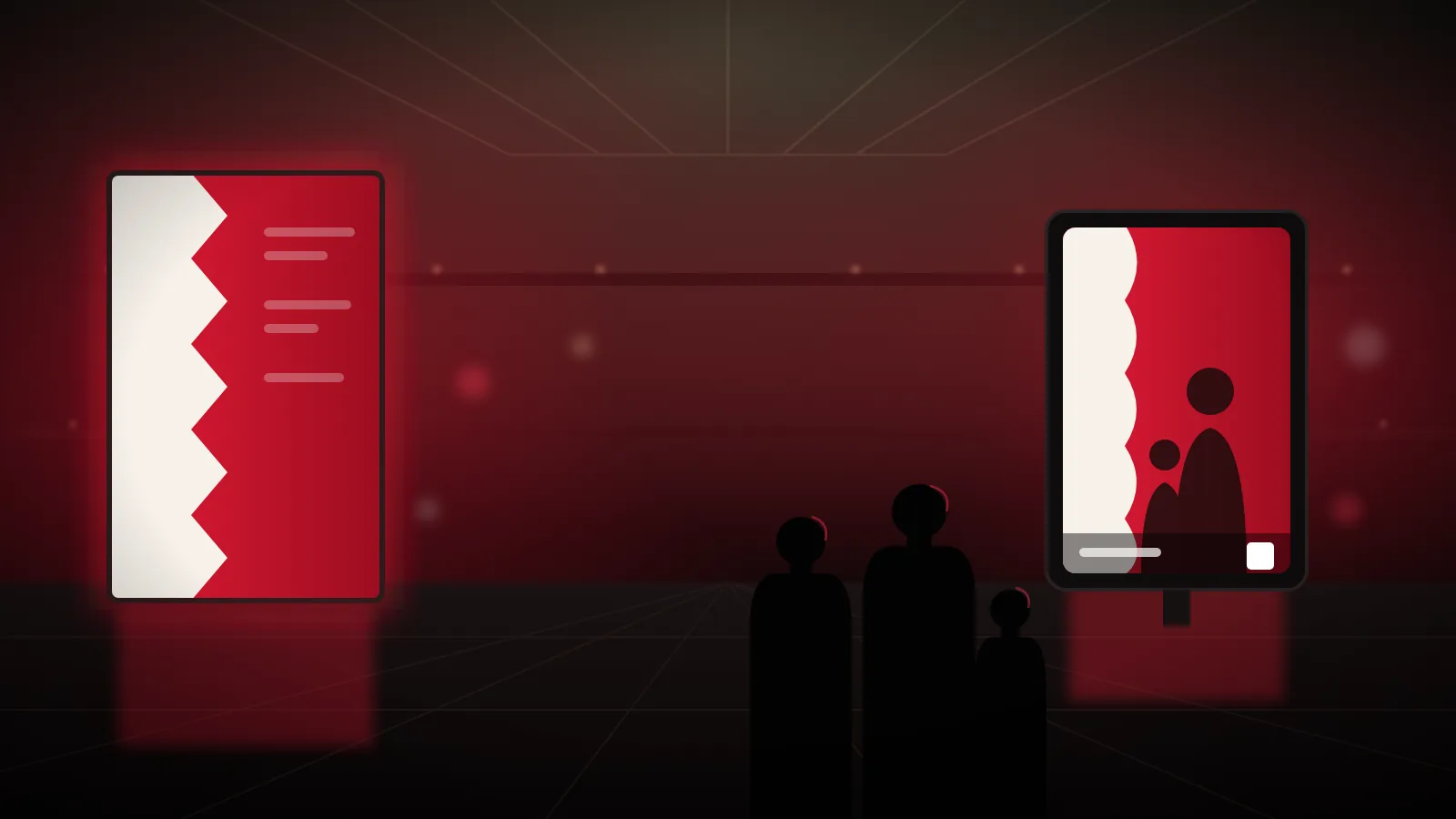
They had a mood board already. Red and white everywhere. A photo moment where each family stands in front of a flag that ripples behind them. A quick game for the children. A wall where people could leave a message for the country and watch it appear, large and bright, above the crowd.
What they did not have was a plan for the evening of the 16th, when the atrium fills after Maghrib and the mall’s guest Wi-Fi quietly gives up.
That is usually where our part of the story starts.
Seven weeks out, and the brief looked easy
Seven weeks sounds like plenty of time. Our interactive stand builds typically take four to six weeks, so on paper there was room to breathe.
The events lead on the brand side had run National Day stands before, with a printed backdrop and a hired photographer. She asked, fairly, why a photo station needed a site visit at all.
We asked to stand in the atrium at three in the afternoon. Then we asked to come back at eight at night.
What the atrium showed us at 3pm
The atrium had a long glass skylight. Lovely for shoppers, less so for a screen.
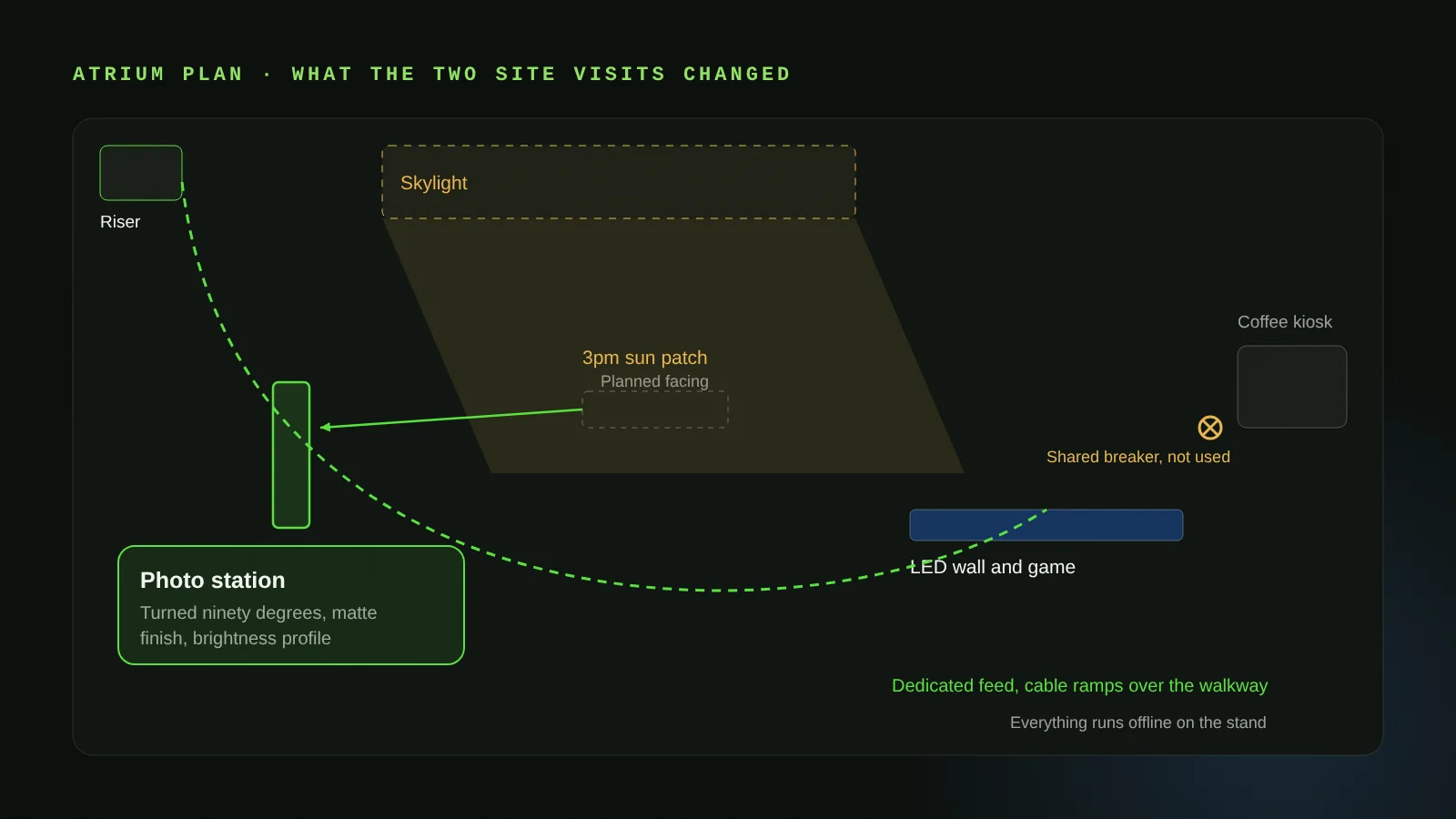
At three o’clock, a slab of winter sun landed almost exactly where the photo screen was meant to face. On a phone held up at that spot, the preview turned milky grey. A family that cannot see itself on screen does not wait around for the photo.
So the station turned ninety degrees. We specified a matte anti-glare finish on the display and built a brightness profile that steps up in the afternoon and settles down after sunset, when the atrium lights take over. None of this was on the mood board, and every bit of it would have shown up on the day.
The lesson we gave the brand team was simple: visit at the hour your event peaks, not the hour that suits the meeting. We have written more about designing screens for glare and busy floors if you want the detail.
And what it showed us at 8pm
The evening visit was about two things nobody draws on a mood board.
First, power. The socket marked on the mall’s floor plan shared a circuit with the coffee kiosk next door. An espresso machine and an LED wall on the same breaker is a coin toss on a busy night. The facilities team could give us a dedicated feed, but only from a riser across the atrium, which meant a longer cable run, ramps over a walkway and an early chat with the safety officer.
Second, the network. We stood in the middle of the evening crowd and tried loading a page on the guest Wi-Fi. It spun. And spun.
That settled it. Every part of the activation would work without the mall’s internet. Our builds are offline-first, with redundant inputs and automatic recovery, and this was exactly the kind of room that rule exists for. If you want the longer version, we explain how offline-first event applications survive venue Wi-Fi in a separate post.
Daylight through the skylight
- Found
- Winter sun washed the photo preview out to a milky grey.
- Fix
- Turn the station ninety degrees, add a matte anti-glare finish and a brightness profile for afternoon and evening.
The evening crowd
- Found
- The planned socket shared a breaker with a coffee kiosk, and the guest Wi-Fi barely loaded a page.
- Fix
- A dedicated feed from the riser, and every part of the activation built to run offline.
The quiet problems: children, consent and Arabic
National Day activations are family events. That means children in photos, and that means consent has to be designed in, not added as a checkbox at the end.
Bahrain’s Personal Data Protection Law (Law No. 30 of 2018) generally requires consent before personal data is processed. We built the photo flow so a parent taps to agree before the camera captures anything. The photo goes to the parent’s own phone through a QR code. Joining the brand’s mailing list is a separate, optional step, and the screen says so plainly in Arabic first, then English.
Consent comes before the camera
We raised this early, while the copy and flow could still change without drama. We are not lawyers, so we always suggest the brand’s own legal team signs off the consent wording.
Then the message wall broke during testing.
One of our team typed a name in Arabic followed by a short English greeting. On the wall, the English words jumped to the wrong side, and the full stop landed at the start of the line. Anyone who has built bilingual screens in the Gulf has seen this bug. Mixed right-to-left and left-to-right text needs its direction handled message by message, and the Arabic typeface needs to be chosen for reading at a distance, which is a different job from looking good in a design file.
We fixed it, then tested with real mixed-language messages from both teams until nothing jumped.
We also added moderation. Every message passes a word filter, then a staff member approves it from a tablet before it reaches the wall.
National Day is not the evening to have something unkind appear three metres tall in front of the whole mall.
Designing for the queue before there is one
Queues are where goodwill drains away. So the game was built around a one-minute play, short enough to keep the line moving and long enough to feel like a real go. A second screen showed the leaderboard to the people waiting, which gives a queue something to watch and talk about.
The photo station was set up so the next family could step in and pose while the previous family was still scanning their QR code at the side. Floor markings showed where to stand. Small things, but by the second evening you feel them.
For more on how we approach play at events, see our interactive games and audience engagement page.
Late changes, as always
Ten days out, the brand’s leadership asked to add a co-sponsor’s logo and swap the game prize. Because the content ran from one panel, that was an afternoon of work, not a rebuild.
The bigger surprise came the night before load-in. The mall’s safety officer walked the space and asked for the whole stand to move back two metres to keep an emergency route clear. It also meant our cable run from the riser was now too short.
This is where carrying spares stops being a line in a proposal. The longer cable and an extra ramp were already in the van. The stand moved, the route stayed clear and nobody had to make a midnight phone call to a supplier.
The night of the 16th
We loaded in after the mall closed. A member of FAIM commissions and stands by every installation we deliver, so the same person who tested the wall at two in the morning was standing beside it the next evening.
By eight, the atrium was full. Teenagers compared scores near the game. A toddler in a red and white scarf refused to leave the photo spot, and his grandmother had given up trying to move him.
Then, a little after nine, the screens on one side blinked off.
It turned out the mall had switched on its own National Day light show from the same distribution board as our riser. Nobody on either side had known the two shared a breaker. For a moment the wall was dark and the game screen was black.
The game came back on its own and picked up the leaderboard exactly where it had stopped, because every score was saved locally. The photo station recovered without anyone touching it. Our team member was already at the board with the mall’s electrician before the queue had properly noticed, and the light show was moved to another circuit for the rest of the run.
The Wi-Fi did collapse that night, just as it had during the site visit. It didn’t matter much. The stand ran on its own dedicated connection, and when that slowed under the crowd, photos queued on the station and went out a few minutes later. The screen told each parent, in Arabic and English, that their photo was on its way.
- By 8pmThe atrium is fullQueues at the game and the photo station, messages rising on the wall.
- A little after 9pmScreens on one side go darkThe mall’s light show shares a breaker with the stand’s riser.
- Moments laterEverything recovers on its ownThe game resumes with its leaderboard intact, and the photo station comes back without anyone touching it.
- Same nightThe guest Wi-Fi collapsesPhotos queue on the station and reach parents a few minutes later.
- Rest of the runThe light show moves to another circuitThe families never notice any of it.
What the families saw
None of that.
They saw red and white light washing over the atrium floor. A flag rippling behind them as the camera counted down. Their own messages rising onto the wall in both languages, slow enough to read, big enough to photograph. A leaderboard that a ten-year-old checked four times before her family dragged her to dinner.
The brand team got a report the next morning with plays, photos delivered and mailing-list opt-ins counted, ready for their own review. The second day, the 17th, ran in afternoon sun with the brightness profile doing its job. The weekend extension went ahead.
Riyadh Season is already running
Riyadh Season opened on 21 October and runs for ten weeks, so Saudi brands planning mall and outdoor activations are running into the same kinds of problems, often at a much larger scale.
A short checklist before you sign off a National Day activation
- Visit the space at the hour your activation will be busiest, and again in daylight if there is a skylight or glass frontage.
- Ask the venue which circuit you are on, and what else shares it, including the venue’s own decorative lighting.
- Assume the guest Wi-Fi will fail. Ask your supplier what happens to photos, scores and data when it does.
- Put consent before capture, especially where children are involved, and have your legal team approve the wording.
- Test the Arabic with real mixed-language messages, not placeholder text.
- Plan for moderation on anything the public can put on a screen.
- Agree who from the supplier will be on site during peak hours, and what spares they bring.
Mid-December is closer than it looks
Interactive builds typically take four to six weeks, and even a simple adaptation needs five to ten working days from approval.
Planning a National Day or Riyadh Season activation?
Tell us the space, the dates and what you want people to walk away with. We will talk it through before anything is designed.
This story is a composite drawn from common situations we see on site, not a single client project.
Sources
- Office Holidays: National Day in Bahrain, 2026 (16 and 17 December)
- DLA Piper Data Protection Laws of the World: Bahrain (Law No. 30 of 2018 and consent requirements)
- Gulf News: Riyadh Season 2026 to begin on October 21 with 10 weeks of entertainment
Found this useful?