Formula E opens its 2026 to 2027 season with a night double-header at the Jeddah Corniche Circuit on 18 and 19 December 2026. If your brand wants to be seen in Jeddah that weekend, five weeks is tight but workable. This is a story about a hologram that fogged up in the sea air, a generator shared with a pizza oven, and a plot that moved forty metres two days before the race.
At ten to eight on the Friday, the hologram went milky.
Not broken. Milky. The product turning slowly above the plinth had a soft grey bloom around it, as if someone had breathed on a window. A boy of about seven stood on his toes and wiped the front with his sleeve, which only made a smear.
Our technician was already walking over with a cloth and a small heater fan. He had been half expecting it since the breeze turned and started coming in off the Red Sea.
We knew it could happen because it had happened on our test night. That was the reason for the test night.
The brief arrived five weeks out
The message came on a Tuesday in the middle of November. A marketing team from Riyadh, working for a home energy brand, had secured an outdoor plot on the Jeddah waterfront for race weekend.
Formula E had confirmed that its new season would open in Jeddah on 18 and 19 December, racing under the lights on the Corniche. The brand wanted a space that people walking to and from the racing would actually stop for.
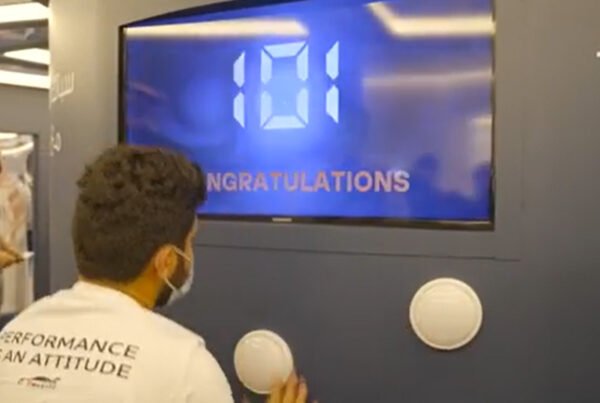
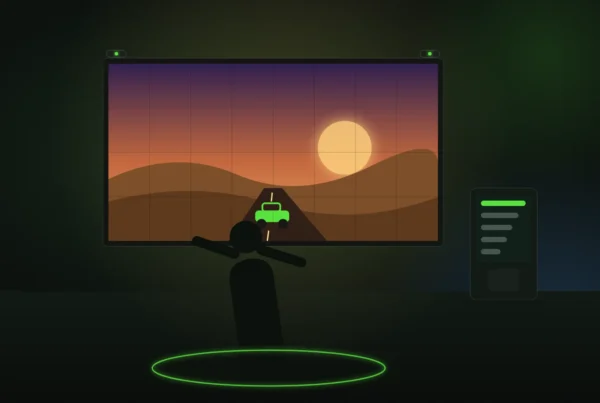
Their idea was a good one. A holographic display of their new home battery, turning in the air above a plinth. A wide LED screen where visitors hit four pads as fast as they can to “charge” a car across the screen. A photo at the end, sent to your phone.
Then the line that made me put my coffee down. Could we do all of this in five weeks?
Our interactive stand builds typically take four to six weeks. Five weeks sat inside that window, just. It meant every big decision had to be made in week one, not week three.
The questions nobody had asked yet
On the first call we asked far more than we answered.
Was the brand an official partner of the race? It was not. So nothing on screen would borrow the series name or its marks, and their legal team would read the game text as well as the printed banners. We had the same conversation with a client before the Bahrain Grand Prix. It is always a cheaper conversation in November than in December.
Where would the power come from? A shared generator, they thought.
“Thought” is not a word you want to hear about power. We asked for the event’s electrical plan and found the plot on the same distribution board as three food trucks, two coffee machines and a pizza oven.
And what does the air do down there at night? Nobody knew. Everyone on the brand side had only visited at lunchtime.
The test night
So two of our Saudi team went down to the waterfront on a Thursday evening with a hologram unit and a test PC in the boot, plus a cheap humidity meter.
It was a soft, warm evening, the kind that makes people walk slowly. By half past nine, the hologram unit, carried straight from an air-conditioned van into the sea air, had a fine film of condensation on its front face. Cold kit, warm wet air. Anyone who has stepped out of a car in Jeddah with sunglasses on has seen the same thing.
That night changed the plan. On the day, the kit would be unloaded in the afternoon and left to come up to outdoor temperature before switch-on. The hologram got a small heater fan behind a vented side panel, and the open side of the plinth was turned away from the water.
The test night showed us something else too. At seven, a lighting tower on the neighbouring plot switched on and threw a flat white wash across exactly the spot where the hologram was meant to stand.
A hologram needs darkness around it to read as solid. We moved the plinth into the shadow of the stand’s own back wall and added a black hood above it. From the walkway, the battery suddenly looked like an object again rather than a ghost.
Visit at the hour you expect to be busy, in the weather you will actually get. A lunchtime site visit tells you very little about a night race.
Building for a phone signal that would vanish
When a large crowd packs into one stretch of road, mobile data slows to a crawl. Venue Wi-Fi rarely does any better.
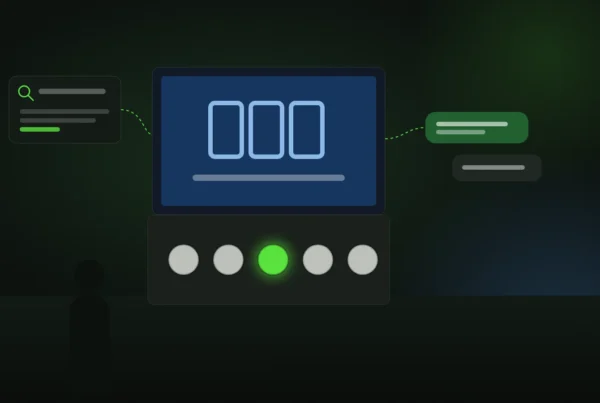
Our builds are offline-first, with redundant inputs and automatic recovery. On this stand that meant the game and the photo station ran on machines inside the stand, not in the cloud. Photos and consent records were written locally first. If a visitor scanned the QR code and the page would not load, their photo waited in a queue and went to the number or email they had chosen once a connection came back.
Consent was two separate choices on the screen. One said “send me my photo”. The other said “I would like to hear from the brand”. Children went through a parent. We asked the client’s legal team to check the wording against Saudi Arabia’s Personal Data Protection Law before a single visitor saw it.
A spare set of pads sat under the counter, already wired and tested. If one pad died in the middle of a round, the game would carry on with the three that still worked.
Then came the Arabic bug. In week three, the brand’s Arabic product name arrived on the LED wall as a row of separate letters, unjoined and running the wrong way. The text layer in the screen’s processor did not shape Arabic at all.
The fix was dull and reliable. We stopped sending live text to the processor and rendered every Arabic line inside the game itself, then had a native reader check each screen on the real wall. It took an afternoon in week three. On race night it would have been five metres wide.
Two days out, the plot moved
On the Wednesday before the race, the organisers moved the brand’s plot forty metres along the waterfront to keep an emergency vehicle route clear. Nobody argued. It was the right call.
But the new plot faced the other way. The queue lane would now cut straight across a walkway, and the sea breeze would hit the stand side on.
We redrew the layout that afternoon as a mirror image, with the queue running along the back wall. The hood frame was weighted down against the wind. The software needed almost nothing, because the game reads its screen layout from a settings file, and flipping it took minutes.
The new plan went to the client’s events lead that evening with one question. Can your staff stand here, here and here? She replied with a photo of the spot and a thumbs up.
What we did not catch until Friday was that the heater vent now faced the sea.
Race night
That is how the hologram came to fog at ten to eight. The breeze found the vent, and the fan was pushing damp air rather than warm air across the front.
Our technician angled the fan, swapped the side panel around, wiped the front and stepped back. Four minutes. The boy with the smeared sleeve was still there when the battery came back into focus, and he pointed at it as if he had fixed it himself.
The busiest minutes were not during the racing. They came before it, as everyone walked in, and straight after, as everyone walked out at once.
We had planned for that. The game had a normal round and a short round. When the line passed the second marker post, the stand manager switched to short rounds from a tablet, and the line started moving again.
At 8:40 the food trucks fired up for the rush. The generator dipped. The LED wall blinked and came back.
The PCs did not notice. Each one had its own battery backup, and the game picked up the round it had been playing. A girl in the middle of a round did not even stop hitting the pads. Her car crossed the line a couple of seconds later than it should have, and she never knew.
Mobile data went the way we expected soon after. The QR page spun on a few phones. The photos waited quietly in their queue, and most had arrived by the time people reached their cars.
A member of FAIM commissions and stands by every installation. That night it meant one of us inside the stand, watching the queue and the battery levels instead of the race.
Just before eleven, a father lifted his daughter so she could reach the pads. She lost to her older brother by half a car length and asked to go again straight away.
The events lead from Riyadh, who had spent five weeks asking whether we would make it, sat down on an equipment case for the first time all night and ordered a karak.
This story is a composite drawn from common situations at outdoor race weekend and waterfront activations, not a single client project.
Before you book a race weekend activation
- If you are not an official partner, has your legal team read every word that will appear on screen?
- Has someone stood on your plot after dark, at the hour you expect the crowd?
- Do you know which generator and which board feed your stand, and who else is on it?
- Is there battery backup on every PC, and spare inputs already wired?
- Will kit be unloaded early enough to settle to outdoor temperature before switch-on?
- Will the game and photo station keep running, and keep saving consent records, with no mobile data?
- Has a native Arabic reader checked every line on the real screen?
- Are “send my photo” and “contact me” separate choices, with a parent route for children?
- Can the layout flip if the organisers move your plot?
- Who from your supplier will be in the stand all night?
Thinking about Jeddah in December?
The Jeddah double-header is on 18 and 19 December 2026. Our interactive stand builds typically take four to six weeks, and simpler builds need a minimum of five to ten working days from approval and advance payment, so a focused activation is still possible if you decide soon. Tell us where you will be and what you want people to remember, and we will tell you plainly what fits. Our team is on the ground in Saudi Arabia and Bahrain, and bilingual Arabic and English is standard.
Start the conversationWhatsApp us+973 3557 7062
Or email info@faimglobal.com.
Related reading: why event apps should work offline first, designing touchscreens for busy floors, building a stand that lasts a whole season and our holographic displays and interactive games services.
Questions buyers ask
When is the Jeddah E-Prix 2026?
Formula E lists a night double-header at the Jeddah Corniche Circuit on 18 and 19 December 2026, as rounds one and two of the 2026 to 2027 season. Check the official Formula E site for any changes before you commit.
Is five weeks enough to build an interactive activation?
Often, yes, if the scope is clear. Our interactive stand builds typically take four to six weeks, with a minimum of five to ten working days from approval and advance payment for simpler builds. The shorter the window, the earlier the big decisions need to be made.
Do holographic displays work outdoors at night?
They can, with planning. A hologram needs darkness around it, so stray floodlights matter more than the night sky. Sea air can also cause condensation when cold kit meets warm, humid air, which is why we test on site and let equipment settle before switch-on.
What happens if mobile data or Wi-Fi fails during the crowd?
Our builds are offline-first, with redundant inputs and automatic recovery. Games, photos and consent records run and save on the stand, and anything that has to be sent waits in a local queue until a connection returns.
Can we use the Formula E name or logo on our stand?
Only with permission from the rights holder. If you are not an official partner, ask your legal team to review every word and image on screen, not only the printed graphics.
Do you work in Jeddah as well as Riyadh and Bahrain?
Our team is on the ground in Saudi Arabia and Bahrain and delivers across the Gulf. Tell us the location and dates, and we will confirm what is possible for that site.
Sources
- Formula E: 2026 to 2027 calendar announcement (Jeddah night double-header on 18 and 19 December 2026, season opener)
- Formula E: updated 2026 to 2027 calendar (Jeddah Corniche Circuit dates kept)
- DLA Piper: Data protection laws in Saudi Arabia (overview of the Personal Data Protection Law and consent)
FAIM is not affiliated with Formula E or the FIA. Event names are used for information only.
Found this useful?