Story · How clients find us
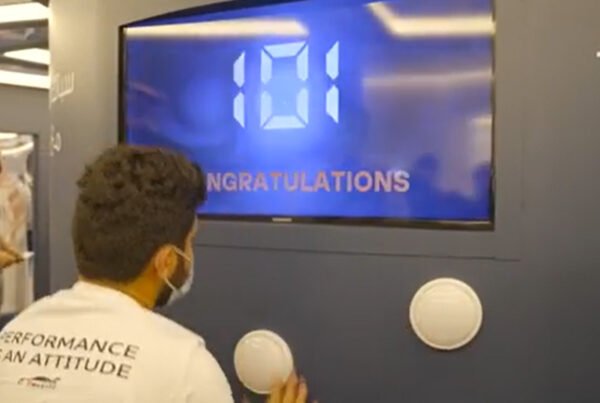
The message came in on an ordinary October afternoon. An event organiser in Bahrain wanted a reaction game: big physical buttons, a live leaderboard, players signing up with a QR code, the whole thing running outdoors on an LED screen. A clear brief from someone who already knew exactly what they wanted. I read it twice, started sketching the console in my head, and then stopped. I could not answer the simplest question about it. How did they find us?
It could have been Google. It could have been a past client, or someone who stood in the queue for the reaction game we built for Al Salam Bank. So I did the obvious thing and asked. The answer came in two steps, and it changed how I think about where our work comes from.
What actually happened. An interior design company in Bahrain found FAIM through ChatGPT search. When we asked them how they found us, the whole reply was one word: “ChatGPT”. They then passed our name to the event organiser, who sent us the reaction game brief. An AI answer opened the door. A person walked the client through it.

Why the request was so specific
A reaction game is a narrow request. Nobody types it by accident. The person on the other end had a specific mechanic in mind: lights, buttons, a clock, a score people can see from across the venue. That usually means one of two things. Either they searched for exactly that, or someone who knows the format told them who builds it.
Both routes lead to the same pages. We have a case study for the Al Salam Bank game, a technical story on how it was built and a games and audience engagement page that names reaction walls as something we make. When someone asks an answer engine who builds this kind of thing in Bahrain, those are the pages it can read. We do not know the exact question that was asked or which page was cited. We do know the answer had our name in it.
What a reaction game actually does at an event
If you are reading this because you are thinking about one, here is the short version. Lights blink across a set of targets. The player hits the right button as each one lights. A screen shows the score and a countdown, usually around a minute. The people watching are the next players, which is why the score has to be readable from the aisle and the rules obvious without a single line of instructions.
A leaderboard turns one play into a reason to come back. Registration by QR code lets a player put their name on that board without a staff member typing anything. Contact details are asked for after the fun, never before it.
Outdoors changes the brief. The screen has to fight daylight, the buttons have to survive heat, dust and a lot of very enthusiastic hands, and the cable runs and power have to be planned for an open site rather than a hall with sockets every few metres. Those are engineering decisions, and they are made at the sketch stage, not on the morning of the event.
Five routes to one enquiry
When an enquiry arrives by email, WhatsApp or phone, it hides the road it took. Broadly, a buyer reaches a specialist in one of five ways.

- Classic search. A results page on Google or Bing, a click, a read, a message.
- AI answers. ChatGPT search, Google’s AI Overviews or AI Mode, where the buyer asks a full question and gets a written answer with sources.
- A referral. A colleague, a past client, a supplier who says “talk to these people”.
- Social and video. A post, a reel, a profile someone saved months ago.
- The event floor. Someone played the thing, liked it, and asked who made it.
The second route is the new one, and it is the one everyone is guessing about. Some of it is measurable. OpenAI states that ChatGPT adds utm_source=chatgpt.com to the links it sends people through, so those visits show up in normal analytics. Google reports clicks from its AI features inside the regular Search Console performance data.
But a buyer who reads an answer on their phone, remembers your name, and emails you two days later from a laptop leaves almost no trail at all. Ours went one step further. The organiser never used ChatGPT at all. Their contact did, then told them about us. No analytics tool on earth would connect those two people. One question did.
What this means for a small specialist studio
You cannot buy your way into an AI answer, and anyone selling a guarantee is selling a guess. What these systems do is read public pages and decide which ones answer the question well. So the only lever a small company really holds is the page itself: does it say plainly what you do, for whom, where, and does it show proof?
That is the work we did on our own site earlier this month. We rewrote the titles and descriptions of every main page and case study so they describe what the page actually says. We published nine solution pages, one per thing we build, each with specifications, a process and the questions clients really ask. We made sure search crawlers, including the ones behind ChatGPT search, are allowed to read the site, and we linked our Google Business Profile so our name and location match everywhere.
Which of those changes made the difference, I cannot prove. What I can say is that ChatGPT put our name in front of a business that then recommended us onward. That is the whole case for writing pages that answer real questions.
Three things we are changing
We ask every new lead how they found us. This story only exists because we asked. One question, before the brief, written down next to the enquiry. “Google”, “ChatGPT”, “a friend at the bank”, “I saw it at an event”. It costs ten seconds and it is the most reliable attribution data a small business will ever have.

We treat every service page as the answer to one question. “Who builds reaction games for events in Bahrain?” should land on a page that says yes, here is one we built, here is how it works, here is how long it takes. If a page cannot answer one real question clearly, it is not finished.
We count AI referrals only when we can see them. A visit tagged from ChatGPT counts. A client who tells us they found us through an AI answer counts. A hunch does not. This one counts because the client said it in plain words. If we start telling ourselves stories about where leads come from, we will spend time on the wrong things.
If you want the practical, step-by-step version of this for your own company, I wrote it up separately: AI search visibility for businesses in Bahrain and Saudi Arabia.
As for the reaction game, we are working on the proposal now. Whether it becomes a project is the client’s call. Either way, I know how it reached us, and I did not have to guess.
Questions clients ask
Did ChatGPT recommend FAIM for this project?
Indirectly, yes. The company that referred the event organiser to us told us they found FAIM through ChatGPT search. We do not know the exact question they asked or which page was cited, so we are not claiming more than that.
Can you build a reaction game for an outdoor event?
Yes. Outdoor play changes the screen brightness, the enclosure, the power and the cable runs, so we plan those from the first sketch rather than adapting an indoor unit on the day.
How long does a reaction game take to build?
Adapting an existing game takes a minimum of five to ten working days from approval and advance. A new mechanic with custom hardware typically runs four to six weeks.
How can I tell if AI search is sending my business enquiries?
Filter your analytics for visits tagged utm_source=chatgpt.com, check the Search Console performance report for Google, and ask every new lead how they found you. Only the last one catches a referral like ours, where the person who used ChatGPT was not the person who contacted us.
Start with a conversation
Thinking about a reaction game, a leaderboard or any game people will queue for at your event in Bahrain or Saudi Arabia? Tell us the date, the venue and what a player should walk away remembering. Games and engagement · WhatsApp FAIM
Joby Thuruthel / FAIM
Found this useful?