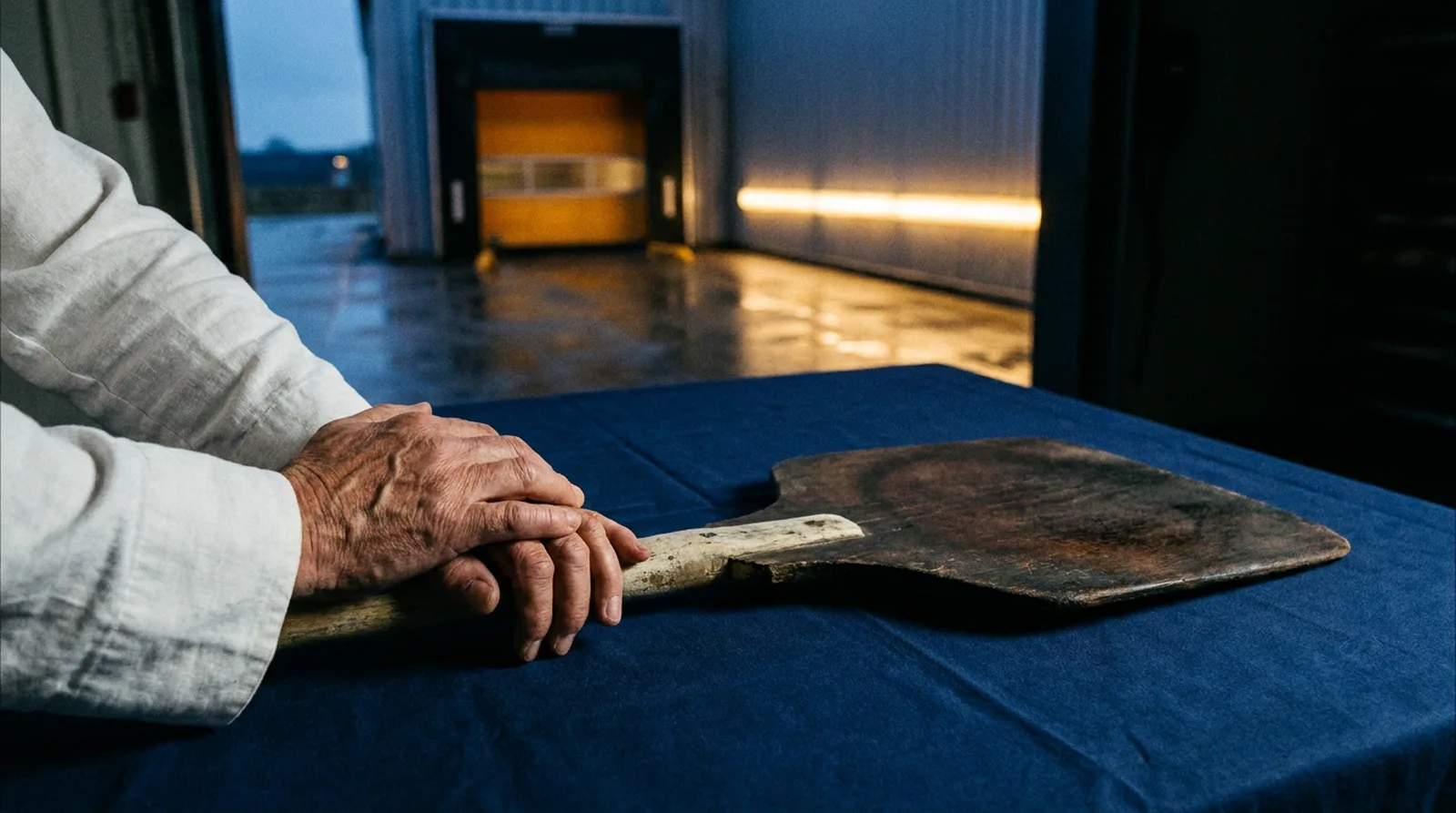
A family bakery group in Bahrain wanted to open its new plant without a ribbon. This is the story of that inauguration ceremony, and of a door that stopped halfway with a minister watching.
The ribbon was already in the box.
Green satin and gold scissors on a velvet cushion. The general manager of a family bakery group in Manama had ordered the set in September, the way his company had always done these things. He sent us a photo of it with a short message underneath.
His father would be eighty-one in December. The new plant in Hidd would open the week before National Day, when the country stops for the holiday on the 16th and 17th. A minister had agreed to attend. And he could not bear the thought of his father’s working life ending in a pair of scissors.
Could we do something better? He had seven weeks.
What was hanging on the wall
We asked to see the old bakery before the new plant.
It still runs, down a lane in Manama, and the smell reaches you long before the door does. On the back wall hung a wooden bread paddle, the handle worn pale and thin by forty years of one man’s grip. The founder had brought it from his first oven.
That was the ceremony, more or less, and we sketched it on the way back to the car.
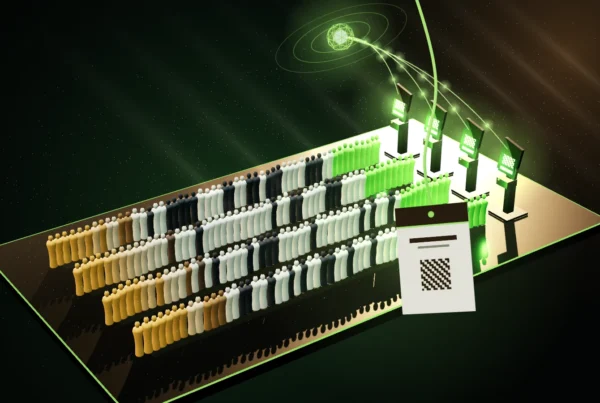
The minister and the founder would rest their hands together on that handle. A thin line of warm light would leave the table, run thirty metres across the ground to the plant’s loading door, and the door would rise. Behind it, the staff in their whites and the first bread of the new plant coming out of the oven.
There would be nothing to cut. Two hands on old wood, and then the smell arriving at the front row.
The general manager went quiet on the phone for a moment. Then he asked what it would take, and we drove to Hidd to find out.
A building that did not exist yet
A new plant looks finished long before it is. This one had a handsome roof, no permanent power and no internet. The electricity inspection was booked for January. Everything on site ran from a contractor’s temporary supply, shared with the welders.
The missing internet cost us nothing. Our ceremonies run on their own local network with the content held on the devices.
Power was a different conversation. We asked who owned the generator on the day, and nobody in the meeting could say. The caterer assumed it was his. The marquee company assumed it was theirs.
So we tested it. On a trial afternoon the caterer’s team switched on their coffee urns and warming ovens together. The generator sagged for a breath and our test player restarted.
In December, in front of a minister, that same breath would have put out the line of light halfway to the door.
We asked for a separate feed for the show, put battery backup under every device, and wrote one electrician’s name on the run sheet as the owner of power on the day.
At a new building, ask who owns the power during the ceremony and get a person’s name. A company name will not pick up the phone.
Switch on the ovens, then give the show its own feed.

The letters that came apart
The line of light carried a sentence with it: the founder’s name and the year he lit his first oven, in Arabic and English.
The film version looked right. The live version came back from the workshop with every Arabic letter standing alone, like beads on a string, and the year sitting at the wrong end of the line.
Arabic is a joined script, and numbers inside it still run left to right. Software that has not been taught both will happily draw nonsense and report no errors. A colleague who reads Arabic natively caught it in the first review. The fix took an afternoon. Found on the day, in front of that old man, it would have been the only thing anyone remembered.
Here is a sample line with the same bug. Turn on what the software was missing.

The wall that looked perfect
Here is the part most buyers never think about. An inauguration ceremony lasts a few minutes. The photograph lasts for decades. This one would hang in the head office and run in the next morning’s papers.
So we shot everything before we approved anything, at the real hour, with the kinds of cameras the press would bring.
The rented LED wall beside the door looked superb to the eye. Our test clip went to a colleague in the Eastern Province, who recognised the trouble straight away from an earlier job in Dammam. On camera, dark bands were crawling through the darker scenes. The eye does not see them. Sensors do, because the panel drives its LEDs in scanned lines. A rental partner in Manama had panels with a lower scan ratio, and the bands were gone in the next test.
Slide the shutter and swap the panel.

The same shoot caught something simpler. With the table where the plan had put it, the low afternoon sun sat directly behind the two guests. In every frame they were silhouettes. We turned the table and the press line, so the light fell across their faces instead.
Move the sun, then turn the table.

We broke the door on purpose
The plant’s quality manager gave us one firm rule. Nothing temporary past the yellow line, and certainly no glass. It was a food plant and that was that, so the light would stop at the threshold. Past it, the only show was the bakery itself. We liked it better that way.
Three days out, we timed the door. Thirty-eight seconds to rise, and it would not hurry for anyone, so the music was rebuilt around the door.
Then we asked the facilities engineer what could stop it. He pointed to a small pair of safety beams at ankle height on either side of the opening. Break the beam and this door halts, whichever way it is moving. The plant had set it up that way for the forklifts.
We sent a technician through the beam at the twenty-second mark, during a full rehearsal. The door stopped dead, the music ran on without it, and the whole crew stood looking at a half-open door. It was awful, and that was the point of doing it.
So we built a hold. If the door stopped, the operator would drop the music into a low loop while the light kept breathing at the threshold. The electrician would stand at the door control with a radio. A strip of yellow tape would mark where the press had to stand. We ran that failure twice more until nobody needed to speak.
Run it yourself, with the hold and without it.

A padlock at eight in the morning
It rained the night before, the first rain of the winter, and the site smelled of wet sand. Our technician walked the guest route at eight, as we do, and stopped at the door.
There was a contractor’s padlock on the isolator, and a handwritten note. A fire alarm test had been set for two o’clock, ninety minutes before the ceremony. It would have left the door dead, and no plan on anyone’s desk mentioned it.
Twenty minutes and three phone calls later, the test had moved to the next morning and the key was in our electrician’s pocket.
Half past three
The minister arrived four minutes early. The founder came to the table on his son’s arm. They put their hands on the paddle.
The sensor under the handle was wired, with a manual backup on the operator’s desk, because we did not trust wireless on a site full of radios. The light left the table low and gold and ran away across the damp ground. Every head turned to follow it.
The door began to rise.
At about waist height a press photographer, chasing his shot, stepped over the tape and through the beam.
The door stopped.
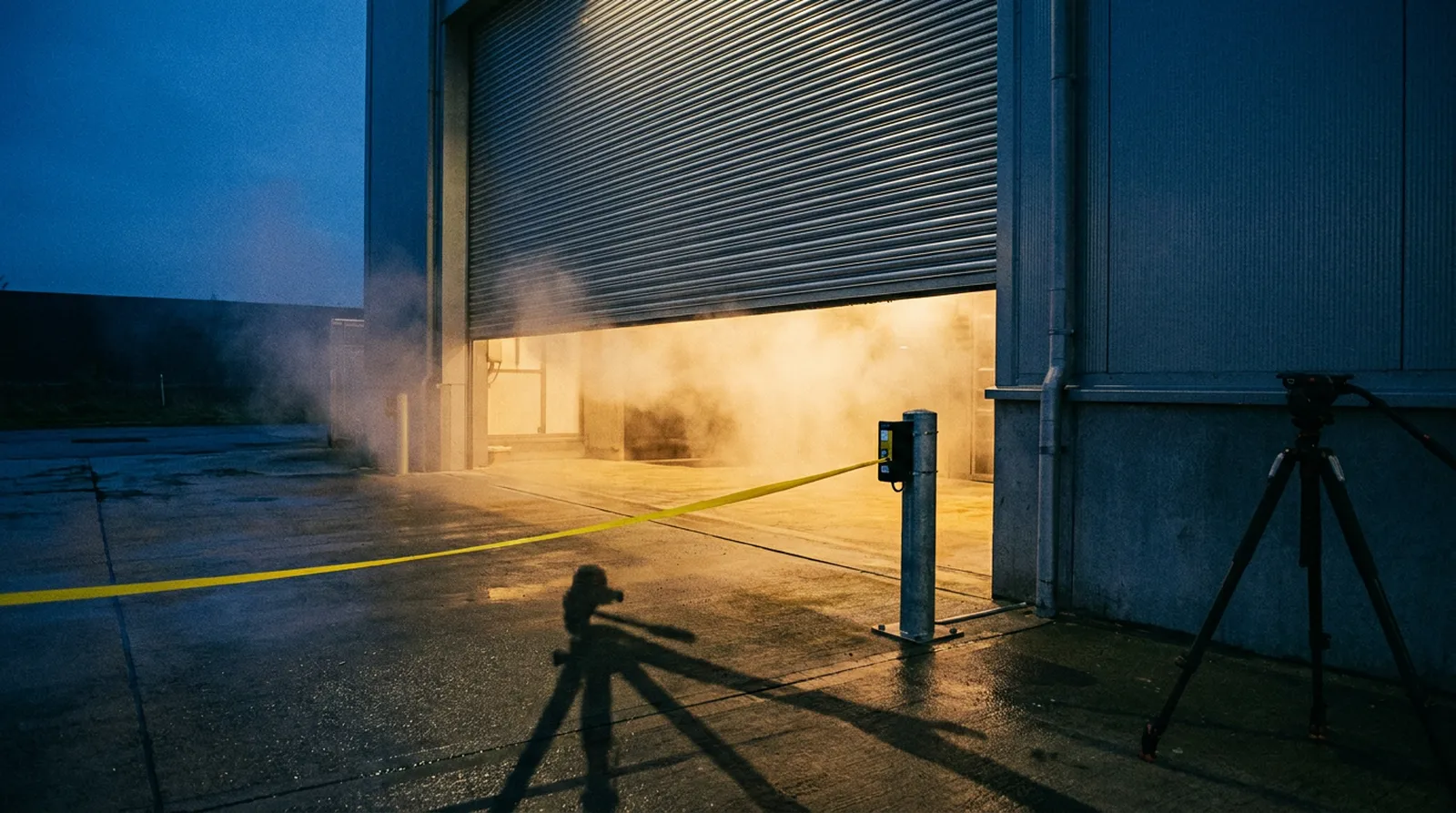
Our operator already had her thumb on the hold. The music sank into its low loop. The light stayed at the threshold and warm air began to drift out from under the door, carrying the first of the smell.
Our floor technician had a hand on the photographer’s elbow and moved him one step back. The electrician keyed his radio. Eleven seconds after it stopped, the door went on rising.
The front row had leaned forward to look underneath. The general manager assumed the pause was part of the show, and only heard otherwise at the debrief.
Inside stood the staff in their whites, with the line running and the first trays coming off. Someone walked out and put a warm loaf into the founder’s hands. He stood holding it for some time and said nothing at all.
The ribbon is still in its box.
This story is a composite drawn from common situations we see at inaugurations and openings in Bahrain and Saudi Arabia, not a single client project.
Buyer checklist for an inauguration ceremony
- Start with what the organisation already holds dear. An object with a history beats a new gadget.
- Walk the actual site early. A new building may have no permanent power or internet on the day.
- Put one named person in charge of power, and separate the show from catering.
- Test on camera at the real hour, with phones and press-style cameras, before you approve the LED wall.
- Check where the sun sits behind your guest of honour.
- Have a native reader check Arabic in the live system, not only in the design file.
- List every moving thing that belongs to the building, and find out what stops each one.
- Rehearse the failure, then mark where the press stands.
- Ask the contractor what is scheduled on site that day, in writing, and walk the route that morning.
Or score your own opening.

- Seven weeks outIdea and site walkAgree the concept, then find out what the building will really have on the day.
- Five weeks outBuild and Arabic reviewTrigger and content built in both languages, then checked by a native reader.
- Three weeks outCamera testShoot the actual wall at the ceremony hour. Move the layout now while it is still cheap.
- Final weekRehearse the failuresOn site, with protocol, press positions and the building’s own team.
- The morningWalk the routeEvery door and every isolator, hours before the guests arrive.
Planning an opening or inauguration?
Tell us the site, the date and who is cutting the ribbon, if anyone is. We will tell you plainly what fits. A single proven system takes five to ten working days, and a connected setup with reveal, film and screens usually takes four to six weeks. Our team is on the ground in Saudi Arabia and Bahrain, and someone from FAIM stays in the room until it is over. See our inauguration and launch experiences or the Jubail Commercial Port film.
Start the conversationWhatsApp us+973 3557 7062
Or email info@faimglobal.com.
Related reading: show control for launches, offline-first event applications, getting names right at an awards night and conference registration.
Questions buyers ask
What can replace a ribbon cutting at an inauguration ceremony?
Any single action your guest of honour can do without practice: a hand on a sensor, a touch on an object with meaning for your organisation. That action can trigger light, sound, a film or a physical reveal from one show control.
How early should we book technology for an inauguration?
One proven system takes five to ten working days. A connected setup with reveal, film and screens usually takes four to six weeks. Earlier is better if the site is still under construction.
What happens if the guest of honour arrives late or early?
The countdown is held by the operator, so it never ends before the room is ready. The run order adjusts and late and early cues are rehearsed beforehand.
Will the ceremony work without internet or permanent power?
Our ceremonies run on a local network with content on the devices, so internet is not needed. Power needs planning. We ask for a clear feed, use backup power and agree who owns it on the day.
Can the screens and film be in Arabic and English?
Yes. Films, countdowns and screen content are delivered in both languages, and we check Arabic in the live system as well as the design.
Will the LED wall look right in press photos?
A wall that looks fine to the eye can show dark bands on camera. We test the actual wall on camera at the ceremony hour before anyone signs it off.
Sources
- Arabian Business: Bahrain National Day holiday (two-day holiday on 16 and 17 December)
- Planar: Lower scan means higher performance for on-camera LED (scan ratio and dark bands on camera)
- W3C: Arabic and Persian Layout Requirements (joined letters; numbers written left to right)
- Quantek: safety beams for doors and shutters (photoelectric beams that stop doors and shutters closing when something blocks them)
Found this useful?