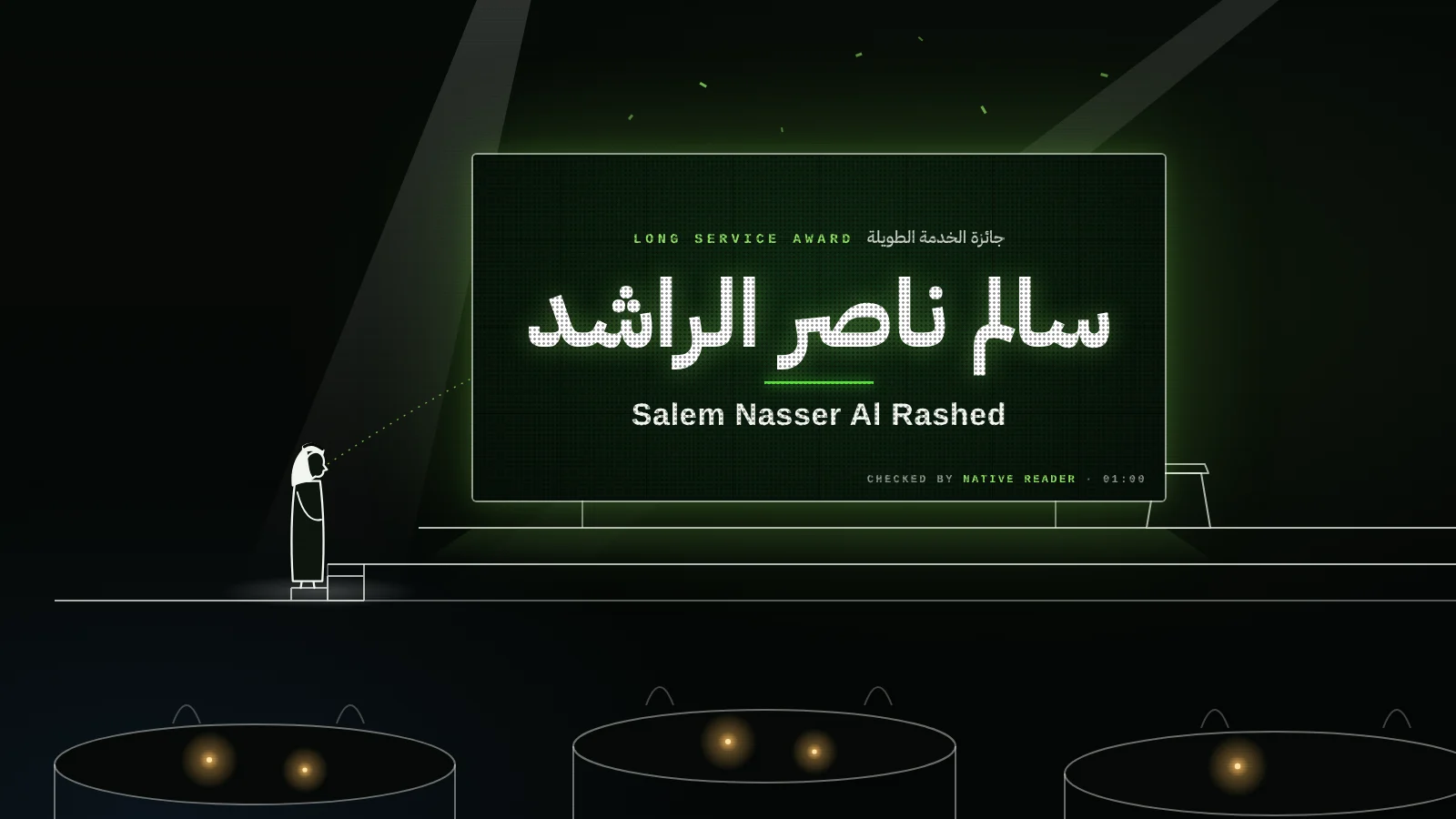
Late in the year, companies across Riyadh and Manama book hotel ballrooms for their annual awards night. Most of the technology on the night is simple. The part that goes wrong is usually the smallest thing in the room: a name on a screen. This is the story of one awards night, from a rehearsal that went dark to a supervisor who finally saw his name written the way his family writes it.
The first message came in the middle of November, from an events director at a Riyadh company that runs warehouses and a fleet of trucks.
She was planning the company’s year-end awards night. A hotel ballroom, around six hundred staff, dinner, a stage and a long LED wall behind it. Fourteen categories.
She wanted a live vote for the people’s choice award, a photo station near the entrance, and every winner revealed on the big screen in Arabic and English.
Then she told us about last year.
What went wrong last year
Last year the voting link froze at the exact moment the host read it out. Six hundred people opened it together on the hotel guest Wi-Fi and the page just spun. The host filled four minutes with jokes nobody remembers.
The worse moment came later. A driver with many years at the company won the long service award. When his name appeared on the wall, the Arabic letters sat apart from each other and ran the wrong way, like a word typed by someone who had never seen the script.
He stood on the stage and smiled politely at it. Everyone in the room saw.
She was clear about what she wanted this time. Nothing clever. She needed the names to be right.
The names are the show
Our first question surprised her. We didn’t ask about the size of the wall or the stage design. We asked where the list of winners lived.
It lived in several places. HR had a spreadsheet. The chief executive’s office had a shortlist in a Word file. The video agency had already started rendering a winner slide for each category as a finished clip.
That last detail is where we stopped the meeting.
A rendered clip can’t change. If a name is misspelled, or a winner changes on the day, someone has to re-edit, export and copy a new file while the hotel staff are laying tables around them.
So we suggested one sheet, owned by one person on her team. Every name in Arabic and English, the photo, the category, and a column marked “checked by”. On the night, our graphics would read the winners from that sheet live. Nothing about a winner would be baked into video. The agency kept the opening film and the short category stings, which was where their strength was anyway.
Then we asked for something that felt slightly awkward. We wanted each nominee to write their own name, in both scripts, the way they actually spell it.
Company records often start from a passport, get transliterated into English, then get typed back into Arabic by someone in a hurry. What comes out is not always what a family would write.
She sent a short form to every nominee that week. Several names came back different from the HR record.

One in the morning, on the real wall
Laptop previews lie. The test that counts happens on the real wall, through the hotel’s own processor.
Ten days out, the hotel gave us a two-hour slot on the ballroom wall after a wedding cleared out. The carpet still smelled of oud and coffee, and the cleaning crew were stacking chairs at the far end.
The first category card went up and the Arabic looked fine. The letters joined properly and ran right to left.
Then the safety award came up. Its Arabic title included the year, and the number had jumped to the wrong end of the line. A few cards later, a nominee’s name shared a line with his English job title, and the two halves had swapped places.
Nothing was broken in the font. This is how mixed text behaves: Arabic runs right to left, while numbers and English words inside it run left to right, and software has to be told which is which. We split each card so the Arabic and English sat on separate lines, each with its own direction, rather than one setting for the whole slide.

The longest name had five parts and ran off the edge. We set that one line to shrink slightly instead of wrapping, because a name broken over two lines on stage looks like an error even when it isn’t.
Then a colleague who reads Arabic natively stood at the back of the ballroom and read every single name aloud from the wall while someone at the desk checked it against the sheet. All of them. It took most of an hour, and two more spellings needed fixing before we packed up.
Six hundred phones at once
The vote needed a different plan from last year, and most of the fix was timing rather than technology.
We didn’t want everyone voting in the same thirty seconds. So the vote opened when guests sat down for the main course and stayed open for about forty minutes. Each table had a card with a QR code.
That code pointed to a page served from a small machine in the room, on our own access points, not the hotel’s guest network. If a phone refused to connect, two tablets at the back of the ballroom took votes too.
The director asked us not to show a live leaderboard during dinner. She didn’t want departments racing each other over the main course. So the result stayed hidden until the operator released it on cue.
Three o’clock, the wall goes black
Rehearsal day. Mid-afternoon, the catering team plugged their hot holding cabinets into sockets behind the stage. A breaker tripped.
The LED wall went black. So did the host’s confidence monitor. Somebody near the stage said a word we won’t print.
Our show machine was on a UPS and kept running. When the hotel engineer reset the breaker and the wall came back, the graphics were exactly where they had been, on category six, because the show runs on the machine and not on the screen. A mirrored backup machine sat in the rack the whole time, ready if the main one ever failed.
We asked the engineer to move catering to another circuit and put tape labels on the stage sockets: show power only. That kind of detail is rarely on a hotel’s power plan, so it is worth asking for before the day.

The phone call at ten past four
Then the chief executive’s office called. Two categories were being merged. One winner was coming off the list, and a joint award was being added for two engineers who had led a project together.
Last year, that call would have meant re-rendering clips in a corridor.
This year, the sheet owner made the change. Our native reader checked the two new Arabic names. We put the new card on the wall during the sound check. The whole thing took less time than finding the person who had approved it.
The photo station and the question of faces
At the entrance, guests could pose with a branded frame and collect their photo by scanning a code.
There was also a gallery screen near the bar. We set it so nothing went onto that screen unless the guest chose it on the spot. A small sign in both languages explained what happened to the photos and when they would be deleted. Photos of people count as personal data, and plenty of guests wanted a picture for themselves and nothing on a public wall.
Dessert caused the only queue of the night. Within a few minutes the line reached the ballroom doors. We opened the second station, which had been waiting in a flight case under the table since the morning.
The reveal
Fourteen times, the host opened an envelope. Our operator waited until the name was actually spoken before pressing, so the screen never gave the winner away a second early.
The long service award came near the end. The winner was a warehouse supervisor who had been with the company for more than twenty years.
His name appeared in Arabic exactly as he had written it on the form, in a spelling his family uses and the HR system had never once got right.
He stopped halfway up the stage steps and looked at the wall a little longer than people usually do. Then he carried on up.
The events director sent us one photo the next morning. It was him, on the stairs, looking up.
This story is a composite drawn from common situations we see at corporate events in Bahrain and Saudi Arabia, not a single client project.
Buyer checklist for a corporate awards night
- Keep every winner’s name, photo and category in one sheet, owned by one person.
- Ask each nominee how they write their own name in Arabic and in English.
- Keep winner names out of rendered video, so a late change is a quick edit.
- Test every name on the real LED wall, read aloud by a native Arabic reader.
- Look closely at any line that mixes Arabic with numbers or English words.
- Run audience voting on a dedicated local network and keep it open for a long window.
- Ask the hotel, in writing, which sockets share a circuit with the stage and catering.
- Put the show machine on a UPS, with a mirrored backup in the rack.
- Make any shared photo screen opt-in, and explain photo use in both languages.
- Ask who from the supplier stays in the room until the last award is given.
Planning a year-end event?
If you are planning an awards night, a gala or a company celebration in Saudi Arabia or Bahrain, tell us the venue, the date and what should happen on stage. We will tell you plainly what fits the time you have. Our builds run offline-first, with redundant inputs and automatic recovery. Bilingual Arabic and English is standard, and a member of our team commissions and stands by every installation, on the ground in both countries. See our event technology and audience engagement work.
Start the conversationWhatsApp us+973 3557 7062
Or email info@faimglobal.com.
Related reading: show control for launches, real-time event walls that run local first, corporate events without the rows of chairs and keeping a conference registration desk moving.
Questions buyers ask
How early should we book technology for a year-end awards night?
As early as you can. A full interactive stand build typically takes four to six weeks, and a ballroom show with several elements benefits from similar lead time. For one focused element, such as a live vote or a data-driven reveal system, our minimum is five to ten working days from approval and advance payment.
Can guests vote live without relying on the hotel Wi-Fi?
Yes. We run voting from a machine in the room on our own network, with a second way to vote if a phone will not connect. Keeping the vote open across a meal, rather than a short burst, also takes pressure off the network.
How do you make sure Arabic names display correctly on the LED wall?
We collect each name as the person writes it, keep Arabic and English on separate lines with their own direction, and test every name on the real wall with a native Arabic reader before the event.
What happens if a winner changes on the day?
Because winner names are read from a single sheet rather than baked into video, a late change can be made, checked and shown on the wall in minutes.
Do we need consent to show guests’ photos on screens?
Photos of people count as personal data under Saudi Arabia’s Personal Data Protection Law, and Bahrain has its own Personal Data Protection Law. Make shared screens opt-in, tell guests clearly how photos are used and when they are deleted, and have your legal team review the plan.
Will someone from FAIM be at the event?
Yes. A member of FAIM commissions and stands by every installation we deliver, and we carry spares.
Sources
- W3C: Arabic and Persian Layout Requirements (joining forms of Arabic letters; numbers and Latin text run left to right inside Arabic)
- Clyde & Co: Saudi Arabia issues Personal Data Protection Law (personal data expressly includes photographs and video recordings of a person)
- Legislation and Legal Opinion Commission, Bahrain: Law No. 30 of 2018 on Personal Data Protection (English text)
Found this useful?