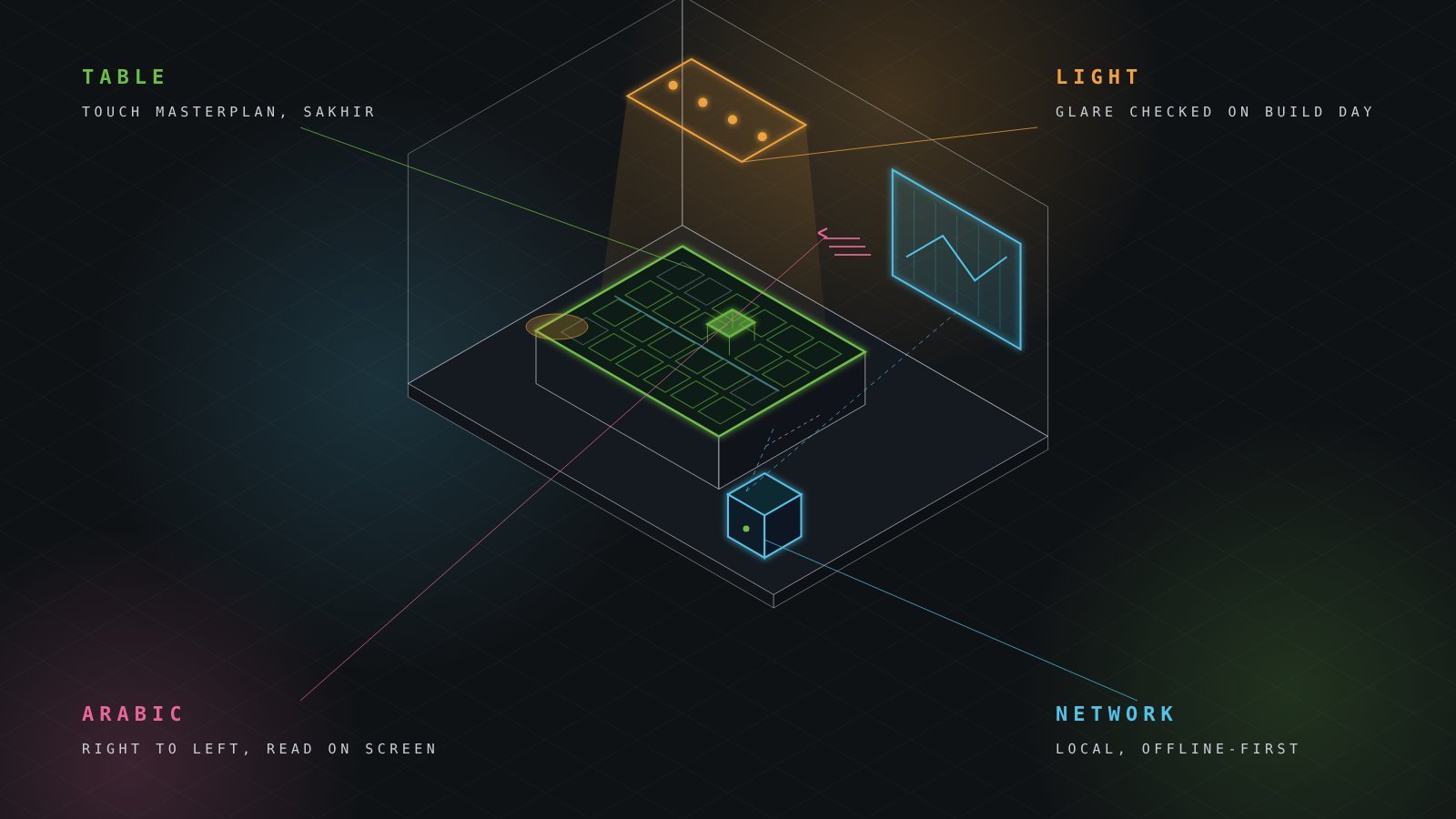
Exhibition stand technology in Bahrain covers the screens, touch tables, sensors, software and lead capture that sit inside a stand, and someone has to own all of it separately from the stand builder. FAIM designs, programs, installs and runs that technology for exhibitors at venues such as Exhibition World Bahrain in Sakhir, through our AI exhibition booth team on the ground in Bahrain and Saudi Arabia. Below is one property stand, told as a story.
The message arrived on a Sunday evening, five weeks before the show. A property developer in Manama had a corner stand at a property exhibition in Sakhir. The stand builder’s render showed white walls, a timber counter, a scale model under glass and three screens drawn as grey rectangles.
“The builder says the screens are included,” the marketing manager wrote. “We want the masterplan on a touch table so people can find their plot. Can you do the software?”
We asked one question back. Who is putting the content on those grey rectangles, and who is standing next to them when they freeze?
Nobody, it turned out. The builder was supplying the structure, the graphics and screens on brackets. The touch table was a picture.
Who supplies the technology on an exhibition stand in Bahrain?
Usually it is split three ways. The builder owns the joinery and power drops, the venue owns the hall with its lighting and Wi-Fi, and the exhibitor brings the content and the sales team.
The technology lives in the gaps. A screen sits in the builder’s wall, runs on the venue’s power and shows the exhibitor’s content. When it fails, all three can point at each other.
We do not build stands. We supply and run the technology inside them, working from the builder’s drawings. So before the brand guidelines, we asked for the joinery drawings, the electrical layout and the hall’s build schedule.
The touch table that was cut for a different screen
The drawings came back on the Tuesday. The table top had a recess cut for a 65 inch display. Reasonable. But the recess was drawn to the size of a consumer TV, and a touch display made for public use has a thicker frame, a deeper body and a fan on the back that needs somewhere to breathe.
On paper, the screen we were planning to use was too wide for the hole by a few centimetres.
In week five that is a phone call. On build day it is a carpenter with a saw at midnight in Sakhir. We sent the joiner the display’s spec sheet and a simple fit drawing with the cable route and a vent slot marked. He moved one line on his drawing.
Why the Arabic plot numbers came out backwards
The masterplan came from the developer’s sales team as a spreadsheet: plot numbers, unit types, sizes and status, in Arabic and English.
English looked fine. On the Arabic side, labels that mixed Arabic words with Latin letters and numbers, a villa type followed by “12-B”, came out in the wrong order. The number jumped to the other side of the word.
Right to left and left to right text in one line is an old trap: the software has to be told which way each piece runs, or it guesses. We set the direction properly for every label, used an Arabic font that joins its letters correctly, and had an Arabic-speaking member of our team read every plot on the real screen before it left the studio.
Build day and the light from above
Build day was loud. Forklifts, drills, someone shouting for a pallet jack. We arrived once the builder’s walls were painted and fitted the display. It went in cleanly.
Then the hall lights came on.
The table sat under a bank of overhead lights. From where a visitor would stand, the glass threw back a white patch the size of a dinner plate, right over the priciest phase of the masterplan.
An anti-glare film from our spares case went on that evening. We also switched the masterplan to a darker base map, which hides reflections far better than a white one, and asked the builder whether the table could turn a few degrees on its spot. He agreed. The patch moved off the plots and onto the table’s frame.
The power that goes off at night
Many halls switch off stand power overnight during build and the show. That means every morning, every machine on the stand starts cold.
Picture a screen waking up to a Windows login, or an update prompt, or a desktop with a recycling bin on it. Visitors notice that before they notice your logo.
Our machines power on by themselves when the supply returns, open the stand application full screen and check their content before showing anything. On the first morning we watched all three screens find their way home without a hand on them. We watched again the next day, because once is luck.
What happens when the venue Wi-Fi collapses?
Minutes after the doors opened, the hall Wi-Fi went the way hall Wi-Fi goes when thousands of phones arrive at once. The sales team’s tablets, running a web form, stopped loading.
Nothing on our side noticed. The touch table, the wall and the lead capture ran on a small local network on the stand. Enquiries were saved on the stand first and copied up later when a connection was there. The sales team switched to the capture screen we had built into the table and carried on.
The form that asked for too much
The developer’s enquiry form had eleven fields. On a stand, at the edge of a crowd, a visitor gives you a few seconds of patience.
We cut it to a phone number, a name and one tap on the plot they liked, which the table already knew. Then we added a plain consent line saying the developer’s sales team would contact them about this project, with a separate box for marketing messages. Bahrain’s Personal Data Protection Law expects consent for this kind of use.
The sales team liked one thing above the rest: every lead arrived already tagged with a plot.
The late change, the night before
At nine in the evening before opening, the sales director called. Fourteen units in the first phase had been reserved that week. Could they show as sold? And the payment plan had changed.
The table read its content from one panel, so it was an edit, a preview check and a sync. No rebuild, no USB stick. We confirmed it on the real screen before we left the hall.
The weekend queue
Day two fell on a weekend. Families came in groups of six, and the table could really serve one family at a time. A queue formed.
We mirrored the masterplan onto the side wall in attract mode, so people waiting could watch the phases light up and pick a favourite. When their turn came, they knew what to touch.
The moment it worked
On the last evening, the hall lights dimmed a little before close. A father and his two daughters stood at the table and touched one plot near the planned park. It lifted out of the map in soft green light, the size and the view drawn in Arabic and English beside it. The younger girl put her hand flat on the glass and said, “That one is my room.”
The marketing manager watched from the counter. She did not say anything. She just went and found a salesperson.
This story is a composite drawn from common situations with exhibition stand technology in Bahrain and Saudi Arabia, not a single client project.
Before you book exhibition stand technology in Bahrain
- Who owns the technology on your stand, separately from the stand builder, and who is on the stand to run it?
- Has your technology partner seen the joinery drawings, with the real screen sizes, cable routes and ventilation?
- Are Arabic labels that mix words and numbers checked on the real screen by an Arabic reader?
- Has someone checked the stand position against the hall lighting for glare?
- Will every screen come back on its own when the hall power returns each morning?
- Does anything a visitor touches depend on the venue Wi-Fi?
- Is your enquiry form short, with clear consent for how the details will be used?
- Can prices, availability or content change the night before without a rebuild?
Have a stand booked and the screens still grey?
Send us the show, the dates, your builder’s drawings and what visitors should do on the stand. Interactive stand builds typically take four to six weeks. Our team is on the ground in Bahrain and Saudi Arabia, and a member of FAIM commissions and stands by every installation. You can try some of our stand products on the live demo hub, and our price list gives estimates, with your final price confirmed in a written quotation.
Start the conversationWhatsApp us+973 3557 7062
Or email info@faimglobal.com.
Related reading: what FAIM builds inside an interactive exhibition stand in Bahrain, designing touchscreens for exhibition floors, lead capture on a stand and the interactive hologram at HEC Dhahran Expo.
Questions buyers ask
Does FAIM build exhibition stands in Bahrain?
No. We supply, program, install and run the technology inside the stand: screens, touch tables, holograms, games and lead capture. We work from your stand builder’s drawings.
What counts as exhibition stand technology?
Anything on the stand that runs software or shows content: displays, touch tables, interactive walls, holograms, AI hosts, sensors and lead capture.
How long does stand technology take to build?
Interactive stand builds typically take four to six weeks. The minimum build is five to ten working days from approval and advance payment.
Will it work if the venue Wi-Fi fails?
Yes. Our builds are offline-first. The stand runs on its own local network, and enquiries are saved on the stand and synced when a connection is available.
Can the content be in Arabic and English?
Yes. Bilingual Arabic and English is standard, with right to left layout and an Arabic reader checking every label on the real screen.
Sources
- The National: Bahrain opens country’s largest exhibition complex (Exhibition World Bahrain in Sakhir, its halls and size)
- DLA Piper: Data protection in Bahrain (Personal Data Protection Law No. 30 of 2018 and consent)
- W3C Internationalization: Languages using right-to-left scripts (Arabic direction and mixed text)
- FAIM FAQ (offline-first builds, spares, on-site commissioning, lead times)
Found this useful?