Winter is family day season in Bahrain and Saudi Arabia. This is the story of one corporate family day near Al Khobar: a tent facing the wrong way, a photo wall nobody had asked the parents about, a quiz question that translated badly, a VR queue fixed with bakery tickets and a breaker that tripped at lunch. A buyer checklist follows.
The call came on a Thursday in the middle of November.
On the line was the events director of an engineering company in Al Khobar. Every January they hire a beach resort south of the city for a Friday family day. Staff come with their husbands and wives, the children, sometimes a grandparent or two.
Last year they had a bouncy castle, a DJ and a raffle. The children loved the castle for about twenty minutes. The fathers stood at the edge of the lawn looking at their phones. She wanted something families would do together, and she had eight weeks.
Eight weeks is comfortable. Our interactive builds typically take four to six weeks, which left room for the step most family days skip: looking at the place first.
Eleven o’clock on the lawn
The plan on paper had three stations under one large tent. A physical reaction game with light-up buttons, where a child and a parent race the same one-minute clock. A VR corner. And a team quiz on a big screen, each family answering from its own tablet, in Arabic and English.
Two of us drove down to the resort on a weekday, at the hour the event would actually run.
The tent was drawn with its open side facing the sea. Nice view. By late morning the sun sat over the water and shone straight into the space where the quiz screen would stand. On a phone camera it was a white rectangle. A breeze off the water lifted the sidewalls every few seconds.
We turned the tent around on the drawing, so its back faced the sea. The screens went onto low floor stands with weighted bases instead of tall poles, and every interface was designed dark, so it stays readable in daylight.
Then our engineer asked the boring question. Where does the power come from?
The lawn sockets ran from a generator the resort shared with the caterer. We asked the caterer what they planned to plug in. Tea urns, two griddles, a popcorn machine, and the list kept going. We asked for a separate supply to the tent, put every station on a small UPS and set each application to relaunch itself on its welcome screen after any interruption.
The resort Wi-Fi reached the lobby but not the lawn. Our builds are offline-first, so the stations would talk to each other over their own small network inside the tent.
The photo wall nobody had asked the parents about
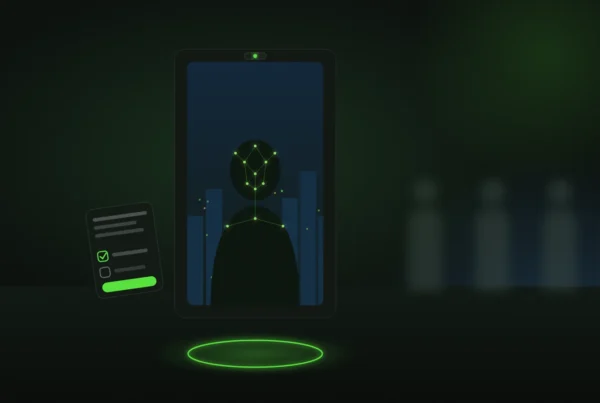
A week into the build, the client added a fourth idea. A photo station where each family takes a picture, the picture appears on the big screen, and the best ones go up on the company’s social pages.
It sounds harmless. It is also a station full of children’s faces, at an event where not every family wants its picture on a screen in front of colleagues. Some mothers would prefer not to be photographed at all.
So we redesigned it around a parent’s choice. The first screen asks, in Arabic and English, whether the photo may appear on the big screen. The default answer is no. The family gets a printed copy to take home either way. Nothing is posted online, and every file is deleted from the station at the end of the day.
Saudi Arabia’s Personal Data Protection Law, like Bahrain’s, puts consent at the centre of how personal data is handled, and a child’s photo is personal data too. We are not lawyers. We sent the wording to the client’s compliance team, and they changed one line.
Question nine
The HR team wrote thirty quiz questions about the company, in English. Someone had run them through a translation tool to save time.
Our Arabic-speaking producer read the Arabic version aloud in the studio one afternoon. Question nine asked about the company’s first project. In the Arabic, it came out closer to asking about the company’s first mistake.
Laughter first. Then a quiet moment while everyone pictured it on a big screen in front of the founder.
Every question was rewritten by a person who writes Arabic every day, not converted from the English. We also added an easier round for younger players, so a ten year old could carry a family to the top of the table without waiting for a parent to answer.
The bakery ticket
We knew where the trouble would be on the day. The VR corner.
Each headset needs wiping between players, and each player needs a short safety brief. The headset maker’s age and health guidance rules some younger children out, and they are usually the ones most desperate to try. Picture a long line and a crew member explaining the age rule to a crying six year old.
Two changes. We cut the VR experience to around three minutes, so the line moved. And we added a small ticket printer, the kind you see at a bakery counter. A family takes a number. A screen above the corner calls the next number. They play the quiz, eat something and come back when their number is close.
Younger children went to the reaction game instead, which got a junior mode with a slower clock and a row of buttons mounted low enough for small arms.
Wednesday night, the forecast
Two days before the event, the forecast changed. Strong wind on Friday morning, with a chance of rain.
The resort offered its indoor hall. Because every station ran on portable stands and its own local network, the move meant redrawing the floor plan over dinner, not a lost night.
The hall brought its own problem. One wall was glass and faced east, which put the morning sun right where the quiz screen had been planned. We moved the screen to the side wall, ran every station through a full test on Thursday in both languages and left the hall at nine.
Friday, half past twelve
Doors opened at ten. Our two crew members had been there since seven, with a case of spares under the table.
The morning went well. The bakery tickets kept the VR corner calm. Fathers lined up to race their own children at the reaction game. The quiz table filled up with family names, some typed in Arabic, some in English, some with a cat emoji the HR team had not planned for.
Then lunch. The caterer had also moved indoors, into the room next door, and that room shared a circuit with the hall. At half past twelve the urns, the griddles and the popcorn machine all ran at once, and the breaker tripped.
The hall lights went out for a few seconds. The UPS units kept the computers running. The reaction game’s buttons blinked off and came back on their attract pattern. The quiz paused on question fourteen and carried on when the power returned, scores intact. A boy at the reaction game asked his father if that was part of the game.
The resort electrician moved the catering onto another circuit within ten minutes. Most guests never knew anything had happened.
The final quiz round ran at four. The winning family had a grandmother on the team, and an eleven year old who had memorised the project list from the roll-up banners by the entrance while waiting for her VR number.
This story is a composite drawn from common situations at corporate family days and outdoor events, not a single client project.
Before you book technology for a family day
- Has someone visited the venue at the hour your event will run, and checked where the sun falls?
- Which generator or circuit feeds your games, and what else is the caterer plugging into it?
- Will every station keep working with no Wi-Fi at all?
- Does your photo station ask a parent first, with no as the default?
- Was the Arabic written by a person, not converted from English by a tool?
- How will the VR queue work, and what happens to children below the headset maker’s age guidance?
- If the weather turns, can everything move indoors in an evening?
- Who from your supplier is staying on site for the whole day?
Planning a family day this winter?
Tell us the venue and the date. Interactive builds typically take four to six weeks, and simpler builds need a minimum of five to ten working days from approval and advance payment. Our team is on the ground in Saudi Arabia and Bahrain, bilingual Arabic and English is standard, and a member of FAIM commissions and stands by every installation we deliver.
Start the conversationWhatsApp us+973 3557 7062
Or email info@faimglobal.com.
Related reading: the reaction game with a live leaderboard, why event apps should work offline first, why grown-ups play at events and the mall stand that kept going when the lights went out.
Questions buyers ask
What interactive games work for a corporate family day?
Games a parent and child can play together or against each other. A physical reaction game and a team quiz on a big screen work well for most ages, with short VR sessions for older children and adults, all in Arabic and English.
Can the games run outdoors?
Yes, with planning. Screens need shade and should face away from low sun, and stands need weighted bases when there is wind. A site visit at the hour of the event shows most problems early.
Do the games need internet at the venue?
No. Our builds are offline-first, with redundant inputs and automatic recovery. Stations share their own local network, so a weak venue signal does not matter.
How do you handle photos of children?
Around a parent’s choice. A photo appears on a shared screen only if a parent agrees, and the station keeps nothing after the event. Your compliance team should review the consent wording.
How early should we book?
Interactive builds typically take four to six weeks. Simpler builds need a minimum of five to ten working days from approval and advance payment.
Sources
- Al Tamimi & Company: An overview of Saudi Arabia’s Personal Data Protection Law (consent requirements)
- DLA Piper: Data protection in Bahrain (Law No. 30 of 2018 and its consent rules)
- FAIM FAQ (offline-first builds, spares, on-site commissioning, lead times)
Found this useful?