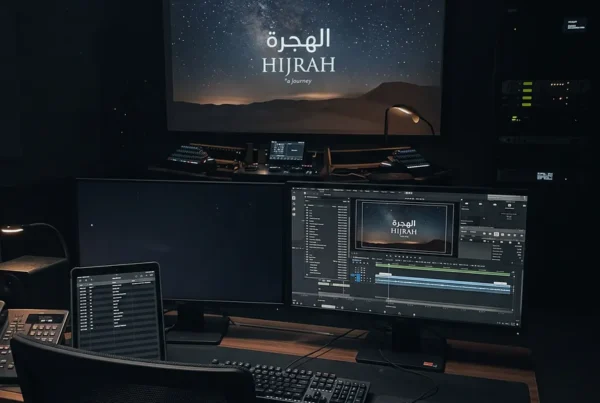
Eleven repositories now cover the motion pipeline in code, from style and 3D to physics, finishing, sound sync and render. None of them replaces taste. They remove keyframe labour so judgement gets more of the day.
Picture a designer in Manama at 11:40 on a Tuesday night, deleting the same keyframe for the fourth time. The logo is meant to settle like a coin on glass. It lands like a dropped tray. The screen goes live in nine hours, and the timeline panel has stopped being a tool and started being an argument.
That argument can now be had in plain language. A coding agent can write the scene, run the physics, read the music and render the file. Matt Penny’s video 10 GitHub Repos to 10x Your AI Motion Graphics collects the open-source projects behind that shift. Its description links eleven repositories, not ten, because the prompt-pack entry points to two.
How this was checked. Every repository below was opened on its own GitHub page on 10 November 2026. Star counts are GitHub figures as read that day and will drift. Nothing here was installed or run for this article. The video description lists the links; this article does not claim how any of them was used on screen.
The eleven repositories at a glance
-
01Style
lemo-opuscar
by lemomo-ai66 film styles for Claude Code, each with a style prompt and a demo film built in code
-
023D
three.js
by mrdoobGeneral-purpose JavaScript 3D library for the browser
-
03Effects
pixelfx
by patch-ggLibrary of 244 pixel art effects, each a small piece of code
-
043D
mcp-for-blender
by ahujasidCommunity add-on that lets a language model control Blender
-
05Prompts
awesome-opus5-5-videos
by yihui-devVideos made with Claude Opus 5.5, paired with their prompts
-
06Prompts
opus-video-prompts
by joeseesun54 public cases of video made through code, plus 18 copy-ready prompts
-
07Style
ClaudeAnimationBase
by JohnHeibelStarter kit for hand-painted-style cartoon animation with p5.js
-
08Physics
react-three-rapier
by pmndrsRapier physics engine wrapped for React Three Fiber
-
09Effects
react-postprocessing
by pmndrsPost-processing effects wrapped for React Three Fiber
-
10Sound
librosa
by librosaPython library for audio and music signal processing
-
11Render
video-shotcraft
by Vincentwei1021Skill that builds product promo videos frame by frame in Remotion
Star counts: GitHub, read 10 November 2026. lemo-opuscar code is MIT; its demo films are CC BY 4.0.
Style and direction
lemo-opuscar is a toolbox of 66 film styles for Claude Code. Each style ships with a prompt and a demo film built entirely in code. You describe a film in plain language, name a style, and the agent directs and renders a short film with no video model involved. It installs as a Claude Code plugin or by cloning the repo, and it needs Node 20 or later, ffmpeg 7 or later and Python 3.11 or later. Useful for look development, when the question is which visual language suits the message. Caveat: the demo films and stills are CC BY 4.0, and six voice tracks are excluded from that licence.
ClaudeAnimationBase is a starter kit for hand-painted-style cartoons, built on p5.js and p5.brush. It includes a character called Clawd, 31 acted emotions, and an ANIMATION_GUIDE.md that tells the model how to build animations. It needs Node.js, Google Chrome and ffmpeg, and renders its 11 second demo to MP4 with one command. Useful when a piece needs a character with feelings instead of geometry.
3D, modelling and physics
three.js is the foundation most browser 3D sits on. Its README describes a general-purpose 3D library that aims to be easy to use, lightweight and cross-browser. The core builds include WebGL and WebGPU renderers, with SVG and CSS3D available as addons. Useful for any scene that has to run live, on a web page or a touchscreen.
mcp-for-blender connects a language model to Blender. A Blender add-on runs a socket server, and an MCP server links it to clients such as Claude, Cursor or Codex. Useful when the hero object needs real modelling, materials and lighting. Caveat: it is a community project, not an official Blender product.
react-three-rapier wraps the Rapier WASM physics engine for React Three Fiber. Its README lists automatic colliders generated from meshes, instanced bodies, collision and contact force events, and six joint types (fixed, spherical, revolute, prismatic, rope, spring). Useful for anything that should fall, collide, swing or settle, which is exactly the coin-on-glass problem from the opening. Caveat: version 2 supports React 19 and React Three Fiber v9, and React 18 projects need version 1.
Finishing and effects
react-postprocessing wraps the postprocessing library for React Three Fiber. The README example uses DepthOfField, Bloom, Noise and Vignette, and the project says it is aimed at simple, linear effect chains. Useful for the last ten percent that makes a render feel photographed.
pixelfx is a library of 244 pixel art effects (fire, explosions, magic, weather, UI and more). It includes a Claude Code skill for drafting, rendering and refining new effects, and it can export sprite sheets for engines such as Godot and Unity. Our reading: it is built with games in mind, and in motion work it serves as an effects library for a deliberate retro look. Caveat: the bundled Patch Pixel font is not covered by the MIT licence.
Sound
librosa is a Python library for audio and music signal processing. Its README says it provides the foundational tools for building music information retrieval systems. In a motion workflow, that means reading tempo and beat positions from a track and handing them to the animation as data, so cuts and pulses land on the music instead of near it. That use is our interpretation of where it fits. The library itself is general audio analysis, not a motion tool.
Product films
video-shotcraft is a skill for Claude Code and Codex that builds product promo videos. It draws each frame in code with Remotion, using your own screenshots and copy, and outputs an editable 1920 x 1080 MP4. Useful when the film is about a real interface. Caveats: audio files in the repo carry their own licences, and Remotion is licensed separately and may require a paid plan for companies.
Prompt libraries
awesome-opus5-5-videos is a regularly updated collection of videos made with Claude Opus 5.5, each paired with the prompt that made it, or with the creator’s original post where no prompt was shared. On the day we read it, it listed 703 prompts, 418 of them with live remakes.
opus-video-prompts is a curated index of 54 public cases of video generated through code (HTML Canvas, Three.js, Remotion), with 18 copy-ready prompts, an overview of technical routes and writing tips. Caveat: the page names no licence, and its disclaimer says copyright in the prompts and videos stays with the original authors. Treat both libraries as reference for how to brief, not as assets to reuse.
How they fit together
No single project needs all eleven. This is one sensible order, and it is our interpretation, not a tested pipeline. Press a stage below, or let it play.
- Reference. Read the two prompt libraries to see what has been achieved and how it was asked for.
- Look. Choose a visual language with lemo-opuscar, or ClaudeAnimationBase if the piece is led by a character.
- Build. Assemble the scene in three.js. Bring in Blender through mcp-for-blender when the hero object needs real modelling.
- Move. Let react-three-rapier handle whatever should fall, collide or swing.
- Time. Use librosa to read the track, then pin cuts and pulses to the beat.
- Finish. Add bloom, depth of field, grain and vignette with react-postprocessing. Reach for pixelfx when the brief calls for pixel art effects.
- Ship. Use video-shotcraft when the film is about a product screen and needs to leave as an MP4.
Two practical warnings. The three React libraries only make sense inside a React Three Fiber project, so they are not drop-ins for a plain three.js page. And licences differ across the set, from MIT to Apache-2.0 to none stated, so check each one before client work.
Anatomy of a motion graphic
The companion tool below shows the same idea from the other side. It walks one illustrative 12 second sequence through nine production stages, layer by layer, and notes where each repository could fit.
What this means on a real floor
An exhibition screen is judged in the first two seconds, by someone who was walking somewhere else. Faster production only matters if it buys more attempts at that moment. What we would measure, before claiming any of this works, is plain: how long people stop, whether they come back for a second look, and whether the content still reads from eight metres with the sound off. We have no figures to publish for these tools yet, and we will not invent any.
The honest position. These repositories shorten the distance between an idea and a moving test. They do not decide what is worth making, and they do not check the result on the real screen, in the real hall, under the real lights. That part is still a person’s job.
16 PRODUCTS · ONE STUDIO · FAIM
FAIM builds interactive experiences for exhibitions and events across Bahrain and Saudi Arabia. 100% interactive, 1 tap to experience. No brochures, no PDFs. Completed works proven on real floors.
Event and Exhibition Technology: PHANTOM F-7085, VAULT F-3042, BLADE F-6019, IGNITION F-1028, CONCIERGE F-8091, COMPASS F-2073, WALL F-4056, NEXUS F-6041
Interactive Media and Games: PORTAL F-5037, REFLEX F-9064, PRISM F-7053, PULSE F-8017
AI Solutions & Web / Apps: CORTEX F-4029, FORGE F-9031, REEL F-3098, COMMIT F-0019
Ask JARVIS to chooseTalk to us on WhatsApp
Jarvis · FAIM Concierge. Watch the case for each product. Engineered with care in Bahrain, deployed across the Gulf.
Joby Thuruthel | FAIM
Sources
- 10 GitHub Repos to 10x Your AI Motion Graphics, Matt Penny (Applied AI), published 9 November 2026. Repository list taken from the video description.
- Each repository’s own GitHub page, linked in the table above, read 10 November 2026.
FAIM is not affiliated with any of the projects listed. Names are used for information only.
Found this useful?