Technical story 09 · Media and content production
The agency delivered a beautiful 4K film. The wall was 7,680 pixels wide and 1,920 tall. On the morning of the launch someone chose between cropping the top and bottom off every shot or stretching the Chairman’s face. Neither was in the brief.
We ask for the pixel map before anyone opens an editor. This story is the production side of the media and content production page.
The rule. Content is rendered to the shape of the installed screen, titled inside its safe zones, and judged on that screen. A master in the wrong shape is a draft.
What a pixel map is
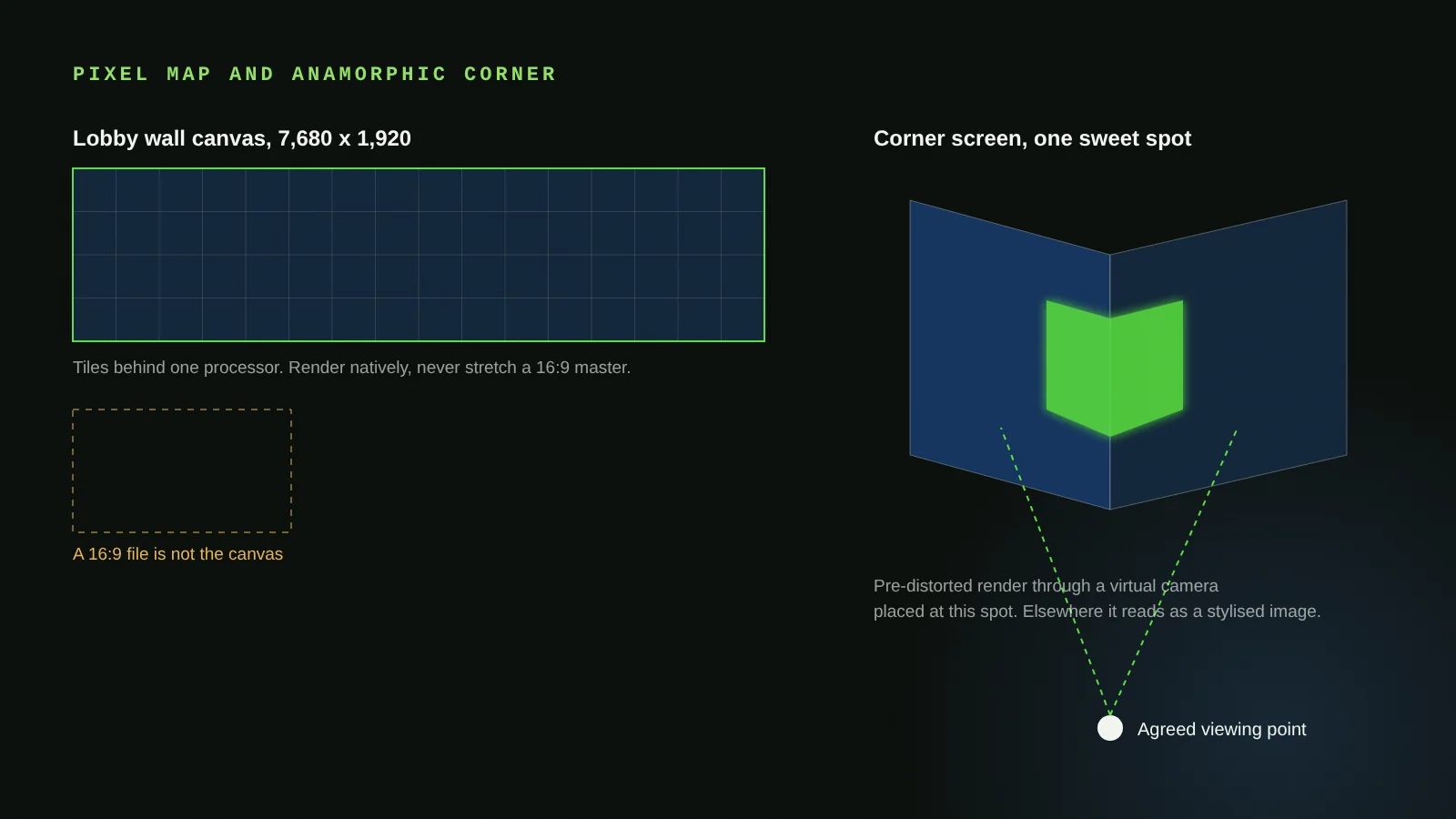
An LED wall is a grid of tiles behind a processor. The processor presents one canvas to the playback system: a width and a height in pixels that often look nothing like a TV. A long lobby wall might be 7,680 by 1,920. A corner installation might be two surfaces that meet at ninety degrees. A ceiling might be a ring. The pixel map is that canvas, plus where the physical seams and corners fall inside it.
Native masters, not stretched ones
We set the composition to the wall’s exact size from the first frame. Titles sit inside safe zones that avoid seams. Motion is designed for the shape: a wide wall wants content that travels across it; a tall one wants content that rises. The Jubail Commercial Port film was paced and composed for a large screen in a room, which is a different film from the same story cut for a phone.
Anamorphic corners
A corner LED screen, two faces meeting at an edge, can show an object that appears to break out of the wall, but only from one viewing position. The render is pre-distorted so that from that spot the perspective lines up. We agree the sweet spot with the client (usually the main approach or the camera position), model the two surfaces in 3D, and render through a virtual camera at that point. From anywhere else it reads as a stylised image, so we design the surrounding content to hold up from every angle.
Grade on the wall
LED walls are brighter than monitors and their colour differs by tile batch. A grade approved on a laptop will look different on the wall. We attend the technical rehearsal, play every piece on the installed screens, adjust brightness, contrast and timing on site, and then load the final files into the playback system ourselves. The sign-off is the wall, not the review link.
Delivery that playback systems accept
Masters in ProRes or H.264 and H.265 at the processor’s frame rate, with audio stems for the venue system. Loops for ambient content with a clean cut point. Social cuts in their own shapes, derived from the same project so the brand reads the same on a wall and in a feed.
Where it fits
- Premium media and content production
- Inauguration and launch experiences
- MIRAGE: anamorphic content production
- ZENITH: anamorphic billboard screens
Questions clients ask
What do you need from us to start?
The processor settings or pixel map, a photo of the installed wall, and the viewing position that matters most. If the wall is not installed yet, the supplier’s drawing is enough to begin.
Can you re-cut an existing film for our wall?
Sometimes. If the original project files exist we re-compose to the new shape. From a finished 16:9 master only, the options are crop or letterbox, and we will show you both before you choose.
Does an anamorphic corner work from every angle?
No. The illusion holds from one agreed position. We design the content so it still reads well from everywhere else.
How long does screen content take?
Films typically three to five weeks from approval. Loops and ambient content faster, scoped with a real timeline at the brief.
More technical stories
- How a cylindrical hologram works: from CAD file to exhibition floor
- Designing touchscreens for an exhibition floor: glare, gloves and the two-tap rule
- Offline first: how we build event applications that survive the venue Wi-Fi
- Hand tracking on a stand: when touchless beats touch, and when it does not
- VR safety training that scores decisions: inside the Tasnee working-at-height build
- Lead capture on a stand: the architecture behind 217 qualified leads
- Multiscreen sync: driving every display on a stand from one content panel
- Show control for launches: one trigger, a countdown that waits, no second take
- Building a physical reaction game: Unity, custom circuits and a one-minute clock
Start with a conversation
Send the pixel map and the date. Media and content production WhatsApp FAIM
Joby Thuruthel / FAIM
Found this useful?