Games and engagement
Interactive games and audience engagement solutions
A good stand game gives people a reason to stop, a reason to queue and a reason to remember the brand. A good session tool gives an audience a reason to look up from their phones. FAIM builds both: physical and digital games with live scoring, and live polls, votes and battles for rooms of fifty or five thousand.
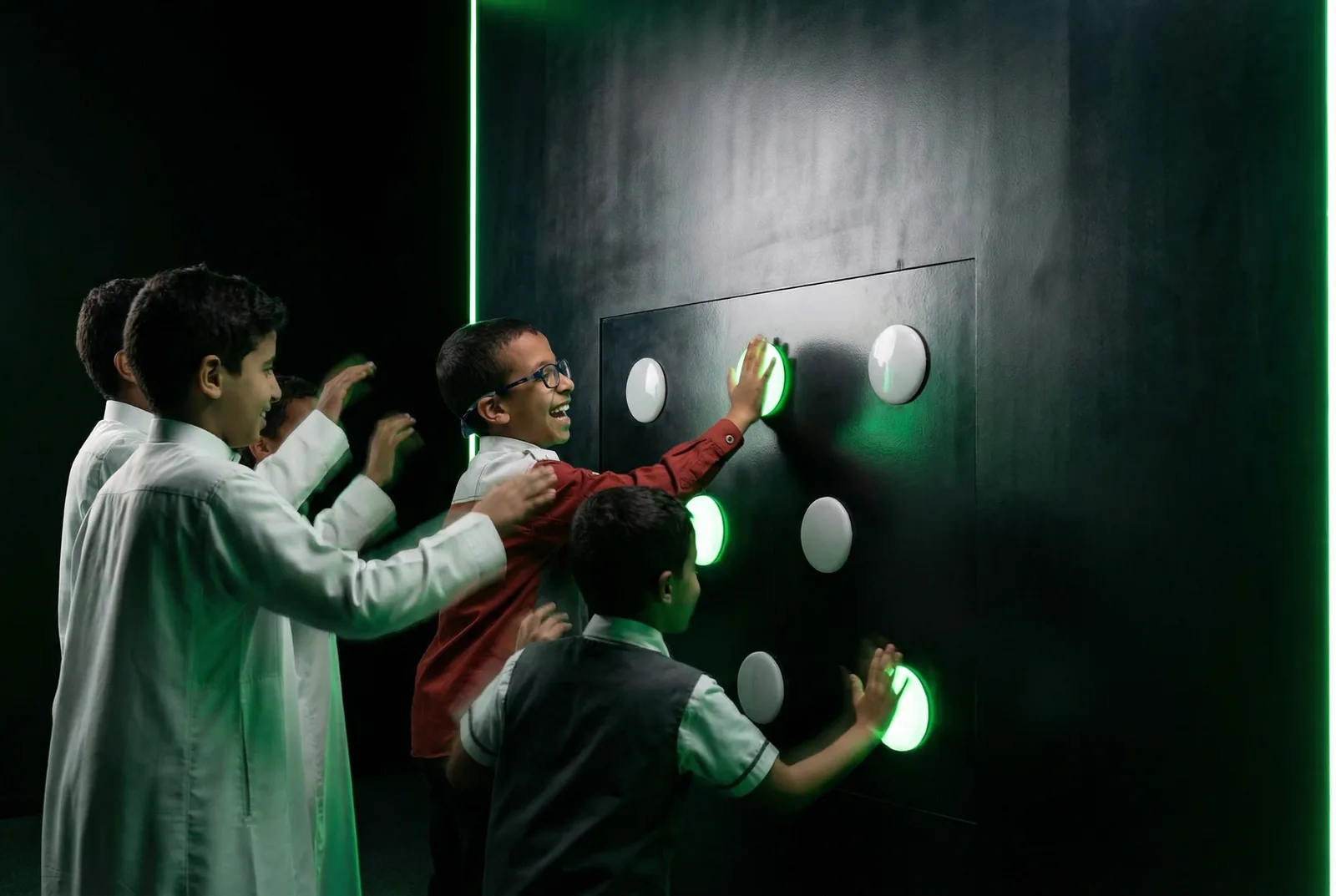
Our Al Salam Bank reaction game combined Unity, custom electronics, physical controls and live scoring on a one-minute clock.
Home / Solutions / Interactive Games and Audience Engagement Solutions
The problems we solve
-
The stand has a giveaway and a queue of people who want the giveaway, not the brand.
A game that carries the message: the questions, the targets and the scoring are built around what you want remembered.
-
A tablet quiz that nobody notices.
Physical games, light-strike walls, boxing pads, goal walls and motion games that are visible from across the hall and loud enough to draw a crowd.
-
Three hundred people in a session, all on their phones.
Live polls, votes and head-to-head battles on their own phones, with results on the big screen in real time.
-
The game ran all day and you have no idea who played.
Every play is scored and timestamped, with a leaderboard, prize draw and consent-based capture at the end.
-
A rented arcade machine with someone else's branding.
Custom built. Software, physical controls and the arena itself designed for the brand.
Why FAIM
- We build the software and the hardware: Unity, custom electronics, physical controls and the arena.
- Our Al Salam Bank reaction game is a working reference, not a mockup.
- Scoring and capture are built in, so engagement turns into a lead list and a prize draw.
- You can play REFLEX, our motion game, in a browser today.
- Arabic and English on every screen, and a FAIM technician on the floor for the whole run.
The technical space
Every FAIM system has the same four parts. What the visitor touches, the FAIM application that runs it, what comes out, and the panel your team controls it from. Data moves along the connectors in both directions, on a local network, with no dependency on venue internet.
Player inputButtons, pads, motion cameras, touch, phones by QR.
FAIM game engineUnity, scoring rules, timers, branding, bilingual UI.
OutputScore screen, leaderboard wall, lights, sound, prize draw.
Admin and dataSession logs, leaderboard export, capture, dashboard.
How it works, step by step
- Message first
We start with what a player should remember, then design a game mechanic that makes them repeat it.
- Mechanic and arena
Reaction, motion, strength, knowledge or hunt. The physical form is designed with the mechanic.
- Build
Unity game, custom electronics and controls, scoring rules, leaderboard and capture flow.
- Playtest
Tested for difficulty, duration and queue flow, so one play takes about a minute and the line moves.
- Install
Arena built, sensors calibrated, sound and lights set for the venue, run through before doors.
- Run and report
Technician on the floor. Leaderboard, prize draw and lead export at close.
Custom games for stands and events
A stand game has about sixty seconds to do its job. We design the mechanic so that one play takes a minute, the queue moves, and the brand message is inside the play rather than printed on the side. Reaction walls, punch challenges, goal walls, motion games, object hunts and cybersecurity quizzes are all built to the brief in Unity, with custom electronics and physical controls where the game needs them.
Scoring is live, on a screen the crowd can see, with a leaderboard that resets per session or runs across the whole show. Every play can end with a name and a consent box, which turns a queue into a lead list and a prize draw.
Live polls, votes and audience battles
In a session or a conference, the phone in every hand is the engagement tool. We run live polls, votes, word clouds, quizzes and head-to-head battles from a QR code, with results animated on the main screen as they come in. No app, no login, and the moderator controls the pace from a tablet.
Who it is built for
- Banks, telcos and consumer brands that need a stand people queue for.
- Industrial and energy companies turning safety and cybersecurity awareness into competition.
- Conference organisers who want sessions that the audience takes part in.
- Internal events, town halls and family days that need something everyone can play.
Our games and engagement solutions
- GLADIATOR: the light-strike reaction wall, rebuilt as a branded arena.
- BLADE: fast competitive challenges that turn brand messages into play.
- REFLEX: motion and gesture control with no touch. Open the live demo.
- TITAN: a boxing-pad challenge measuring speed, power and rhythm.
- VALIANT: an interactive goal wall that tracks every shot.
- HELIOS: an interactive sensor ball for team games.
- VOYAGE: a point-based QR scavenger hunt through every zone of a venue.
- CITADEL: cybersecurity games that teach threat awareness through competition.
- PULSE: live votes, polls and battles for audiences in a session.
- FRESCO: a digital graffiti wall that lets visitors leave their mark on the stand.
Features
- Branded mechanics. Targets, questions, timers and visuals built around the message, not a reskin.
- Physical and digital. Custom electronics, buttons, pads, cameras and arenas alongside the software.
- Live scoring. A visible score screen, leaderboards per session or per show, and automated prize draws.
- Motion and gesture. Camera-based games with no touch surface, playable in a suit or a thobe.
- Phones as controllers. QR-based polls, votes and hunts with no app and no login.
- One-minute plays. Designed so the queue moves and more people play.
- Capture built in. Consent-based name and contact at the end of a play, exported with the score.
- Bilingual. Arabic and English on every screen and in every question.
Technical specification
SpecFAIM standard
01Engine
Unity, built per game, with scoring rules, timers and branding managed in an admin panel.
02Controls
Custom electronic circuits and physical controls, light-strike targets, pressure pads, depth cameras for motion, touch, phones by QR.
03Displays
Score screen and leaderboard on 55 inch and larger screens or LED walls; sound and lighting cues tied to play.
04Audience tools
Browser-based polls and battles from QR, moderator tablet, results animated on the main screen in real time.
05Data
Per-play logs with score, time and optional capture; leaderboard export; prize-draw log.
06Languages
Arabic and English standard.
07Connectivity
Stand games run on a local network. Phone-based audience tools need venue Wi-Fi or mobile data for the audience only.
08Footprint and power
Standard 220V. A reaction wall arena needs about 2.5 by 2.5 metres; motion games about 3 by 3 metres with a clear play zone.
09Lead time
Minimum five to ten working days from approval and advance for an adapted game. New mechanics with custom hardware typically run four to six weeks.
On-site support
Games get played hard. We build the arena, calibrate sensors and lights, test the queue flow and brief your staff on running a prize draw. A FAIM technician is on the floor for the whole show to reset, repair and keep the leaderboard honest. At close you get the scores, the capture list and the draw results.
- Arena build, sensor calibration and playtest before doors.
- Technician on the floor for the full run, with spare controls and compute.
- Moderator support for live polls and battles in sessions.
- Leaderboard, capture and prize-draw export at close.
Proof from real events
We designed and built an interactive reaction game for Al Salam Bank. Players react as lights blink in sequence and press the right buttons within a one-minute countdown, with a dedicated screen showing the live score and remaining time. It was built in Unity with custom electronic circuits and physical controls. Our VR safety training for Tasnee used the same scoring approach, tracking decision accuracy and reaction time for more than 200 participants.
How a FAIM project runs
- Conversation. You tell us the event, the audience and what a player should remember.
- Written scope. A scope with line-item pricing you can adjust: game, arena, screens, days on site.
- Build. Mechanic, software and hardware built and playtested, in Arabic and English.
- On site. A member of FAIM commissions the game and stays on the floor.
The client owns the delivered assets. FAIM retains its own underlying tools, frameworks and reusable systems.
Questions clients ask
Are the games branded?
Yes. Every game is built for the specific brief, with the message inside the mechanic, not printed on the side.
Can people play without touching anything?
Yes. REFLEX and other motion games use cameras and gesture. You can open the REFLEX demo in your browser.
Do live polls need an app?
No. The audience scans a QR code and plays in the phone browser. The moderator controls the pace from a tablet.
Do you deliver in Arabic?
Yes. Bilingual Arabic and English delivery is standard.
Do you attend on site?
Always. A member of FAIM commissions and stands by every installation we deliver.
Related solutions
- AI-powered exhibition booth, the stand the game sits in.
- AR and VR experiences, for competitive VR with a leaderboard.
- Web and application development, for custom scoring and capture systems.
Technical stories
How we build it, in detail, with the case studies and a small interactive lab in each.
- Building a physical reaction game: Unity, custom circuits and a one-minute clock
- Hand tracking on a stand: when touchless beats touch, and when it does not
- From the floor to the memory: the FAIM story
Insights
Where this kind of work is heading, and how we would approach it.
- Points for saying hello: how leaderboards make networking easier
- Why grown-ups play: the psychology behind gamification at events
- Out of the seat: turning passive attendees into active participants
- Pixels on a building: when retro games meet projection mapping
Start with a conversation
Send the event date, the venue and what a player should walk away remembering. Message us on WhatsApp or email info@faimglobal.com. You can also open working demos in our Experience Library before you commit.