A car launch event in Bahrain needs a reveal that lands on cue, screens built for a glossy car in a glass room, and a team in the showroom who has rehearsed what happens when something slips. FAIM designs, builds and runs the reveal, the screens, the configurator and the launch show control for car distributors and their agencies in Bahrain and Saudi Arabia. Below is one showroom launch in Manama, told as a story, with a buyer checklist at the end.
The brief fitted on one slide. A car distributor in Manama was launching a new seven-seat SUV in its own showroom on a Wednesday evening. About two hundred guests: fleet buyers, a handful of motoring journalists, loyal customers and their families.
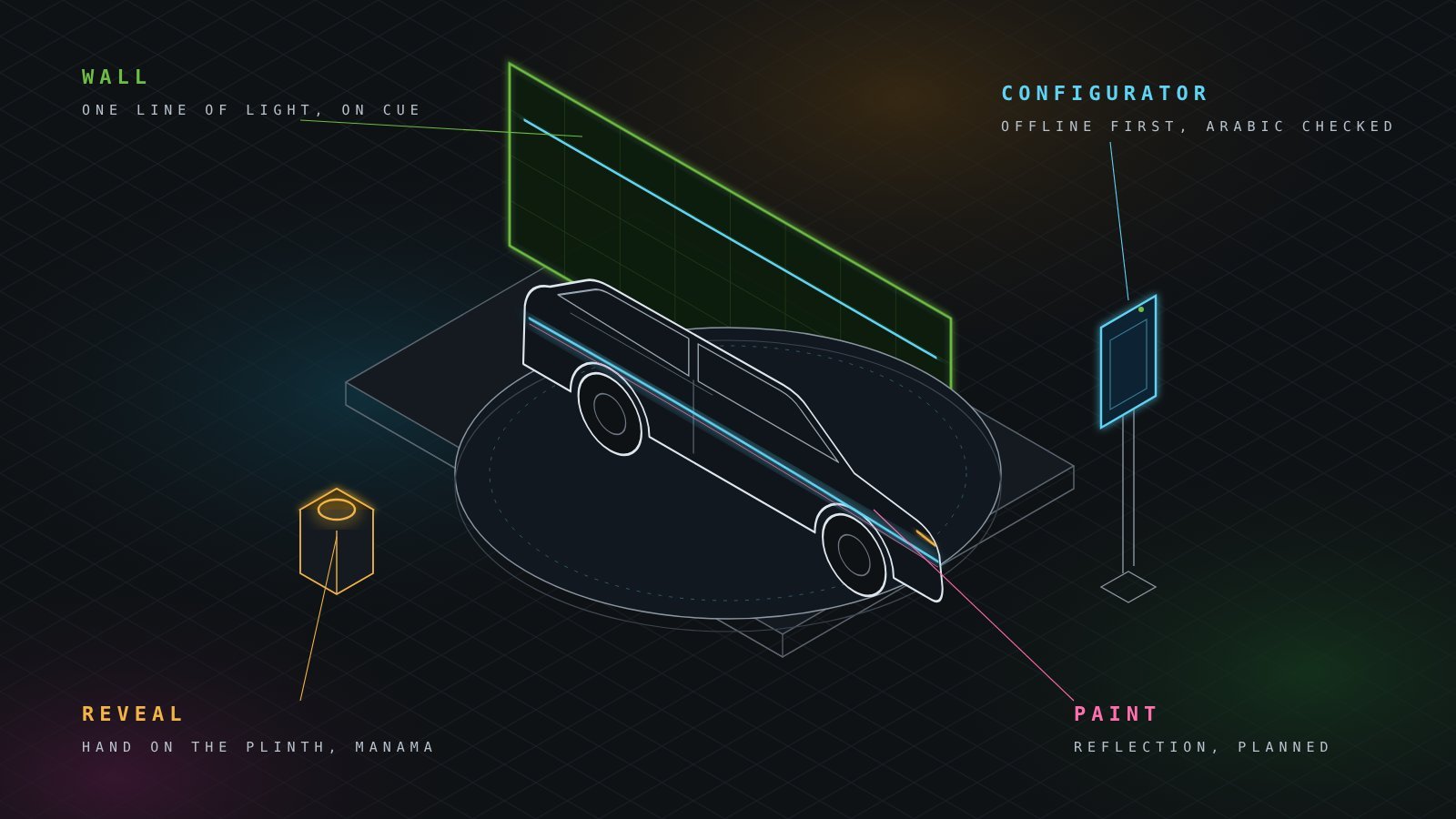
The render was lovely. The car sat on a low turntable under a grey silk cover, a wide LED wall behind it, and a touchscreen configurator off to one side where guests could choose a colour and leave their details.
“The hardware’s booked,” the marketing manager told us. “We need someone to make the screens do something.”
Five weeks out. Enough time, if nothing hid in the details. Something usually does.
What does a car launch event in Bahrain actually need?
Less than people fear, and more than the render shows. A cover comes off. A wall changes. Somebody presses something. Under that sits a run of small questions nobody has been asked: who gives the cue, what the wall shows while the speeches run long, what the configurator does when two hundred phones join the guest Wi-Fi at once.
We asked for the boring things first. The showroom floor plan. The wall’s processor resolution. The electrical layout. And the paint colour of the car being revealed.
That last one surprised them. It mattered most.
The wall that appeared on the bonnet
The launch colour was a deep metallic black. On a car like that, every bright thing in the room shows up as a reflection. Lighting designers who work in showrooms will tell you the same: polish sells, but a ceiling of light points mirrored in a bonnet is rarely the look anyone wanted.
We mocked up the scene with the real wall dimensions and the turntable’s position. With the planned content playing, a big white logo animation behind the car, the wall reappeared as a bright rectangle stretched across the bonnet and both front doors. In photographs it would have looked like a smudge of overexposed light right where the badge sits.
Moving the wall was not an option. So we changed what it showed and when. Before the reveal, the wall stayed dark and warm, with slow movement low in the frame. At the moment of the reveal it would run a single thin line of light from left to right. Reflected in the paint, that line would travel along the side of the car like a highlight on a studio photograph.
The photographers would get the badge, and a highlight they had not asked for.
The configurator that wrote the speed backwards
The distributor sent us the spec sheet in both languages. Our first build of the configurator pulled it straight in.
English was fine. On the Arabic side, one line came out scrambled. The acceleration figure, a number, a unit in Latin letters and another number, rendered in the wrong order once it sat inside a right-to-left sentence. It read like a different car.
Mixed direction text does this. Arabic flows right to left, numbers and Latin units run left to right, and a screen has to be told exactly where each run starts and stops. We isolated every figure and unit, and our Arabic-speaking producer read every screen on the actual kiosk. She found one more: a warranty line where the kilometre figure had jumped to the wrong end.
The price that could not be shown
Nine days before the launch, an email arrived from the brand’s regional office. The price was embargoed until the following Sunday. Nothing on any screen could show it.
The configurator had prices in three places. The guest’s summary card. The comparison screen. The email guests would receive after leaving their details.
Because the content lived in one panel rather than inside the app, this was a twenty-minute change. The price field became “Ask our sales team tonight”, with a callback option. Nobody reprinted anything. The distributor’s sales manager liked it more than the original, because it sent guests to his people instead of to a number.
What if the showroom Wi-Fi fails during a car launch?
Rehearsal was the evening before, with the client’s staff playing guests. Twenty minutes in, the caterers arrived and plugged two hot cabinets into the wall behind the bar. The breaker went. Half the showroom went dark, including the circuit feeding the LED processor.
Better then than the next night. The venue’s electrician moved the catering onto its own feed. Our playback machines already sat on a protected supply, so when the wall came back it picked up on the same frame.
On the night itself, the guest Wi-Fi gave up around ten minutes after the doors opened, as two hundred phones tried to post the same video. We had expected that. The configurator ran on its own local network and saved every entry on the device first, syncing later. Guests never saw a spinner.
Consent got a screen of its own. One box for a callback about the car, a separate one for future offers. A guest who ticked neither still got their colour choice as a picture on their phone.
The cover that caught a mirror
The reveal itself was simple on paper. The distributor’s general manager would put his hand on a lit plinth. The countdown would finish, the line of light would run, the cover would lift away and the turntable would start.
At rehearsal, the cover caught on the passenger wing mirror and hung there like washing on a line. Two staff walked in to free it, in full view of the empty chairs.
The fix had nothing to do with software. The event company folded the mirrors in for the reveal and added two light guide cords inside the silk. We ran the pull six more times until it came off clean every time.
We also made sure nobody depended on that one moment going perfectly. Our operator held the countdown, not a timer. If the speech ran long, the number would wait. A manual backup sat under her other hand in case the plinth sensor did not fire.
Seven minutes past eight
The speech ran four minutes long. The countdown held at ten.
The general manager finished, stepped across and laid his hand on the plinth. Our operator watched him, not the screen. The number dropped, the showroom lights dipped, and a single line of white crossed the wall from left to right.
It crossed the car too. For a second the line ran down the black flank of the SUV, over the front wheel arch, along the doors. Then the silk slid away and the turntable began to move.
The journalists in the second row had their phones up already. In the pictures they posted that night, the line sits right along the paint.
Later, by the configurator, the sales manager was scrolling the list of callbacks. He asked whether the same set could travel to their showroom in Al Khobar.
This story is a composite drawn from common situations at car launch events in Bahrain and Saudi Arabia, not a single client project.
Before you book a car launch event in Bahrain
- Has anyone checked how the screens will reflect in the car’s paint, from the angles guests and cameras will see?
- Who gives the reveal cue, and does the countdown wait if a speech runs long?
- Is there a manual backup if the reveal trigger does not fire?
- Has the cover pull been rehearsed on the real car, with mirrors and aerials accounted for?
- Are the screens, playback and catering on separate power, with protected supply for playback?
- Will the configurator and lead capture keep working when the guest Wi-Fi fails?
- Has an Arabic reader checked every spec, figure and unit on the actual screen?
- Can prices or specs change two days out without rebuilding the app?
- Is consent asked clearly, with separate choices for a callback and for future offers?
Planning a car launch in Bahrain or Saudi Arabia?
Send us the date, the showroom or venue, the car’s colour and the running order as it stands. A single proven reveal system can be ready in five to ten working days from approval and advance payment. A connected setup with reveal, film and screens on one show control takes about four to six weeks. Our team is on the ground in Bahrain and Saudi Arabia, bilingual Arabic and English is standard, our builds are offline-first with redundant inputs and automatic recovery, and a member of FAIM commissions and stands by every installation we deliver. You can try some of our products on the live demo hub, and our price list gives estimates, with your final price confirmed in a written quotation.
Start the conversationWhatsApp us+973 3557 7062
Or email info@faimglobal.com.
Related reading: show control for launches: one trigger, a countdown that waits, how we build event apps that survive the venue Wi-Fi and the myhome SuperApp launch, where a touch application gave a digital product a physical front door.
Questions buyers ask
What does FAIM do at a car launch event in Bahrain?
We design, build and run the reveal trigger, the countdown, the screen content, the configurator and the show control, and we stay in the room on the night. Hardware such as LED panels often comes from the venue or an AV supplier.
How far ahead should we book?
A single proven reveal system needs five to ten working days from approval and advance payment. A connected launch with reveal, film and screens on one show control takes about four to six weeks.
Can the VIP trigger the reveal?
Yes. A touch, a press or a hand on a lit plinth can start the reveal. An operator holds the countdown, and a manual backup is always ready.
Will the configurator work if the showroom Wi-Fi fails?
Yes. Our event applications are offline-first. Entries are saved on the device and synced later.
Can specs and prices appear correctly in Arabic?
Yes. Bilingual Arabic and English is standard, and an Arabic reader checks every figure and unit on the actual screen before the event.
Sources
- Lumenpulse: How dealerships use lighting to sell cars (reflections of light points on car bodywork, daylight and positioning)
- W3C Internationalization: Languages using right-to-left scripts (Arabic direction and mixed direction text)
- Legislation and Legal Opinion Commission, Kingdom of Bahrain: Law No. 30 of 2018 on Personal Data Protection (official text)
- DLA Piper: Data protection in Bahrain (summary of consent rules under the PDPL)
- FAIM FAQ (offline-first builds, spares, on-site commissioning, lead times)
Found this useful?