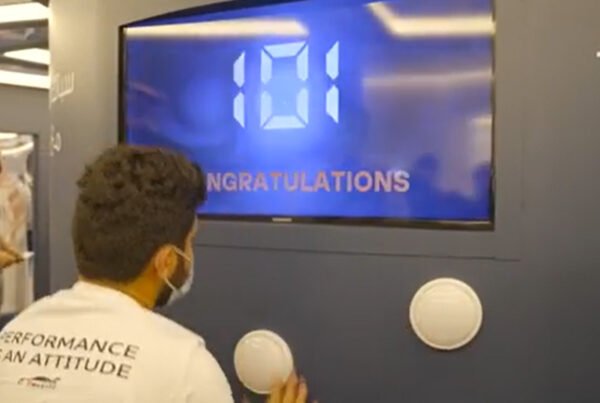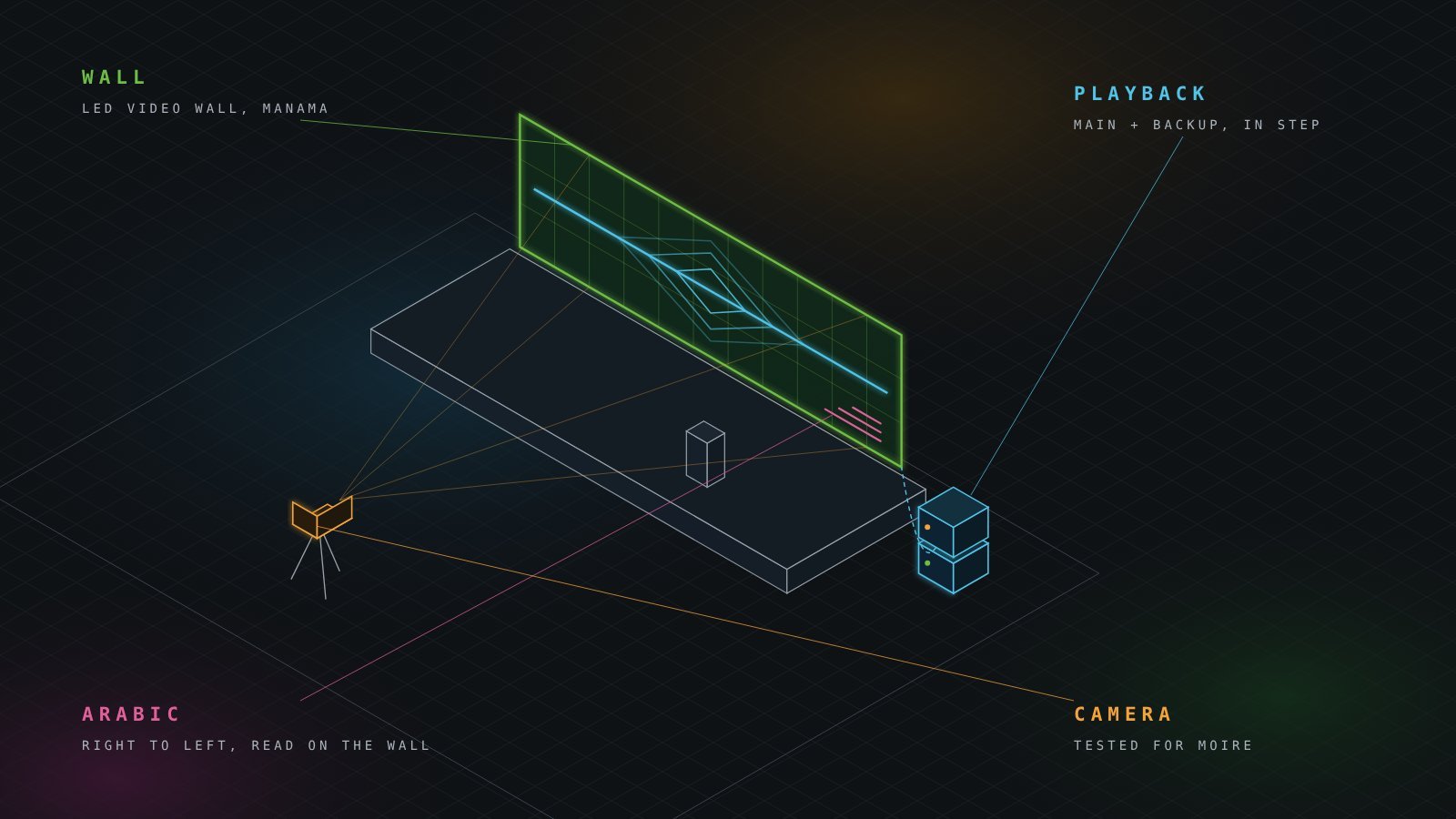
An LED video wall in Bahrain is only as good as the people who program it and run it on the day. FAIM programs, operates and supports LED video walls for conferences, launches and exhibition stands in Bahrain and Saudi Arabia, working beside the venue or AV supplier who provides the panels, through our smart event technology team on the ground. Below is one partner conference in Manama, told as a story, with a buyer checklist at the end.
The call came from a marketing team in Riyadh, three weeks out. They were bringing their regional partners to a hotel ballroom in Manama for a one-day conference. Three hundred guests, eleven speakers, a product reveal before lunch and a livestream for the people who could not travel.
“The wall is sorted,” the marketing manager said. “The hotel’s AV company is putting in a big LED screen behind the stage. We just need someone to make it look good.”
That sentence usually means the wall is the only part that is sorted.
A wall is panels, a processor and a power feed. What appears on it, in which order and in which language, and what happens when it drops out mid-keynote, belongs to nobody until someone owns it. We do not rent walls. We program them, run them and stay in the room.
Who actually runs an LED video wall at a conference?
Here, nobody had been asked. The AV company would install the panels and leave a technician to watch the hardware. Speakers would bring slides. The agency had a reveal film. In between sat a hundred small decisions with nobody’s name against them.
So we asked for the dull documents first: the processor’s output resolution, the panel layout, the pixel pitch, and a stage plan with the front row marked.
The wall was wide and short, nearer four to one than sixteen to nine. The front tables, kept for the most senior partners, sat a few metres from the stage. One common rule of thumb multiplies the pixel pitch in millimetres by ten to get a comfortable viewing distance in feet. By that rule, the front row was close enough to see the pixels in small type.
Nobody changes panels three weeks out. We changed the type instead. Names got bigger, fine print came off the wall, and detailed charts moved to the side screens and the livestream.
The slides arrived in the wrong shape
Eleven speakers meant eleven decks, all built in sixteen to nine. On a four to one wall, a normal slide sits in the middle like a postcard pinned to a billboard.
We built one show file for the whole day. Each speaker became a block of cues: a walk-up with their name in Arabic and English, their slides framed by the brand’s own animated background, and a hold state for questions. The slides stayed exactly as the speakers made them. Everything around them filled the wall.
That mattered later.
Why the Arabic names broke on the lower thirds
The speaker list came as a spreadsheet. Our first test render pulled the names straight from it into the graphics template.
English looked fine. Two of the Arabic names came out as separate letters with the word order reversed. The template had been built left to right, and the text engine was not shaping Arabic. On a laptop preview it was small enough to miss. Behind a stage, three metres tall, it would not have been.
We rebuilt the template with a right-to-left layout for the Arabic side, set the Arabic in a font that joins properly, and had our Arabic-speaking producer read every name on the actual wall at rehearsal.
The cable that worked until it did not
The hotel’s plan put the control desk at the back of the ballroom, a long cable run from the processor behind the stage. At rehearsal the night before, the wall blinked to black twice in twenty minutes. A second each time. The technician’s processor showed nothing wrong.
A long video run can pass a bench test and still be marginal in a full room. We did not want to find out during the keynote.
We moved our two playback machines to a rack beside the processor and controlled them over the network from the back. Main and backup played the same show in step, so the processor could switch to the backup without the audience ever knowing it existed.
No more blinks.
Why the wall shimmered on the livestream
On the morning itself, the livestream crew framed the lectern and the wall behind it crawled with rippling colour on their monitor. Nobody in the room could see it.
That is moiré: the camera’s sensor grid and the wall’s pixel grid interfering. The brand background, full of fine diagonal lines, made it worse.
The camera moved back and zoomed in, and the operator opened the aperture so the wall fell softer behind the speaker. We swapped in a speaking version of the background with the fine lines removed. The room barely noticed. The stream stopped shimmering.
What happens if the LED wall loses power mid-keynote?
At 9:40, eleven minutes into the first keynote, a power fault somewhere in the building dropped the ballroom for a moment. The house lights flickered, and the wall went black.
Three hundred people looked up at the ceiling.
Our playback machines sat on their own protected supply and never stopped. When the processor came back, the wall picked up on the same slide, the CEO’s name still in the corner in both languages. He made a joke about the weather in Riyadh and carried on.
The late change at 11:20
Forty minutes before the reveal, the client’s events lead came to the desk. The regional director’s flight had landed late. Could he swap with the speaker after lunch?
Each speaker was a block of cues, so it was a drag and a save. We checked the new order on preview and told the stage manager.
The coffee break brought a second request: put the guests’ photos from the morning on the wall. They had been sending pictures by QR code since registration. Our team approved each one before it reached the screen, which is how a photo of a partner who had asked not to be filmed never appeared.
The reveal
At midday the room went dark. The wall held one thin line of light across its full width. Our operator was not watching the clock. She was waiting for a word the CEO had agreed with us at rehearsal.
He reached it. She went.
The line split, the wall filled from the centre out, and the product turned slowly inside twelve metres of light, its Arabic and English names drawing in together. The front row leaned back in their chairs.
At lunch, the marketing manager came over with her phone. A partner from the front table had sent her a photo of the wall, no caption. She wanted to know if we could do the same thing in Riyadh in March.
This story is a composite drawn from common situations with LED video walls at conferences in Bahrain and Saudi Arabia, not a single client project.
Before you book an LED video wall in Bahrain
- Who owns what appears on the wall, cue by cue, and who is in the room to run it?
- Do you have the processor’s output resolution and panel layout, so content is built to the real shape of the wall?
- Has someone checked the pixel pitch against where your front row sits, and sized the text to suit?
- Are Arabic names and titles built right to left and checked on the wall by an Arabic reader?
- Is playback close to the processor, with a backup machine running the same show in step?
- Does playback have its own protected power, and will the show hold its place if the wall goes dark?
- If the event is filmed, has the background been tested on camera for moiré?
- Can the running order change on the day without rebuilding the show?
- If guest photos or messages go on the wall, who approves them first?
Have an LED wall booked but nobody to run it?
Send us the date, the venue, the wall’s size and processor details if you have them, and the running order as it stands. A minimum build is five to ten working days from approval and advance payment. Our team is on the ground in Bahrain and Saudi Arabia, bilingual Arabic and English is standard, our builds are offline-first with redundant inputs and automatic recovery, and a member of FAIM commissions and stands by every installation we deliver. You can try some of our screen products on the live demo hub, and our price list gives estimates, with your final price confirmed in a written quotation.
Start the conversationWhatsApp us+973 3557 7062
Or email info@faimglobal.com.
Related reading: rendering content for LED walls and anamorphic screens, driving every screen from one content panel and the Interactive HUB at Aramco EXPEC, where one content service drove every display on the stand.
Questions buyers ask
Does FAIM rent LED video walls in Bahrain?
No. We program, operate and support LED video walls. The panels usually come from the venue or an AV supplier, and we work beside their team on content, playback and show control.
What does FAIM do with an LED wall at an event?
We build content to the wall’s real shape, run playback with a backup machine, handle Arabic and English graphics and stay in the room for the event.
Why does an LED wall look strange on a livestream?
Usually moiré: the camera’s sensor grid interferes with the wall’s pixel grid. Camera distance, focus and simpler backgrounds behind speakers reduce it.
Can you show Arabic text on an LED wall correctly?
Yes. Bilingual Arabic and English is standard. Arabic is laid out right to left in fonts that join correctly and checked on the wall by an Arabic reader.
How much notice do you need?
A minimum build is five to ten working days from approval and advance payment. A full conference show with custom content needs longer, so contact us early.
Sources
- Planar: What is pixel pitch and why does it matter? (pixel pitch and the ten times rule of thumb for viewing distance)
- Panasonic: How to manage the moiré effect for live productions (why LED walls cause moiré on camera, and shooting fixes)
- W3C Internationalization: Languages using right-to-left scripts (Arabic direction and letter joining)
- FAIM FAQ (offline-first builds, spares, on-site commissioning, lead times)
Found this useful?