A camera experience is the easiest way to pull a crowd at LEAP 2027 and the easiest way to get a stand into privacy trouble. Process the camera on the device, ask before you keep anything, and plan the build back from 12 April.
The first email arrived on a Tuesday afternoon with a video attached. Forty seconds long, filmed on a phone in an office in Riyadh.
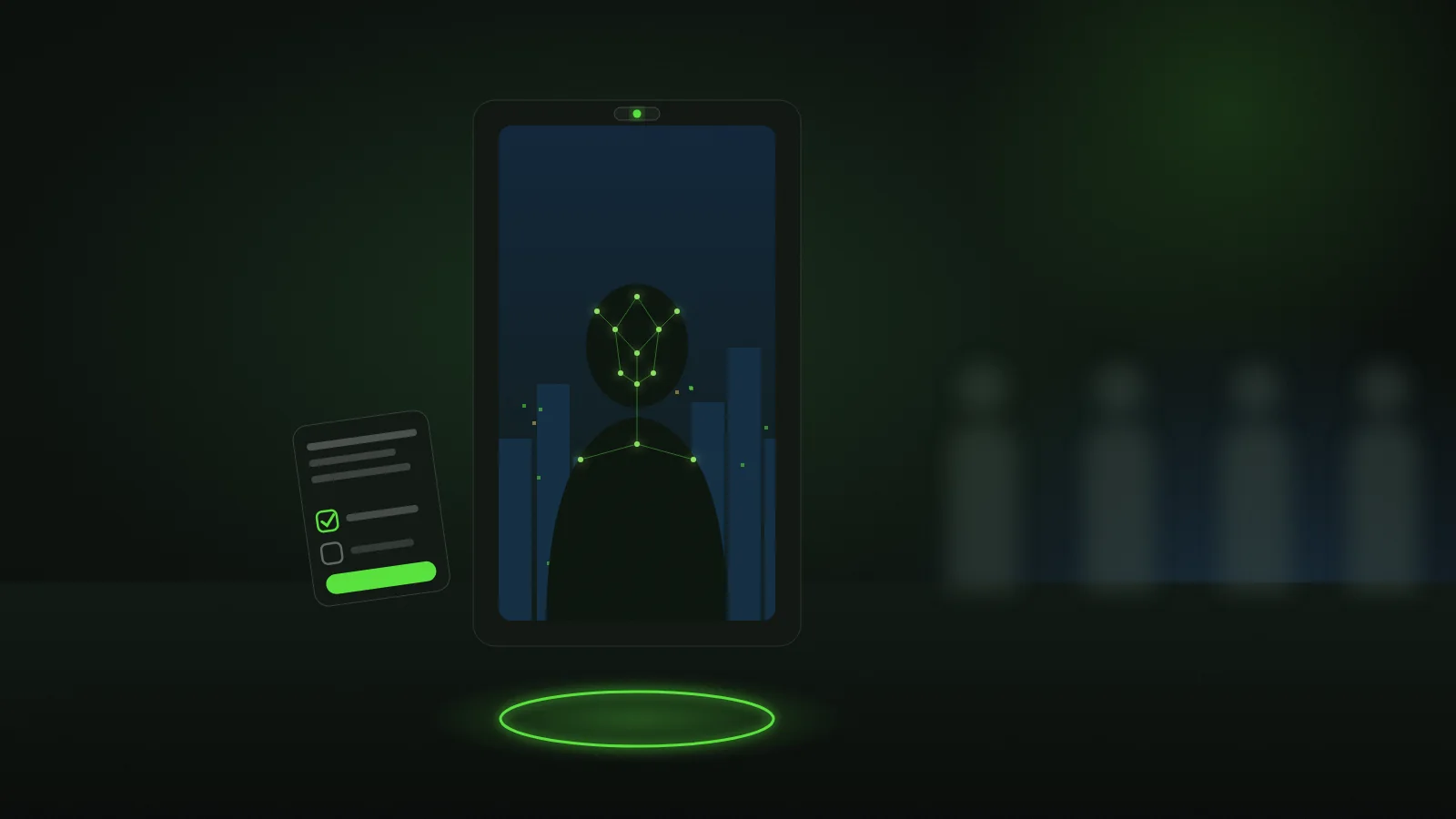
In the video, a man stands in front of a tall portrait screen. The screen shows him back to himself, but the office behind him has gone, replaced by a glowing city at night. A label floats over his head with a guess at his age and his mood. Then a message pops up on his phone with the picture.
The sender was an events director at a software company. They had space booked at LEAP 2027, which runs from 12 to 15 April 2027 at the Riyadh Exhibition and Convention Centre in Malham. The video showed a prototype another supplier had put together. She wanted it finished, branded and bilingual, and she wanted to know if we could do it.
We could build it. I watched the clip three times anyway, and what I kept looking at was the people walking past in the background.
Where do the faces go?
On the first call, I asked one question. When a visitor stands in front of the mirror, where does the picture of their face go?
Nobody on the call knew. The prototype worked, so nobody had looked.
We asked for a copy and ran it in our workshop with the network traffic logged. Every frame from the camera was being sent to a cloud service for the age and mood guess. Everyone in shot, not only the person playing. The visitor had agreed to nothing, and the people walking behind them did not even know there was a camera.
Saudi Arabia’s Personal Data Protection Law has been fully enforced since September 2024, overseen by the Saudi Data and AI Authority. Bahrain has had its own data protection law since 2019. We are not lawyers, and we said so on the call. But you do not need a lawyer to see the problem with a stand that quietly films a tech crowd and posts it to a server nobody can name.
The camera can see a visitor without anyone keeping their picture. Tracking runs on the stand’s own machine, live, and nothing is saved until the visitor chooses to keep a photo.
Rebuilding the mirror around a yes
We rebuilt the core so the face and body tracking ran on a PC inside the stand. The city effect needed that tracking, but it did not need a recording. Each frame was used to draw the effect and then thrown away.
We already work this way on our own demos. Our live jewellery try-on runs the tracking inside the visitor’s browser and sends no photo or video anywhere. The mirror used the same thinking, just on bigger hardware.
A photo now only existed if the visitor asked for one. A short screen came first, in Arabic and English, explaining what the photo was for and how long it would be kept. Getting marketing emails was a separate tick box, empty by default. Saying no to marketing still got you the photo.
The events director pushed back on one point. Her CEO loved the age and mood label. It was the bit everyone laughed at in the office.
We pointed out that guessing a stranger’s age and mood on a public screen is the kind of joke that lands well with colleagues and badly with a senior visitor from a government delegation. Then we offered a swap: the visitor picks their own city style from three options with a wave of the hand. People laugh just as much when they choose, and nobody gets labelled.
The CEO agreed by the end of the week.
The walkway problem
Two weeks into the build, we set the mirror up in the workshop and walked past it at a normal pace, the way people move down an aisle.
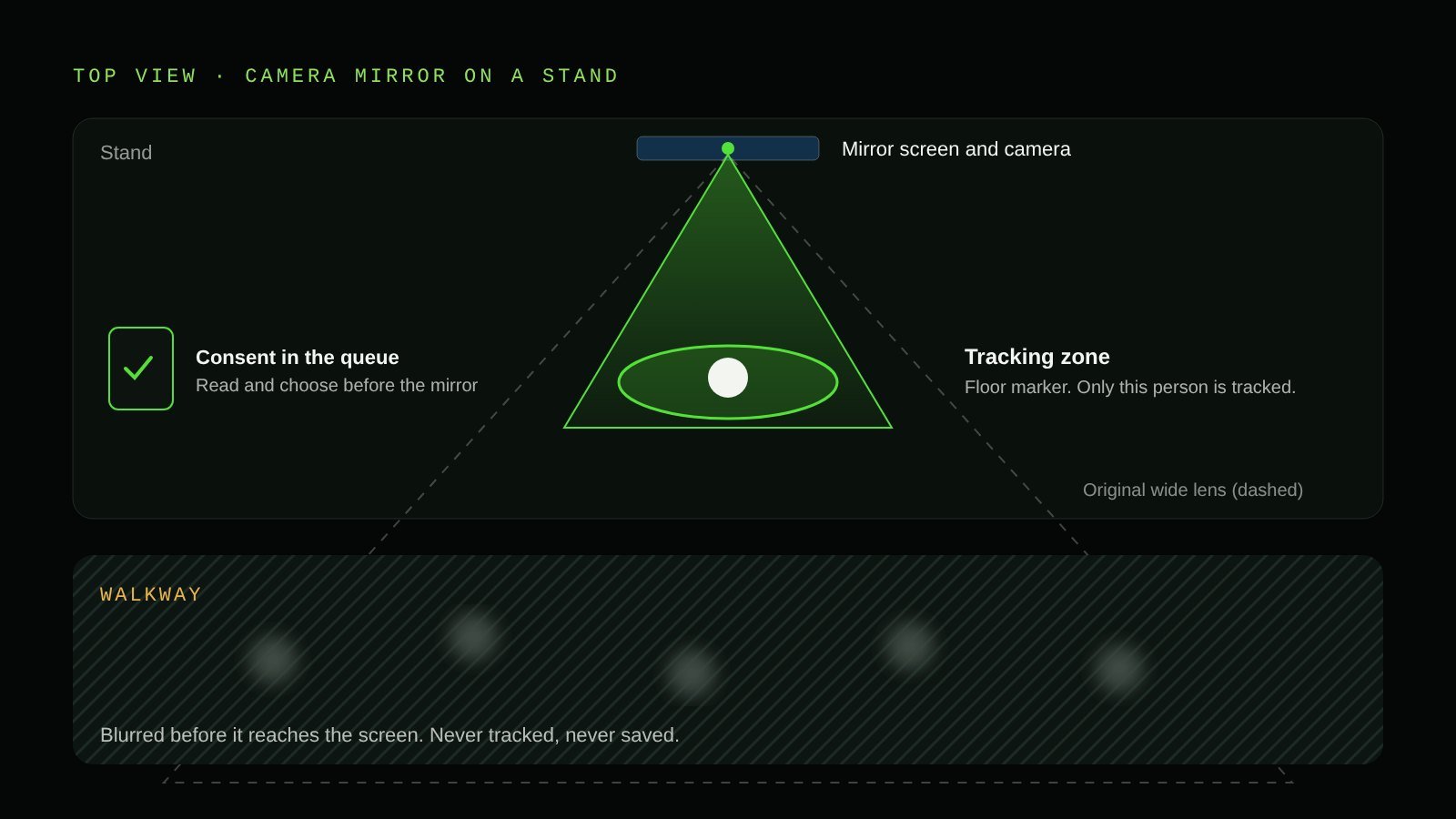
The wide camera picked up everyone within about four metres, including people who were clearly walking past. The tracking locked onto a colleague carrying a box. On a show floor, that would be a stranger appearing in somebody else’s photo.
We changed the camera lens to a narrower one, set the tracking zone to a marked spot on the floor, and blurred everything outside that zone before the image ever reached the screen.
The phone number that read backwards
Arabic testing found the next fault. We had native Arabic readers go through the consent screen, and one of them stopped at the WhatsApp field.
In the Arabic layout, the phone number was displaying with the country code at the wrong end. The digits were correct, but they looked wrong, and a visitor typing their own number would have started deleting it to fix it. The tick box for marketing had also drifted to the left of its label, which made it unclear which line it belonged to.
On a consent screen, unclear is a real problem. We forced the number field to run left to right inside the Arabic page, moved the box back beside its sentence, and had the same readers go through it again.
Rehearsal day
Three weeks before the show, the company staged a full rehearsal in their Riyadh office with a couple of hundred staff, the screen at full height and a queue rope.
Two things happened in the first hour.
The office network slowed to a crawl as everyone joined it on their phones, and the photo messages stopped going out. The mirror itself kept running because it never needed the internet. Photos people had chosen to keep sat in an encrypted queue on the stand PC and went out in order once the line came back. Nobody lost a picture. We have written more about this in our post on event applications that survive the venue Wi-Fi.
The second thing was the queue. Each turn took a little over a minute, and most of that was people reading the consent screen with someone waiting behind them. So we moved it. A staff member with a tablet walked the line and let people read and choose before they reached the mirror. At the screen, a visitor only had to wave.
A slow consent screen is a queue problem. Move it earlier in the line and keep every word of it.
The request that came late
Ten days before load-in, the marketing team sent one more idea. Could visitors find their photo later on a gallery page, by uploading a selfie and letting the system match their face?
It meant storing face data for every visitor, for weeks. That is a different project with different risks, and it was ten days away.
We said no to the face matching and suggested something simpler. Each kept photo gets a short code printed on a small card, and the code opens that one picture. No matching, no stored faces. Marketing ended up liking the card, because it went home in people’s pockets.
Show week
Every installation we deliver is commissioned by someone from FAIM, who stays with it. For this one, that meant our team in Saudi Arabia on site from build-up, with a spare camera and a spare PC in a case under the counter.
On the floor plan, the stand opposite had a large LED wall facing ours. We had planned for that weeks earlier, with a matte film on the mirror screen and a few degrees of tilt, so the reflection fell to the carpet and not across the visitor’s face.
The days were busy and technically quiet. At closing each evening, the team ran the deletion check the company’s data protection lead had asked for: no unconsented images anywhere on the machine, kept photos held only for the period promised on the screen. The log went to her by email before the hall lights went down.
The events director told us later that she spent almost all of the show talking to buyers. She checked on the mirror twice, both times because people were laughing at it.
This story is a composite drawn from common situations we see on camera-based stand experiences, not a single client project.
Working back from 12 April 2027
Our interactive stand builds typically take four to six weeks, and the minimum is five to ten working days from approval and advance payment. A camera experience also needs time for your own legal or data protection review, so it pays to start earlier than the build alone suggests.
- JanuaryBrief and data mapAgree what the experience does, what data it touches and who signs off on consent wording.
- FebruaryBuild and Arabic reviewCore build in both languages, then native readers check every consent line.
- Early MarchWorkshop testsWalk past it, leave it running overnight, pull the network cable, check the glare.
- Late MarchFull rehearsal and change freezeReal queue, real staff, then no new features.
- 12 to 15 AprilLEAP 2027Commissioned on site by FAIM, with a deletion check at every close.
Buyer checklist for camera experiences at LEAP 2027
- Ask exactly where camera frames go, and ask for it in writing.
- Prefer tracking that runs on the stand’s own hardware, with no recording unless the visitor chooses a photo.
- Keep marketing consent as its own unticked box, separate from the photo. Our post on lead capture architecture for exhibition stands covers the rest of the data flow.
- Limit tracking to a marked zone and blur the walkway.
- Have native Arabic readers review the consent screen, including number fields.
- Drop features that label visitors, such as age or mood guesses.
- Say no to late face matching. Use a printed code instead.
- Agree how long photos are kept and how deletion is proven each day.
- Test with the network switched off before you test with it on.
- Check your consent wording with your own legal or data protection adviser.
Exhibiting at LEAP 2027?
If you are planning a camera experience or any interactive exhibition stand for LEAP or another show in Saudi Arabia or Bahrain, talk to us before the build starts. We will tell you where it is likely to fail and how we would stop that happening.
Questions buyers ask
When is LEAP 2027?
LEAP 2027 runs from 12 to 15 April 2027 at the Riyadh Exhibition and Convention Centre in Malham, according to the event’s official site.
How early should we brief an interactive stand for LEAP 2027?
Our interactive stand builds typically take four to six weeks. For a camera or data-driven experience, brief in January. That leaves time to agree consent wording and still rehearse properly before the show.
Can a camera experience work without storing visitor faces?
Yes. Tracking can run live on the stand’s own machine, so frames are used and discarded. A photo is only kept when the visitor chooses one.
Do we need consent for photo booths and lead capture in Saudi Arabia?
Saudi Arabia’s Personal Data Protection Law places consent at the centre of how personal data is collected and used, and direct marketing needs opt-in consent. Check your exact wording with your legal or data protection adviser.
What happens if the hall Wi-Fi fails during LEAP?
Our builds are offline-first, with redundant inputs and automatic recovery. The experience keeps running, and anything the visitor asked to receive is queued and sent once the connection returns.
Is the experience available in Arabic?
Yes. Bilingual Arabic and English delivery is standard across our interactive applications.
Sources
- LEAP: Key information (next edition 12 to 15 April 2027, Riyadh Exhibition and Convention Centre, Malham)
- Latham & Watkins: Saudi Arabia’s data protection law enters into force (SDAIA as regulator, consent requirements, one-year transition to September 2024)
- CMS: One year anniversary of the Saudi Personal Data Protection Law (full enforcement from 14 September 2024, opt-in consent for direct marketing)
- Trowers & Hamlins: PDPL, Bahrain’s data protection regime (Law No. 30 of 2018, in effect from 1 August 2019)
Found this useful?