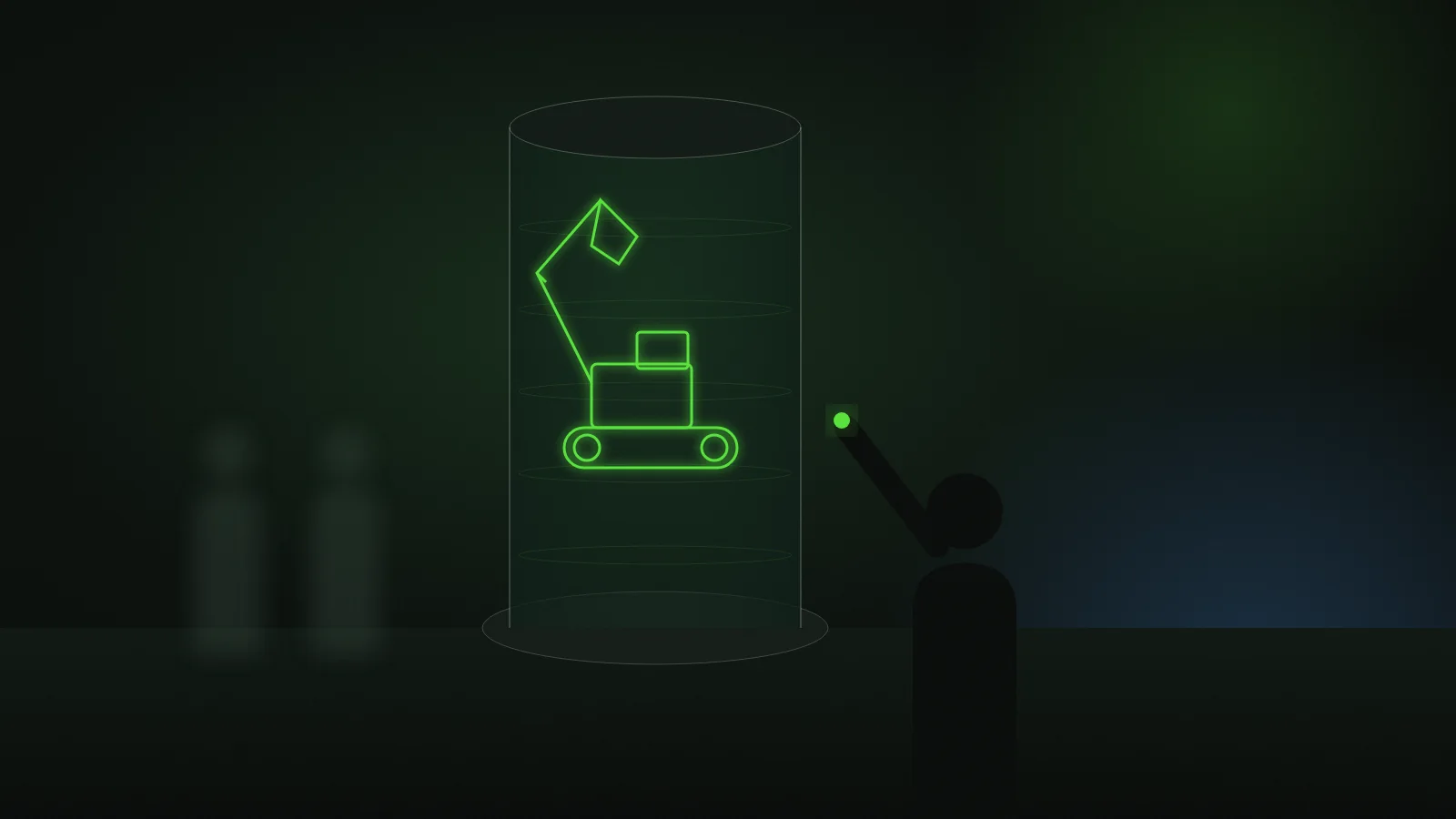
Insight · Holograms
An engineer from a contractor in the region stops at the stand, looks at a 30-tonne excavator floating inside a glass column, and reaches out to rotate the boom. He spends the next four minutes inspecting the hydraulics. Afterwards he says it felt like walking around the real machine.
The short version. A hologram earns its place when it shows something that cannot be in the room. It stops being decoration the moment people can touch it.
The problem we were asked to solve
For the interactive hologram at HEC Dhahran Expo, PWS needed to show 30-tonne excavators and crawler cranes without shipping them to the site. Flat screens were not enough, because engineers expect to inspect moving parts from every angle. The brief was a life-size, glass-free hologram that felt tactile and surfaced specifications on a gesture.
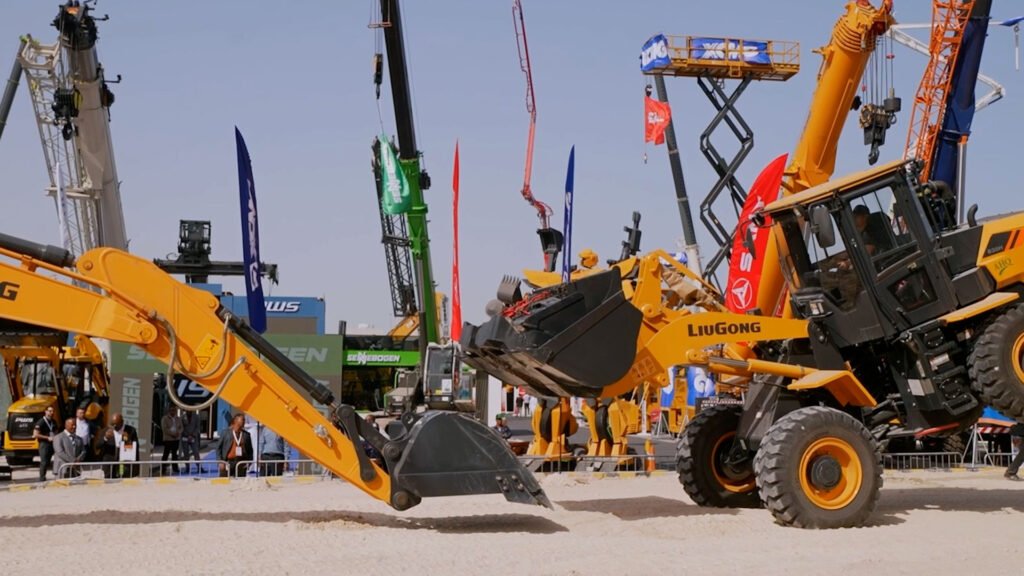
What we built
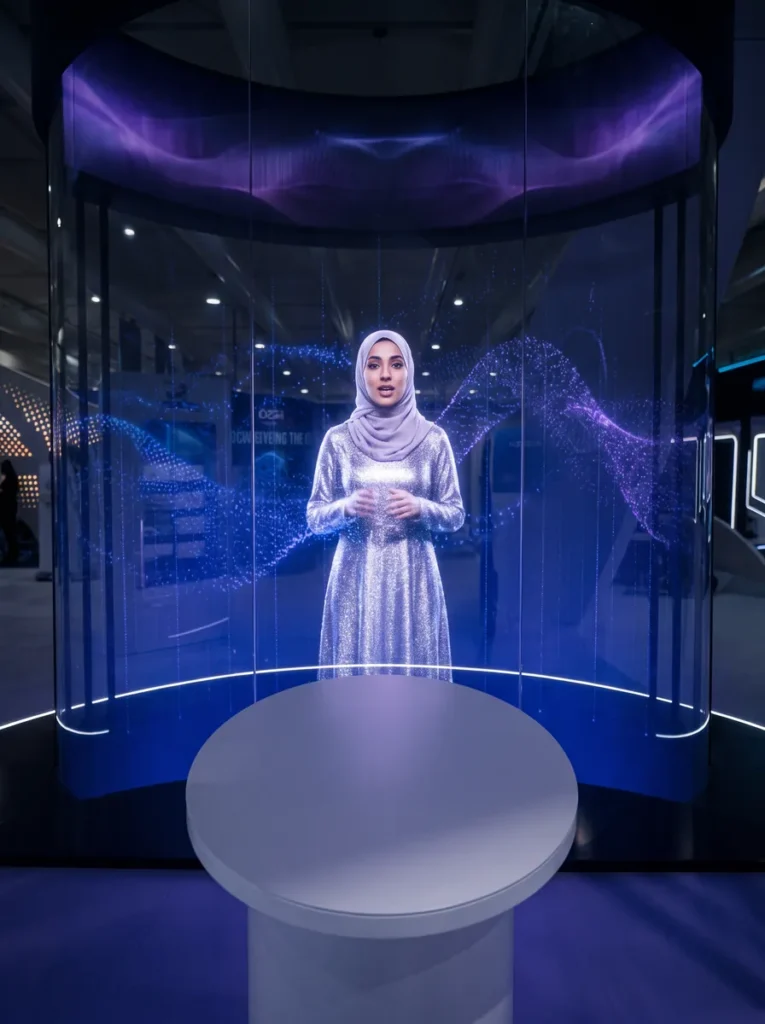
A 2.1 metre cylindrical holographic display, viewable from 360 degrees with no headset. CAD files were converted into real-time models in Unity, and hand tracking let visitors pinch to rotate the boom, air-tap to explode assemblies and hover a palm for live telemetry. Rendering ran on local hardware inside the base, so a weak venue connection never froze the model.
Try the same interaction below. Move across the stage to rotate, tap to explode.
What the floor told us
The system logged 4,187 interactions across 72 hours. The average session was 4 minutes 42 seconds, and 83 percent of sessions went all the way down to component specifications. The stand captured 217 qualified leads. Those numbers came from the hologram’s own logs, which is why we build logging into every display.
Formats beyond the column
The cylinder is one shape. PHANTOM floats a product or presenter in mid-air, SERAPH puts a life-size presenter on stage, and ORACLE lets physical objects on a table summon holographic answers. A full technical walkthrough is in our post on how a cylindrical hologram works.
Mistakes we see
- Treating the hologram as decoration. If visitors cannot change what they see, it is a looping video in an expensive box.
- Streaming the render from the cloud. A venue connection drop should never freeze the model.
- Skipping testing with real users. At HEC Dhahran we replaced a swipe-to-zoom gesture with two-handed scaling after testing with PWS field engineers.
- Not logging anything. Without interaction logs you cannot tell the client what the stand achieved.
Where it fits
- holographic displays
- interactive hologram at HEC Dhahran Expo
- ECLIPSE: the 360 degree transparent column
- NEBULA: volumetric 3D with no glasses
Questions clients ask
Do visitors need glasses or a headset?
Not for our cylindrical holograms. The HEC Dhahran column was viewable from 360 degrees with no headset.
Can you use our existing CAD files?
Yes. That is how the HEC Dhahran models were built, optimised for real-time rendering.
What happens if the venue internet drops?
Nothing visible. The model renders on hardware inside the display.
More insights
- Don’t read it, play it: inside the FAIM JARVIS Experience Library
- Walk the floor before the truss goes up: digital twins for event planning
- Light, sound and scent: designing zones people remember
- Out of the seat: turning passive attendees into active participants
- Your guests are your broadcasters: live content zones done properly
- How a cylindrical hologram works: from CAD file to exhibition floor
- Lead capture on a stand: the architecture behind 217 qualified leads
Start with a conversation
Tell us the event, the venue and what people should walk away remembering. Holographic displays WhatsApp FAIM
Joby Thuruthel / FAIM
Found this useful?