Host Arabia returns to Riyadh on 7 to 9 December 2026, with evening opening hours and live coffee on stand after stand. This is the story of a Riyadh coffee equipment distributor, a touchscreen that had to live beside the steam wands, and the night the hall network gave up.
The first thing he sent us was a photo of somebody else’s stand.
It was late October. A sales manager at a coffee equipment distributor in Riyadh had space booked at Host Arabia 2026. At another show he had seen a curved LED wall with four tablets on brass stands in front of it. He wanted the same, with his own machines on the counter.
We asked what his buyers usually wanted to know.
He took a moment. Mostly, he said, they want to know which machine to buy. A young couple opening their first café. A hotel group fitting out several outlets. A juice bar owner who has finally decided to add espresso. A bakery chain. They walk up, they taste, and then they ask how many group heads they need. His salesmen answer that question all day long, on paper napkins.
The napkin interested us more than the wall.
The training bar smelled of hot milk
We visited his showroom the following week. At the back was a training bar where baristas practised on the machines he sells. Three steam wands were hissing at once and the counter was wet from end to end.
A trainee wiped her hands on the towel tucked into her apron, then on her jeans, then picked up her phone.
Every hand in that room was damp or sticky, usually both.
Touchscreens hate that. A film of milk or a few drops of water can register as a finger, and a screen that starts tapping itself in front of a buyer looks broken even when the software is fine.
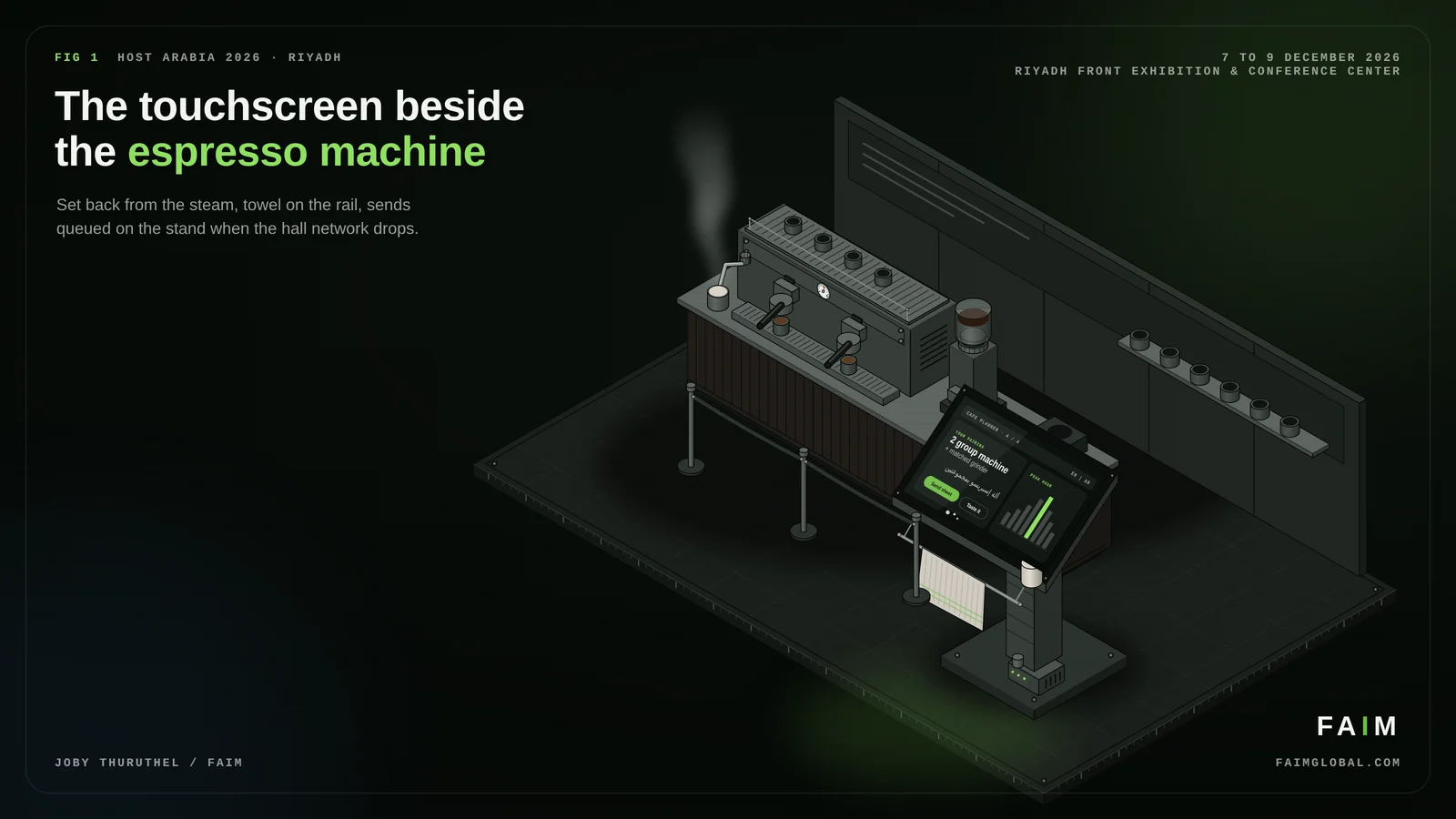
So the idea changed shape. No tablets on stands. Instead, one counter height planner, angled back like a lectern and placed at the far end of the bar from the steam. A visitor answers four plain questions: what kind of place, roughly how many cups in the busiest hour, mostly milk drinks or mostly black, and how much counter space there is. The screen suggests a machine and grinder pairing from the distributor’s own range, turns it in 3D, and offers to send a short spec sheet to the visitor’s phone. The salesman sees the same result on his handheld and carries on from there.
We also drew a towel rail under the front lip of the planner. Nobody in the approval meeting asked about it.
The Arabic that came apart
Two weeks out, we ran the planner in the showroom with the client’s own staff playing visitors.
The English side behaved. Then one of the trainers switched to Arabic, read the result screen and frowned. The machine name was fine. The description underneath it looked like a row of loose letters, each one standing on its own, like an alphabet chart on a classroom wall.
The spelling was correct. One component in the result card was rendering Arabic through a path that skipped letter joining, so characters that should connect sat apart. On a studio laptop with a different font it had looked perfect, which is exactly why nobody had caught it.
We fixed it that evening. The next morning the same trainer read every screen again, out loud, in both languages. Bilingual Arabic and English is standard in our builds, and part of that standard is a native reader checking the live system on the real hardware.
A grinder stuck at the port
Nine days before build-up, the phone rang. The new grinder he planned to launch at the show would not clear in time. He had another model he could put on the counter. Could the screen just change?
It could, because nothing was baked into the app. Products, photos, specs and the pairing rules all came from one content panel. We swapped the model, rebuilt the 3D view from the manufacturer’s drawings and ran the planner overnight through every combination of answers, to be sure the missing grinder never appeared as a suggestion.
Some version of that call comes before almost every show we work on.
Opening night, eight o’clock
Host Arabia opens at four in the afternoon on its first day and closes at ten at night. It shares the venue with HORECA Riyadh and the Salon du Chocolat et de la Pâtisserie, so by eight the aisles were thick with people carrying paper cups and pastry boxes.
That was when the hall network went. Phones around us showed full bars and loaded nothing. On the next stand, a salesman kept refreshing an online catalogue that never came back, then gave up and started describing his machines with his hands.
Our planner kept going. Our builds are offline-first, with redundant inputs and automatic recovery, so everything the planner needed to make a suggestion lived on the stand itself. Spec sheets that visitors asked for went into a local queue with a time stamp, and sent once a connection returned. The salesmen could see on their handhelds which sends were still waiting, so nobody told a visitor a message had gone when it had not.
The tick box nobody wanted
Earlier that evening the sales manager had asked for one change. Could the planner simply add every visitor’s number to the company’s WhatsApp broadcast list? It would save his team a job.
We pushed back. Saudi Arabia’s Personal Data Protection Law takes consent seriously, especially for marketing, and a café owner who asks for one spec sheet has not asked for a year of promotions. So the planner offered two separate choices in Arabic and English: send me this sheet, and, left unticked unless the visitor chose it, keep me updated about new products. We also suggested he run the wording past his own legal adviser before the show, and he did.
He was not delighted. By the second day he had stopped bringing it up.
A latte on the glass
The second day opens at two. At about half past four, a café owner set his cup on the ledge of the planner while he talked, turned to point at a machine on the back counter, and caught the cup with his elbow.
Milk ran across the bottom third of the glass.
The screen did what wet screens do. It began registering touches that nobody was making. Our technician had been standing a couple of metres away for exactly this moment. He pressed the hidden wipe button we had built in, which tells the planner to ignore touch for a short while, took the towel off the rail and cleaned the glass. The planner came back on the same visitor’s result, as if nothing had happened.
The café owner apologised. The salesman laughed and handed him a fresh cup. The whole thing took less time than pulling a shot.
A member of FAIM commissions and stands by every installation we deliver, and we carry spares. A spare glass overlay sat in a crate under the counter all three days. We never opened it, and we would bring it again.
The line at the tasting bar
The harder problem on day two was not liquid. It was the queue.
Live coffee draws a line, and a line of buyers staring at the back of the person in front is a line of buyers quietly deciding to leave. We had seen this at the showroom rehearsal, so the planner had been turned to face the end of the tasting queue rather than the aisle.
People in the line answered the four questions while they waited. By the time they reached the bar, the barista could see their suggested pairing and pull their shot on that exact machine. The salesman’s opening question stopped being “what are you looking for?” and became “shall we taste it on yours?”
On the last night, close to ten, a young couple came back who had used the planner on the first evening. They were planning a small café in a new neighbourhood in the east of the city. She had the spec sheet open on her phone. They wanted to taste the suggested machine again before deciding, and they wanted to talk about payment terms.
Nobody reached for a napkin.
This story is a composite drawn from common situations at exhibitions in Bahrain and Saudi Arabia, not a single client project.
Planning your Host Arabia 2026 stand
Host Arabia 2026 runs from 7 to 9 December at Riyadh Front Exhibition & Conference Center, organised by Fiera Milano and Semark. Hours on the organiser’s site are 4pm to 10pm on 7 December and 2pm to 10pm on 8 and 9 December. Our interactive stand builds typically take four to six weeks, with a minimum of five to ten working days, so a December stand needs a decision this month.
- This weekGet the paperworkStand drawing, exhibitor manual, build-up times and the deadline for ordering power.
- Mid NovemberApprove the ideaAgree what a visitor should do on the stand first, then what they see.
- Late NovemberArabic on the real screenA native reader checks every screen in the live system, out loud.
- First week of DecemberRehearse wet and offlineInternet off, damp hands, a spilled cup and a real queue.
- 7 December, 4pmDoors openYour supplier should be on the stand, with spares, until close.
Buyer checklist
- Where does the screen sit in relation to steam, water and the tasting counter?
- What happens when someone spills a drink on the glass, and who cleans it?
- What still works on the stand with the internet off, and what waits in a queue?
- Has a native reader checked the Arabic on the actual hardware, not a laptop?
- Can products and prices change from a content panel if stock is delayed?
- Do visitors give consent, in their own language, before any marketing message?
- Does your queue have something useful to do while it waits?
- Who from your supplier stands by the build for all three evenings?
Exhibiting at Host Arabia?
Send us your stand number and the question your sales team answers most often. We will tell you plainly what fits your space and the time left before 7 December. Our team is on the ground in Saudi Arabia and Bahrain, bilingual Arabic and English is standard, and a member of FAIM commissions and stands by every installation. You can also explore the live demo.
Start the conversationWhatsApp us+973 3557 7062
Or email info@faimglobal.com.
Related reading: designing touchscreens for exhibition floors, why event apps should work offline first and lead capture that visitors agree to.
Questions buyers ask
When and where is Host Arabia 2026?
The organiser lists 7 to 9 December 2026 at Riyadh Front Exhibition & Conference Center, alongside HORECA Riyadh and the Salon du Chocolat et de la Pâtisserie. Check the official site for build-up times and any changes.
Is there still time to plan an interactive stand for Host Arabia?
Yes, if you decide soon. Our interactive stand builds typically take four to six weeks, with a minimum of five to ten working days from approval and advance payment. A simpler build is safer than a rushed complex one.
Will a touchscreen work next to live coffee and food demos?
It can, with planning. Keep it away from steam and water, angle it so drips do not sit on the glass, give staff a way to pause touch while cleaning, and have someone on the stand to wipe it.
What happens if the venue internet fails during the evening rush?
Our builds are offline-first, with redundant inputs and automatic recovery. Content runs on the stand, and anything that must be sent, such as a spec sheet, waits in a local queue until a connection returns.
Can visitors receive product details on WhatsApp?
Yes, when they ask for it. We separate the request for one document from consent for future marketing, in Arabic and English. Check the wording with your own legal adviser against Saudi data protection rules.
Do you deliver in Riyadh if your studio is in Bahrain?
Yes. Our team is on the ground in both Saudi Arabia and Bahrain, and we carry spares and stay in the room for the whole show.
Sources
- Host Arabia official site (2026 dates, opening hours, organisers, co-located shows, product sectors)
- Zawya: Host Arabia concludes its first edition in Riyadh (first edition and announcement of the 2026 dates)
- ICE Italian Trade Agency: national pavilion at Host Arabia 2026 (dates and venue)
- Al Tamimi & Company: overview of Saudi Arabia’s Personal Data Protection Law (consent and marketing context)
Found this useful?