Saudi Founding Day is on 22 February. In 2027, Saudi astronomical calculations expect Ramadan to begin on 8 February, which would put Founding Day inside the holy month. If you are planning a mall or brand activation, plan for the night crowd, lock your Arabic content early and start the build before the year ends.
The brief arrived in the second week of November, with a mood board and a deadline that felt comfortably far away.
A marketing team from a shopping centre group in Riyadh wanted something special for Founding Day. Their mood board was beautiful. Mud-brick walls in late sun. A carved wooden door with brass studs. Dallah coffee pots, palm fronds, children in traditional dress.
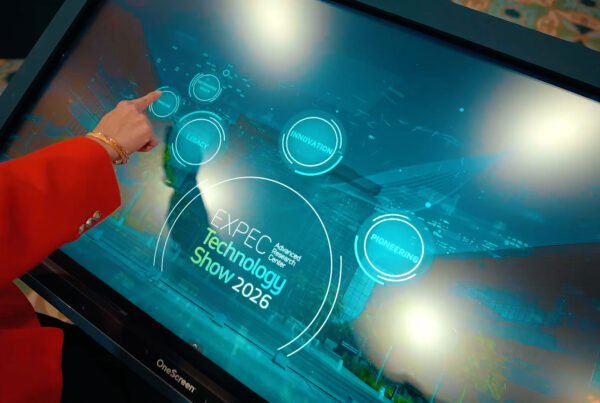
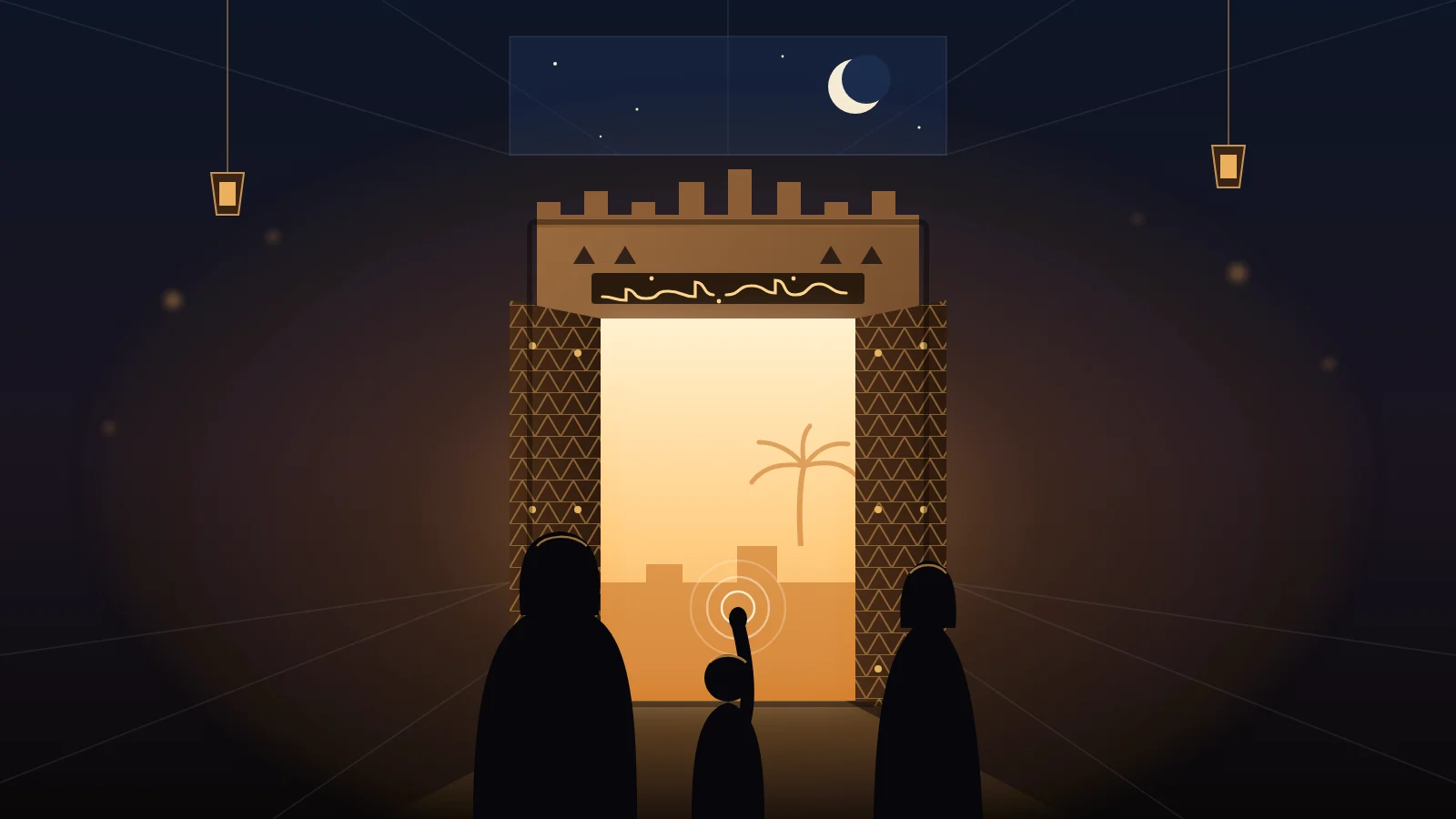
The idea was simple and good. A tall screen shaped like a Najdi door stands in the atrium. A visitor touches it and the door swings open on a short animated story of Diriyah. Then the family steps into a photo moment framed with heritage patterns and scans a QR code to take the picture home.
Three months to go. Plenty of time, they said.
We opened a calendar while they were still talking.
The date nobody had checked
Founding Day falls on 22 February every year. King Salman set the date by royal order in January 2022, to mark 1727, when Imam Muhammad bin Saud became ruler of Diriyah and began the First Saudi State.
The fixed date is the easy part. The moving part is the Hijri calendar. Saudi astronomical calculations expect the first day of Ramadan 2027 on Monday 8 February. Official moon sighting has the final word, but if that holds, Founding Day falls roughly two weeks into the holy month.
We said this on the call. There was a pause long enough to hear someone’s keyboard.
Every photo on that mood board was taken in afternoon light. During Ramadan, a mall atrium at four in the afternoon is calm, almost sleepy. The crowd comes after iftar, then again after taraweeh, and it stays late. Families arrive together, in groups of six or eight, grandparents included.
The marketing manager admitted their whole test plan had been written for a busy weekend afternoon. Staff rotas, cleaning schedules, the sponsor’s appearance, the commissioning visit. All of it pointed at the wrong hours.
So we rebuilt the plan around the night.
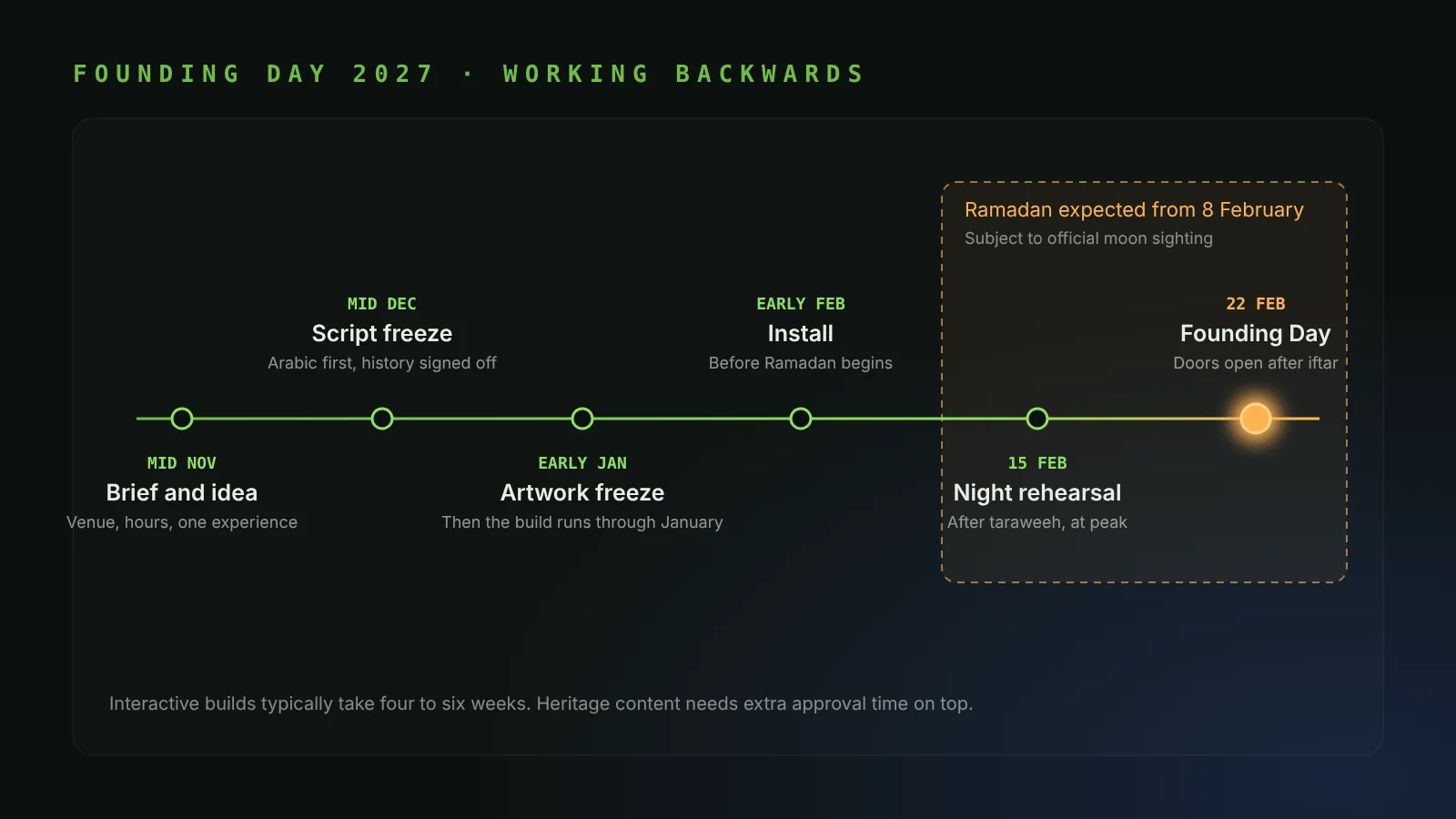
Working backwards from 22 February
Our interactive builds typically take four to six weeks. That part was never the risk here. The risk was approvals.
A heritage story needs more sign-off than a product demo. Dates, names, the shape of a window, the pattern on a door. The client’s leadership wanted to review every frame, and they were right to. Getting history slightly wrong on Founding Day would undo everything else.
We put the script first. Arabic was written first, by an Arabic writer, and the English was written alongside it rather than translated afterwards. The script froze in mid December. Artwork froze in the first week of January. The build ran through January, with installation scheduled before Ramadan began, when night access to the mall was easier to arrange.
That left February for testing at the hours that mattered.
The inscription that read backwards
The first real problem showed up in week two of the build.
The door carried a carved Arabic inscription that glowed as it opened. The animators had pulled the text straight from a design file into their render tool. On screen, the letters stood apart from each other, unjoined, and ran left to right.
Anyone who reads Arabic would have seen it from across the atrium.
We caught it early only because we put real Arabic on the real screen from the first week, never placeholder text. The fix was to set the inscription as artwork, shaped correctly, and to give the calligraphic font more line height so the upper marks were not clipped. Then a native Arabic reader went through every screen, one by one, on the actual display.
Small thing. It would have been the only thing people photographed.
Glare at two, glow at ten
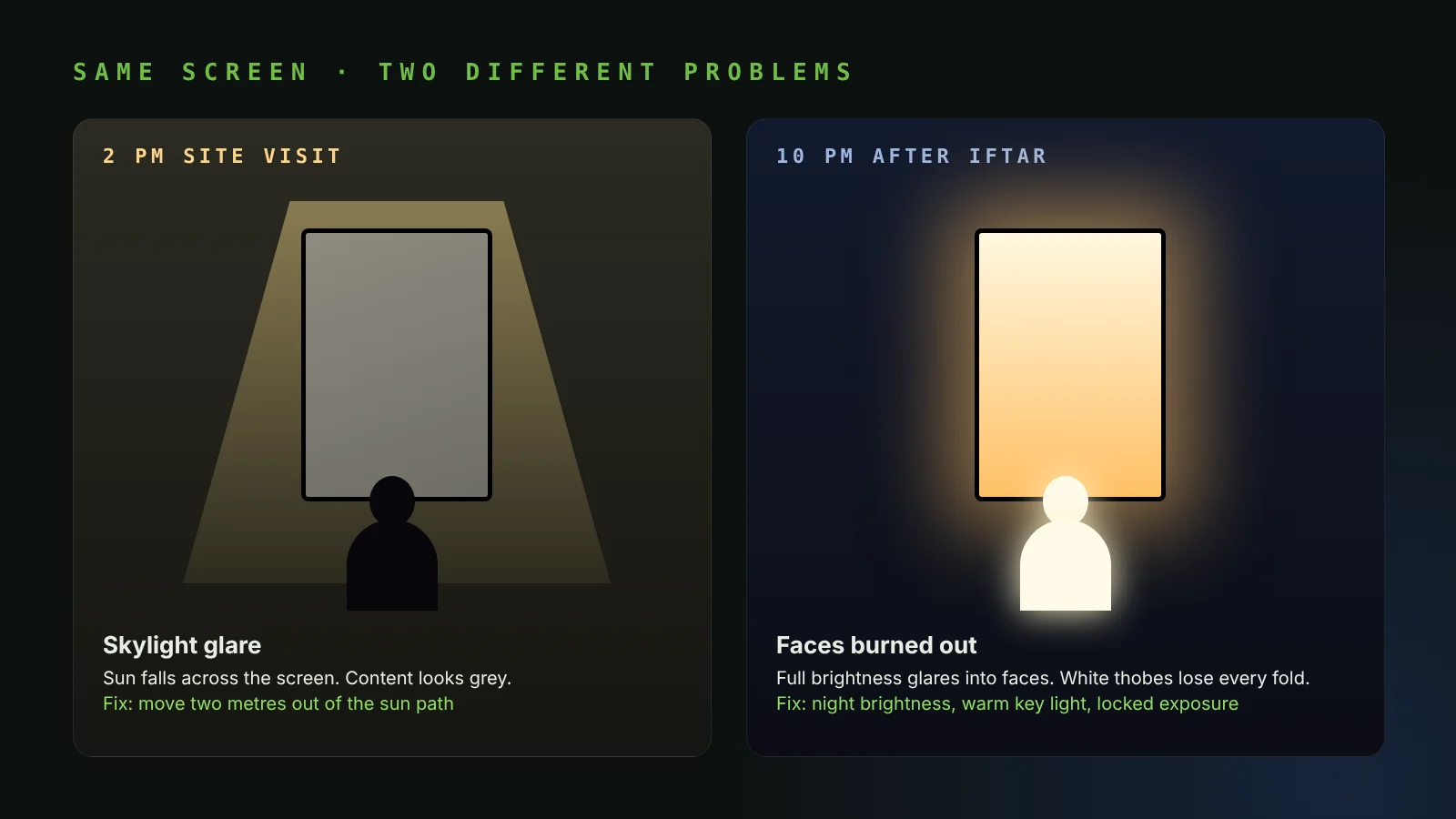
Our site visit was at two in the afternoon. The atrium had a skylight, and a bright band of sun fell straight across the spot marked for the door. The screen looked grey and tired.
The client suggested we simply move it. We moved it two metres out of the sun path. Then we came back at ten at night.
At night the problem flipped. At full brightness the screen lit faces from below and burned out the photos. A white thobe turned into a glowing shape with no folds. The gold of an abaya’s embroidery vanished.
We set a brightness schedule tied to the clock, added a soft warm key light above the photo spot and locked the camera exposure for night conditions.
Whose photo goes on the wall
The client’s first idea was to show every photo on a large screen beside the door, as it was taken.
We pushed back. These were families. Mothers, daughters, grandmothers, small children. Some would love seeing themselves on a big screen. Many would not, and nobody should find out that their picture was public after the fact.
The final design asked first. Nothing appeared on the wall unless the guest tapped yes on a clear Arabic and English screen. Families who preferred no photo at all could choose an illustrated heritage frame with their name written in calligraphy instead. Photos stayed on the local machine, went only to the person who scanned the code, and were deleted on an agreed date after the event.
The client’s legal team checked the consent screen against Saudi Arabia’s Personal Data Protection Law before we went near the floor. We have written more about this in our post on camera installations that ask first.
Rehearsal night
We ran a full rehearsal one week before Founding Day, after taraweeh, with the mall at its busiest.
By eleven, the guest Wi-Fi had slowed to almost nothing. Thousands of phones were fighting for the same signal. On a cloud-only build, the QR pages would have hung and the queue would have watched the spinner.
Ours is offline-first. The door kept opening. The story kept playing. Photos waited in a local queue and went out to guests once the connection came back. Nobody lost a picture.
Just after one in the morning, the screen went black.
A cleaning contractor had plugged a floor machine into the same circuit and tripped the breaker. The PC stayed up on its battery. When facilities reset the breaker, the screen and the application came back to the opening loop on their own. Our technician had already traced the circuit, and the mall agreed to a dedicated feed for the rest of the run.
Ten days out
Late changes always come. Ten days before Founding Day, a sponsor joined. They wanted their logo inside the door animation and a prize draw at the end.
We said yes to a clean end card after the story. We said no to touching the door animation itself. The animation was frozen and tested, and every new render meant checking the Arabic again on the real screen. The prize draw moved to a host with a tablet, away from the door, so it would not slow the line.
The queue needed its own design too. Large family groups meant longer waits, so we trimmed the story, put a second screen beside the line playing a silent version with Arabic and English captions, and let the host handle photo consent while people waited.
The night itself
On 22 February the atrium filled soon after iftar. The air smelled of cardamom coffee from the stall near the escalators. Children in small embroidered thobes and dresses ran ahead of their parents and pressed both hands flat against the door.
It opened. The inscription glowed, joined and right to left.
At one point an older man stood very close to the screen and traced a line of the calligraphy with his finger, reading it aloud to a grandson who was more interested in the photo. Most of the family chose the illustrated frame. Two of the teenagers chose the wall.
Our technician spent the evening in the corner with a spare touch frame and a spare PC in a hard case. The case stayed closed.
This story is a composite drawn from common situations we see on activations in Saudi Arabia and Bahrain, not a single client project.
Buyer checklist for a Founding Day 2027 activation
- Check the Hijri calendar against 22 February before you write the brief, and plan for the post-iftar crowd.
- Send a final brief before mid December if you want four to six weeks of build time plus content approvals.
- Write the Arabic first, with an Arabic writer, and test it on the real screen from week one.
- Visit the site at the hours you will run, not only the hours you are free.
- Ask for a written consent flow for any camera, with a no-photo option and a deletion date.
- Confirm the build works without venue Wi-Fi and runs on its own power protection.
- Agree a freeze date, and decide in advance where late sponsor changes are allowed to go.
- Ask who from the supplier will be standing by on the night, and what spares they bring.
Planning a Founding Day activation?
If you are briefing an interactive experience or a mall activation in Saudi Arabia or Bahrain for February, now is a comfortable time to start. Tell us the venue, the hours and the idea, and we will tell you plainly what fits. Our team commissions and stands by every installation, on the ground in both countries.
Start the conversationWhatsApp us+973 3557 7062
Or email info@faimglobal.com.
Related reading: how we build offline-first event applications, a Bahrain National Day mall activation that survived a power cut and building a stand that lasts through Riyadh Season.
Questions buyers ask
When is Saudi Founding Day 2027?
Founding Day is celebrated every year on 22 February, set by royal order in 2022 to mark the founding of the First Saudi State in 1727.
Will Founding Day 2027 fall during Ramadan?
Saudi astronomical calculations expect Ramadan 2027 to begin on 8 February, which would place Founding Day inside the holy month. The official start depends on moon sighting, so confirm closer to the date and plan evening hours either way.
How early should we brief a Founding Day activation?
Our interactive builds typically take four to six weeks, and heritage content usually needs extra approval time. Briefing by mid December gives a comfortable margin. Our minimum for one focused experience is five to ten working days from approval and advance payment.
Can the experience run in Arabic and English?
Yes. Bilingual Arabic and English is standard on our builds, and we test Arabic on the real screen from the first week.
What happens if the mall Wi-Fi or power fails?
Our builds are offline-first, with redundant inputs and automatic recovery. We carry spares, and a member of FAIM commissions and stands by every installation.
Is it safe to photograph visitors at a family activation?
It can be, with clear opt-in consent, a no-photo option, local storage and an agreed deletion date. Have your legal team review the consent screen against Saudi Arabia’s Personal Data Protection Law.
Sources
- Saudi Ministry of Foreign Affairs: Founding Day (22 February, 1727, Imam Muhammad bin Saud and Diriyah)
- Arab News: Saudi Arabia to celebrate Founding Day on Feb. 22 every year, says decree (royal order of January 2022)
- Jordan News: First day of Ramadan 2027 according to astronomical calculations (expected 8 February 2027, citing Saudi Hijri calendar calculations)
- Clyde & Co: Saudi Arabia’s Personal Data Protection Law becomes enforceable
Found this useful?