Technical story 10 · Interactive games and engagement
Sixty seconds. A wall of lights. A queue of people who were on their way somewhere else and are now watching a stranger’s score climb. When the buzzer goes, the stranger is grinning, the next person is already stepping up, and the brand on the wall has been in front of forty people for the length of a minute without saying a word.
This is the reaction game we built for Al Salam Bank, and the thinking behind the games and engagement page. The physical part and the software part were designed together, which is the only way a game like this holds up to a day of being hit.
The design target. One play takes about a minute. The score is visible from the aisle. The next player is ready before the current one finishes. The brand message is inside the mechanic, not printed beside it.
The mechanic
Lights blink in sequence across a set of targets. The player presses the right button as each one lights. A dedicated screen shows the live score and the remaining time, counting down from one minute. Simple to understand from across the hall, which is the point: the people watching are the next players.
Unity talks to the hardware
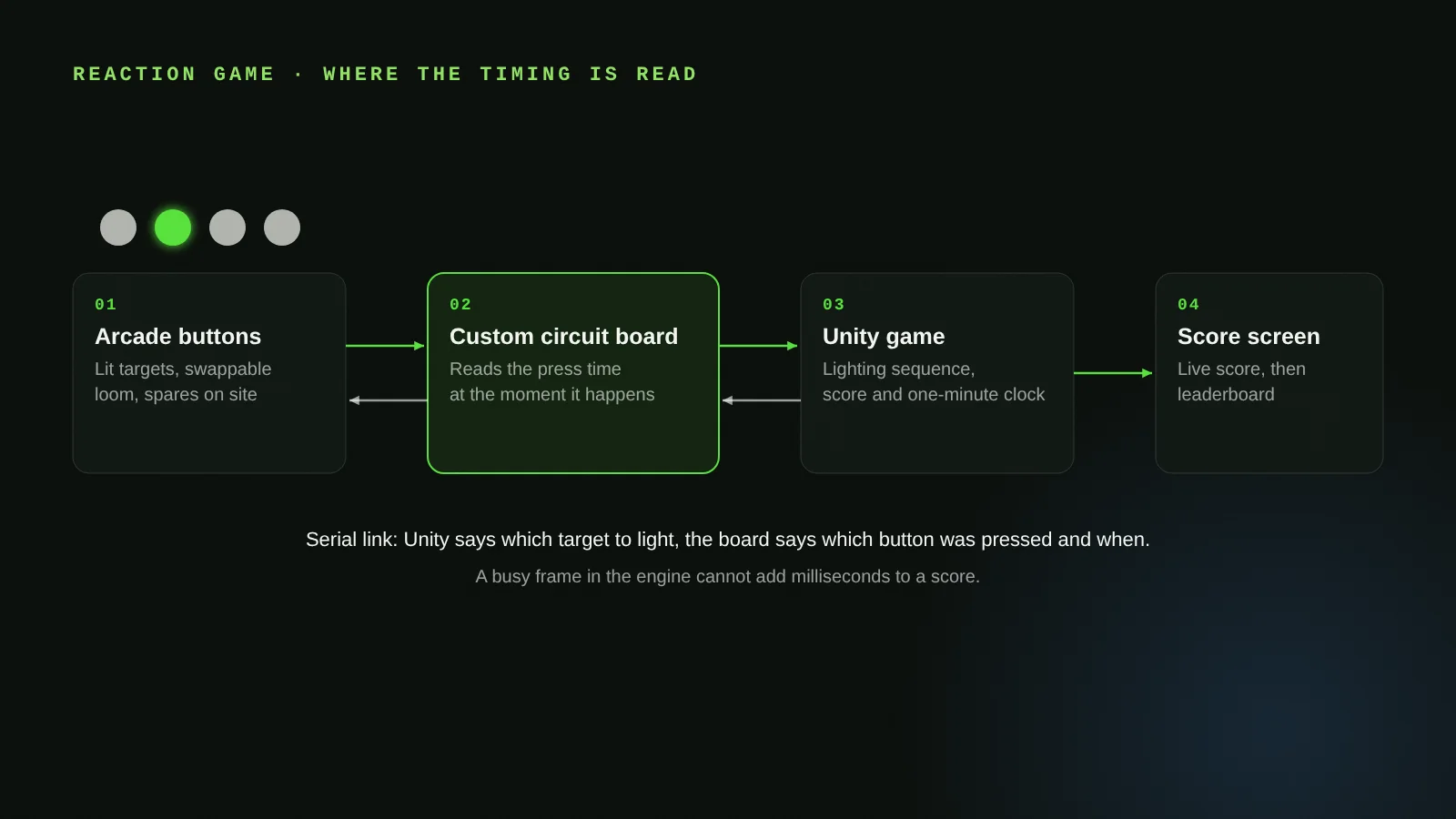
The game logic, the score screen and the lighting sequence live in Unity. The buttons and the lights live on custom electronic circuits. Between them is a serial link: Unity tells the board which target to light; the board tells Unity which button was pressed and when. Timing is read on the board at the moment of the press, so a busy frame in the engine does not add milliseconds to a player’s score. For a game judged on reaction, that detail is the game.
Physical controls that survive a crowd
Event hardware gets hit, leaned on and played by children. The buttons are arcade-grade, the targets are mounted so a miss does not bend anything, and the wiring is in a loom that can be swapped on site. We carry spare boards and spare buttons for every show, and a FAIM technician is on the floor to swap them before anyone notices.
Tuning the difficulty
Too easy and the score means nothing; too hard and people stop after one try. We playtest the sequence speed and target spacing until a first-time player scores somewhere in the middle and a second try visibly improves. That improvement is what makes people queue again, and a second play is a second minute with the brand.
Scoring, leaderboard and capture
Every play writes a record: score, time, and an optional name and contact with consent at the end. The leaderboard resets per session or runs across the whole show, and the prize draw is picked from the records automatically. The same scoring backbone sits under our VR safety training, where decision accuracy and reaction time are logged for more than 200 participants; a competitive game and a training module are closer than they look.
Branded in the mechanic
The targets, the countdown screen, the sounds and the celebration state all carry the client’s identity, and the messages a player sees between rounds are the ones the client wants remembered. A rented arcade machine with a logo sticker cannot do this. A game built for the brief can.
Where it fits
- Interactive games and audience engagement
- AI-powered exhibition booth: the play zone of a stand
- GLADIATOR: the light-strike reaction wall
- TITAN: the boxing-pad challenge
Questions clients ask
Can the game carry our safety or product messages?
Yes. The messages between rounds, the target labels and the celebration state are built to your brief, so the mechanic teaches what you want remembered.
How many people can play in a day?
With one-minute plays and a reset of a few seconds, one station handles well over a hundred plays an hour at peak. We add stations for larger crowds.
What happens if a button breaks?
A FAIM technician on the floor swaps it from spares in minutes. The electronics are modular for exactly this reason.
Does the leaderboard need internet?
No. Scoring, leaderboard and capture run on the local network. The export at close is yours.
More technical stories
- How a cylindrical hologram works: from CAD file to exhibition floor
- Designing touchscreens for an exhibition floor: glare, gloves and the two-tap rule
- Offline first: how we build event applications that survive the venue Wi-Fi
- Hand tracking on a stand: when touchless beats touch, and when it does not
- VR safety training that scores decisions: inside the Tasnee working-at-height build
- Lead capture on a stand: the architecture behind 217 qualified leads
- Multiscreen sync: driving every display on a stand from one content panel
- Show control for launches: one trigger, a countdown that waits, no second take
- Rendering for the wall: pixel maps, anamorphic corners and why 16:9 is not a plan
Start with a conversation
Tell us what a player should walk away remembering. Games and engagement WhatsApp FAIM
Joby Thuruthel / FAIM
Found this useful?