The sixth Hajj Conference and Exhibition runs in Jeddah from 8 to 11 November 2026, organised by the Ministry of Hajj and Umrah with the Pilgrim Experience Program. Some exhibitors are still planning their screens with days to go. This is a story about building one thing properly in ten working days, for a hall full of people who speak many languages, and about what the venue tried to throw at it.
The call came on a Thursday, just after Asr, from an operations manager at a ground transport company in Jeddah.
His company had a stand booked at the Hajj Conference and Exhibition. The structure was ordered and the graphics were at the printer. But the space where the screens should go was still a white rectangle on the drawing, because the supplier meant to fill it had walked away from the job that week.
He had a list. A hologram. A VR ride along the routes. A game. A photo wall for the social media team.
He also had ten working days.
We told him the honest thing first. In ten working days you can build one experience properly, or four badly. Four badly is how a stand ends up with dark screens and a printed sign that says “back soon”.
He went quiet for a moment. Then he asked which one we would choose.
One table, one morning
We asked who he most wanted to stop at the stand. Not visitors in general. Specific people.
His answer took a while. Officials who plan the season, and Hajj missions from other countries looking for reliable partners on the ground. Hotel and catering operators came up later, almost as an afterthought, though they depend on his buses more than anyone.
None of them needed a ride. They needed to see how his company moves people on the hardest days of the season, and to believe it.
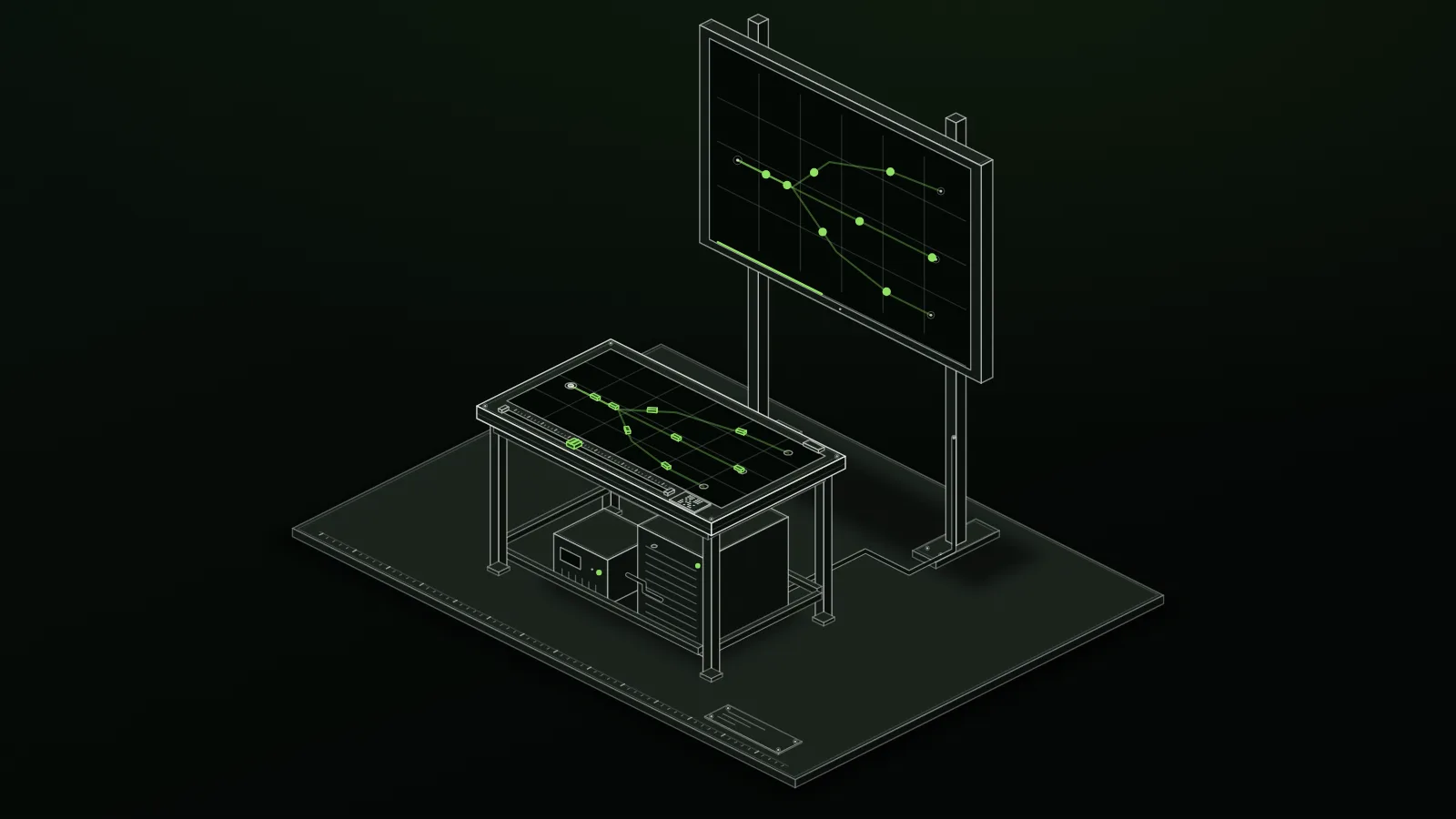
So we proposed a single touch table. A map of the routes between the holy sites, with a timeline along the bottom edge that you drag with one finger. Move it forward and the fleet moves with it, bus by bus, hour by hour, through the night and into the morning. Behind the table, a large wall screen would mirror everything at full height, so people at the back of a crowd could follow what the person at the front was doing.
He said yes before we finished the sentence. The finance approval took a little longer, which is normal, and the clock started the following Sunday.

The bus that left before it arrived
On day four, the Arabic version broke in a way nobody could see on a laptop.
Every route on the map had a code, a Latin letter with a number. On the real touchscreen, in Arabic mode, some of those codes and departure times shuffled themselves inside their labels. Right-to-left text and left-to-right text were arguing on the same line. One bus appeared to depart after it arrived.
A small bug. Also the first thing an Arabic-speaking official would spot, and the last thing you want them to.
We test bilingual layouts on the actual screen that goes to the hall for exactly this reason. The fix took an afternoon. Every code and every time was wrapped so it keeps its own direction, and then every label was checked again by a colleague who reads Arabic first.

More languages, two days out
Two days before build-up, the client’s team came back with a new idea. Exhibitors and visitors would come from well over a hundred countries. Could the table also speak Urdu, Bahasa, Turkish and French?
It was a generous instinct, and a risky one.
Bilingual Arabic and English is standard across our interactive applications. Adding four more languages in forty-eight hours would mean translations nobody had reviewed, shown to the very people who speak them, in front of their own officials. A wrong word about a sacred journey is not a typo anyone laughs off.
So we argued for the opposite. Make the table speak less. The map, the moving buses, the clock and a few clear icons tell the story without words. The labels stay in Arabic and English, checked twice. A QR code on the table edge opens a short summary page, which the client can translate properly after the show and grow over time.
He agreed. I think he was relieved.
Light from above
Build-up night in Jeddah. The hall smelled of carpet glue and cut aluminium.
Our technician walked a slow circle around the table with the hall lights at full show brightness, stopping wherever a visitor might stand. From two sides, the ceiling fixtures sat right on the glass. The map vanished under a white smear.
We have met this on other floors. A screen lying flat catches every light in the roof. That is why a matte anti-glare film lives in our spares case, and why the table frame was built to tilt a few degrees. With the film on and the top tilted, he walked the circle again. The smear shrank to a soft sheen at the very edge, where nothing important lived.

Opening morning
The doors opened, the aisles filled, and the hall Wi-Fi gave up within the first hour.
Across the aisle, a presenter kept refreshing a video that would not load. Our table did not notice. Every map and every frame of animation lived on the machine under the table. The only thing that needed a connection was the QR summary, and that loaded on the visitor’s own phone over mobile data.

Around midday the client’s social media lead arrived with a camera on a small rig. She wanted to film faces as the fleet swept across the map.
We understood why. It would make a good clip. But the hall was full of officials and delegations from many countries, and plenty of them would not want their faces on a company’s social channels. In Saudi Arabia, images of people are personal data, with obligations under the Personal Data Protection Law.
We moved the camera. It looked down at the table, at hands on the glass and buses spreading along the routes. It made a better clip anyway. A small card in Arabic and English said what was being filmed. If the team wanted a face, they asked first.
The wall went dark
Mid-afternoon on the second day, a stand two rows away overloaded a shared circuit and our corner of the hall dropped.
The table computer sat on a small UPS and kept running. The wall screen, fed from the stand builder’s distribution board, went black.
A delegation of around twenty people was standing in front of it.
When the power came back, so did the wall. We set every display we install to switch itself on and pick up its feed without anyone touching it, part of the automatic recovery built into our installations, and the presenter carried on from where he had stopped. Most of the delegation assumed it was a transition.
That evening we asked the stand builder to move the wall onto protected power. Then it went into our own pre-show list, underlined.

One finger, slowly
That delegation taught the presenter something too. Twenty people cannot share one table, so that night we built a guided mode: one tap from the presenter and the morning plays itself across the map at a calm pace while he talks over it. From then on, delegations watched the wall while he drove.
By the final evening the aisles had thinned. Cleaners were already working the far end of the hall, and the carpet near the entrance had gone grey with four days of footsteps.
An older man from one of the visiting delegations came to the table on his own. He ignored the timeline. He put one finger on the map and followed a single route from one end to the other, slowly, the whole way, the way you might trace a road you once walked yourself.
Then he nodded to the presenter and went to find the rest of his group.
The anti-glare film turned out to be the only spare we opened all week.
This story is a composite drawn from common situations we see on stands and events in Bahrain and Saudi Arabia, not a single client project.
Buyer checklist for a short-notice stand at the Hajj Conference and Exhibition
- Pick one experience you can finish and test, rather than several you cannot.
- Name the visitors who matter most, and design for what they need to see.
- Test Arabic and English on the real screen, especially codes, times and numbers inside Arabic text.
- Add another language only when a native speaker has reviewed every line.
- Make sure the experience runs without venue Wi-Fi.
- Ask the stand builder which screens are on protected power, in writing.
- Walk around any flat screen under full hall lighting before the doors open.
- Agree in advance what any camera on the stand may film, and how visitors are told.
- Have a guided mode ready for delegations too large to share one screen.
- Ask who from the supplier will be on the stand, and what spares they bring.
Short on time before a show?
If you are planning event technology or an interactive exhibition stand in Saudi Arabia or Bahrain, tell us the venue, the dates and what you hoped to show. We will tell you plainly what fits the time you have. Our minimum build for one focused experience is five to ten working days from approval and advance payment, and a member of our team commissions and stands by every installation, on the ground in both countries.
Start the conversationWhatsApp us+973 3557 7062
Or email info@faimglobal.com.
Related reading: designing touchscreens for an exhibition floor, a camera installation that had to ask first and exhibition stand ideas that stop visitors walking past.
Questions buyers ask
When and where is the Hajj Conference and Exhibition 2026?
The sixth edition runs from 8 to 11 November 2026 in Jeddah. It is organised by the Ministry of Hajj and Umrah with the Pilgrim Experience Program, under the patronage of King Salman. Check the organiser’s channels for the hall and opening hours.
Can an interactive stand be built in under two weeks?
For one focused experience, yes. Our minimum build is five to ten working days from approval and advance payment. Fuller interactive stand builds typically take four to six weeks.
What if the hall Wi-Fi fails during the show?
Our builds are offline-first, with redundant inputs and automatic recovery. Content runs locally, so a busy venue network does not stop the experience.
Can the stand work in languages other than Arabic and English?
Bilingual Arabic and English is our standard. If you need more, plan the extra languages early so every translation can be reviewed by a native speaker before it goes on screen, and lean on maps, numbers and icons that need no translation at all.
Can we film visitors at our stand in Saudi Arabia?
Images of people count as personal data under Saudi Arabia’s Personal Data Protection Law. Film hands and screens rather than faces where you can, tell visitors clearly what is being recorded, ask before featuring anyone, and have your legal team review the plan.
Will someone from FAIM be on site?
Yes. A member of FAIM commissions and stands by every installation we deliver, and we carry spares.
Sources
- Asharq Al-Awsat: Sixth Hajj Conference and Exhibition to be held in Jeddah in November (8 to 11 November 2026, organisers, patronage, more than 520 participating entities, providers from more than 150 countries)
- Arab News: Jeddah conference will advance 2027 Hajj season preparations (tracks and exhibition communities)
- Clyde & Co: Saudi Arabia issues Personal Data Protection Law (personal data expressly includes photographs and video recordings of a person)
Found this useful?