Technical story 05 · Immersive AR and VR
A maintenance supervisor with twenty years on site puts on the headset, climbs the virtual ladder, reaches the platform and does not clip on. He knows the rule. He has told a hundred people the rule. In the simulation, at the moment of habit, he skipped it. The system logged it. He saw the fall. He talked about it for the rest of the day.
That is why we build training as a scenario with consequences, scored, rather than a video with a quiz at the end. It is the thinking behind the AR and VR page, and the Tasnee project is the worked example.
What the client needed. Not more awareness. Evidence of behaviour: who makes the right call under pressure, who hesitates, and where the gaps are. A slide deck cannot produce that. A scored simulation can.
Scenario design: consequences, not lectures
The Working at Height module covers equipment checks, harness inspection, anchor selection and safe movement at elevation. Each step presents a decision a worker makes in real life. Choose correctly and the scenario continues. Choose wrongly and the scenario shows the consequence, briefly and without melodrama, then continues. Nobody is thrown out of the simulation for a mistake; the mistake is recorded and the training goes on, because that is how a real shift works.
Why standalone Meta Quest
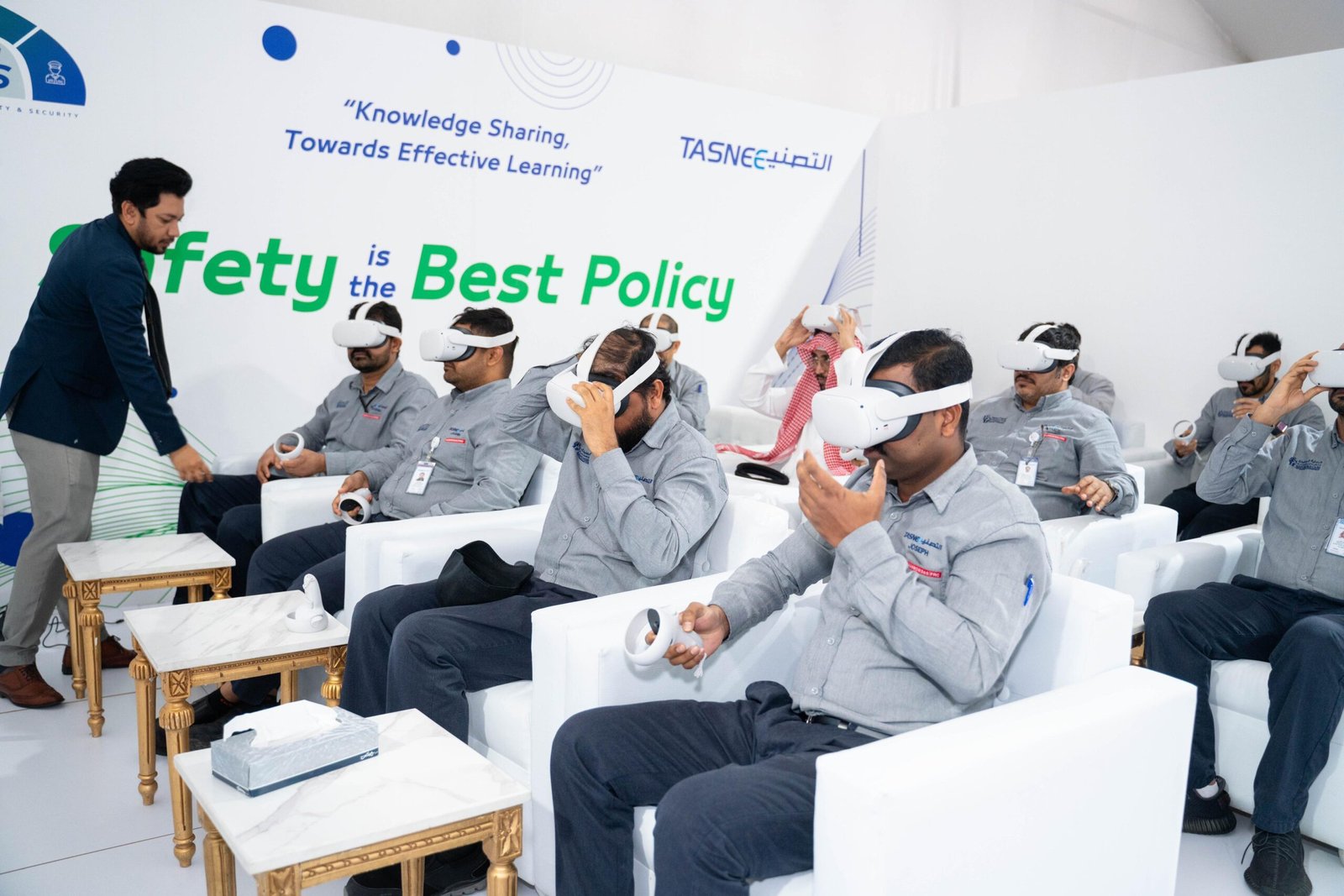
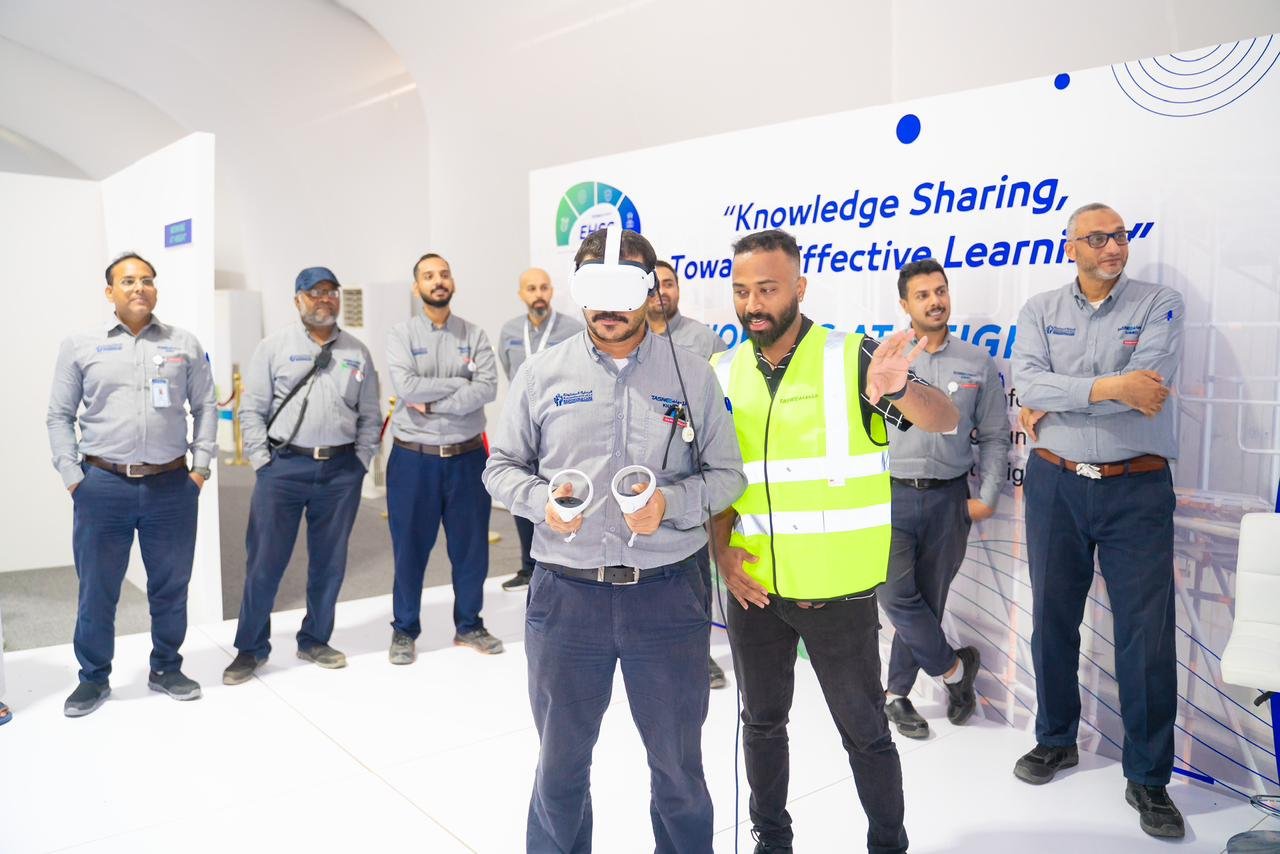
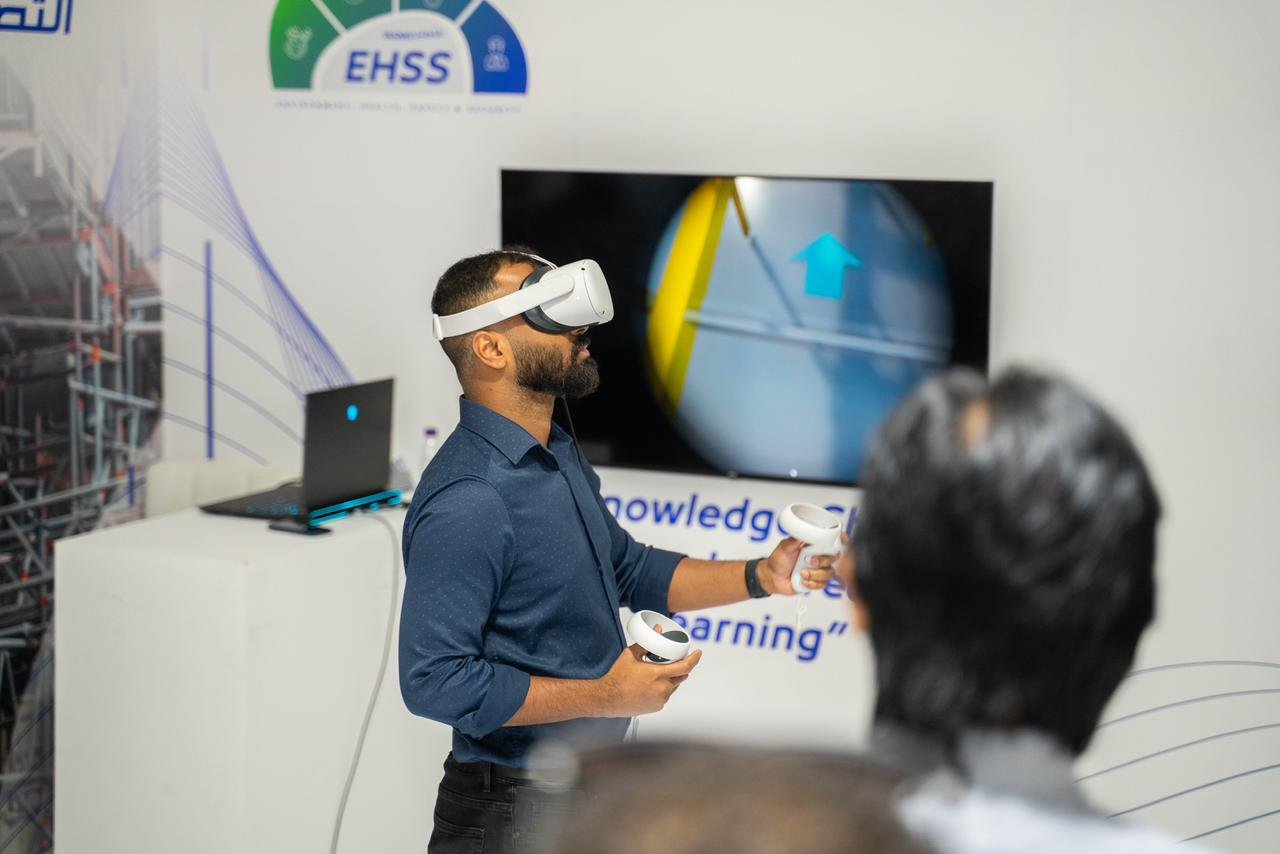
The event was a single day with hundreds of people. A PC-tethered headset means a cable, a rig, a technician per station and a long reset between users. A standalone Meta Quest means the whole station is the headset. We pre-loaded the build, locked the device to the experience, and ran it wireless. Setup on the day was minutes, not hours, and a FAIM operator could run several headsets at once.
The scoring model
Two numbers per decision: was it correct, and how long did it take. Decision accuracy tells the HSE team where knowledge is missing. Reaction time tells them where knowledge exists but habit is slow. A worker who clips on correctly after four seconds of hesitation is a different training case from one who does it instantly, and a different case again from one who skips it. The export at the end of the day lists every participant, every decision, every time.
Comfort is a design constraint
A first-time VR user who feels sick takes the headset off and never comes back. We use guided movement and teleport rather than free locomotion, keep the horizon stable, keep sessions short, and brief every participant in person. The operator can pause or end any session from outside the headset.
Running 200 people in a day
More than 200 participants completed the training at Tasnee’s Safety and Operational Excellence event. The operational side mattered as much as the software: battery rotation, lens cleaning between sessions, a queue system so people knew when they were next, and a mirror screen showing the headset view so the queue was learning while it waited.
The same approach on an exhibition stand
Strip out the scoring and keep the scenario and you have the VR journeys we built for Aramco TeraPOWERS, where visitors stepped inside the reservoir. The engine, headset and operator model are the same; the brief changes what is measured.
Where it fits
- Immersive AR and VR experiences
- Interactive games: the same scoring idea, competitive
- AEGIS: interactive industrial safety zone
- ELYSIUM: bespoke VR journeys
Questions clients ask
Can the scenario be built from our own procedures?
Yes, and it should be. We script the decisions from your permit-to-work and HSE procedures so the simulation teaches your rules, not generic ones.
What data does the HSE team receive?
A per-participant log: each decision, correct or not, and the time taken, exported to CSV or Excel. Aggregate reports by department or site on request.
Do participants need VR experience?
No. Most of the Tasnee participants were first-time users. The operator briefs each person, movement is guided, and sessions are short.
How many headsets do we need?
It depends on session length and the number of people per hour. We size it at the brief; a typical booth runs two to six headsets with one operator.
More technical stories
- How a cylindrical hologram works: from CAD file to exhibition floor
- Designing touchscreens for an exhibition floor: glare, gloves and the two-tap rule
- Offline first: how we build event applications that survive the venue Wi-Fi
- Hand tracking on a stand: when touchless beats touch, and when it does not
- Lead capture on a stand: the architecture behind 217 qualified leads
- Multiscreen sync: driving every display on a stand from one content panel
- Show control for launches: one trigger, a countdown that waits, no second take
- Rendering for the wall: pixel maps, anamorphic corners and why 16:9 is not a plan
- Building a physical reaction game: Unity, custom circuits and a one-minute clock
Start with a conversation
Send the procedure you want people to practise. AR and VR experiences WhatsApp FAIM
Joby Thuruthel / FAIM
Found this useful?