When an exhibition agency sells an interactive stand, the technology partner behind it carries the agency’s name into the hall. This is the story of a Riyadh stand builder whose touch table was sealed inside a wooden counter, and of the checks we run on an agency’s drawings before anything reaches the workshop.
The drawing set arrived as a PDF with forty-one pages. Only page twenty-six mattered to us, and it took a while to find it.
It came from a project manager at a stand-building company in Riyadh. His team designs and builds exhibition stands, mostly timber and printed graphics, and they are good at it. For a December show at a Riyadh venue they had three stands going up in the same week.
One client, a food manufacturer from the Eastern Province, had approved the design. Then they asked a question nobody on his team could answer alone.
“Can the counter be a touch table? Our distributors want to browse the products and leave their details.”
He had said yes in the meeting. Now he was calling us to find out what yes meant.
Saying yes on someone else’s behalf
We hear this moment a lot. An agency wins a stand and the client adds something interactive late. The agency then has to deliver it under its own name. The client may never see our logo. If the screen goes dark on day two, it is the agency’s phone that rings.
So his first question was not about the screen. He wanted to know who would be in the hall.
We told him what we tell every agency we work for. A member of FAIM commissions and stands by every installation we deliver. We would arrive during his build and work to his schedule and site rules until the show closed. His account manager would remain the person the client talks to.
He sounded relieved, and then a little wary. He had heard promises like that before.
Page twenty-six
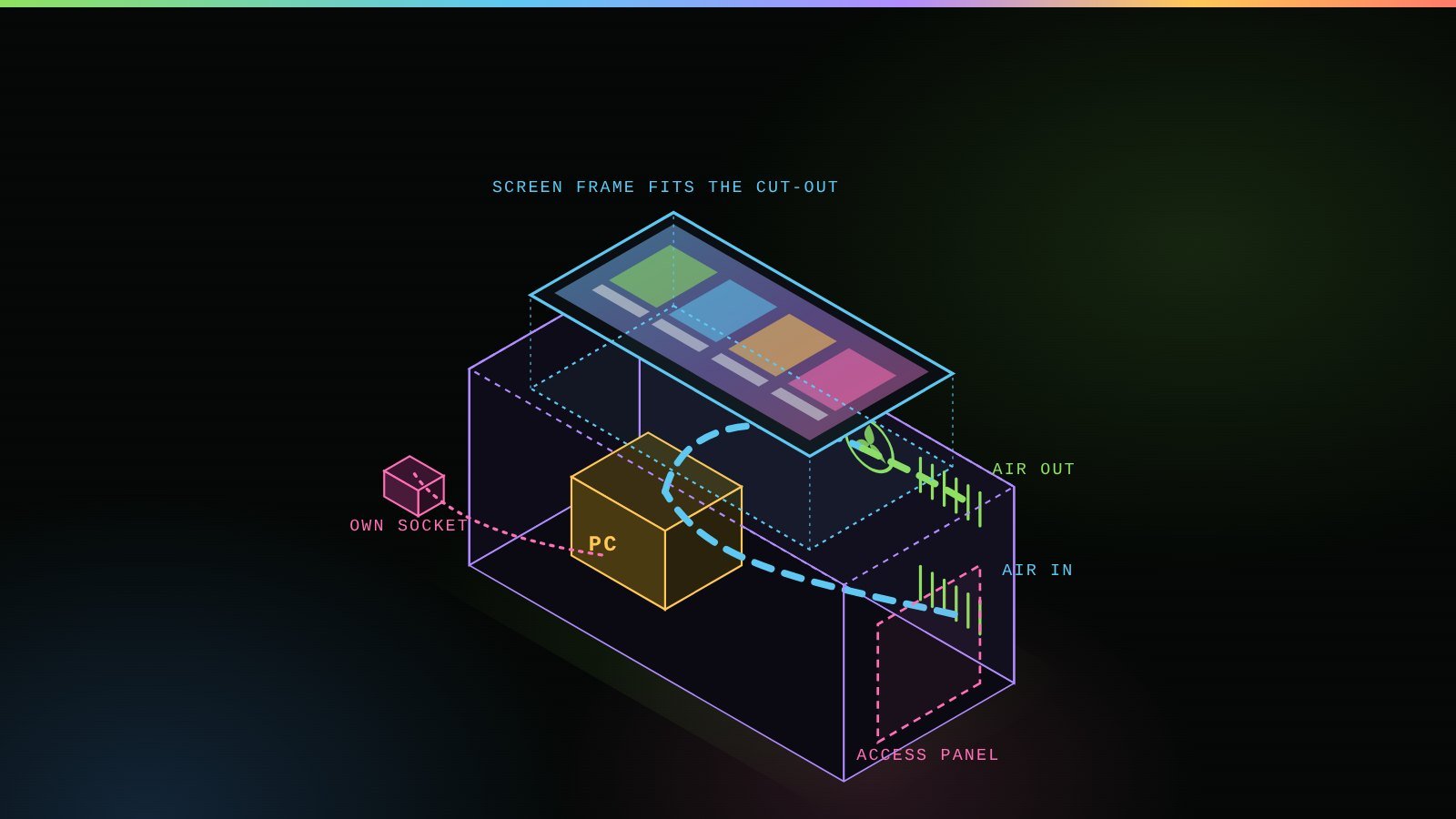
The touch table lived inside the main reception counter. On the joinery drawing it was a neat rectangle cut into the top, with a note: “55 inch screen, flush.” Below it, the counter was closed on every side. Painted MDF, a lockable door at the back, no openings at all.
Before we quoted anything, we asked for the screen model they had in mind and the venue’s electrical schedule for build-up and show days.
The screen model answered the first worry. The cut-out on the drawing matched the visible picture area, not the outer frame of the screen. Built to the drawing, the screen would not have fitted the hole. Someone would have discovered that at eleven at night on the second build day, holding a jigsaw, with no good options.
The closed counter was the second worry. A touch screen and its computer, sealed in a wooden box under hall lights for a full show day, get hot. Hot computers slow down and eventually restart, usually at the worst time. Visitors never see the computer. They see a frozen screen and a member of stand staff tapping it, slightly embarrassed.
We marked up page twenty-six in red. A larger cut-out with a proper frame for the screen. One ventilation grille low at the back and another high, with a quiet fan pulling air across. A removable panel, so whoever is on site can reach the computer without lifting the counter top in front of visitors. And a dedicated socket for the table, so it never shared a circuit with the stand’s coffee machine.
The project manager sent it to his workshop that afternoon. It cost his designer a few hours. His workshop foreman grumbled about the extra panel and built it anyway.
The power that switches off at night
The venue’s electrical schedule had a line most people skim. During build-up, stand power came on only in working hours. During the show, power to the stands went off after closing.
That changes how you plan software. We had intended to load the final product content on the last night of build-up. With the stand boards dead overnight, that update would never have happened, and nobody would have known until the client’s sales team opened the catalogue on day one and found last week’s prices.
So the update moved to the afternoon, while people were still in the hall to check it.
The nightly switch-off mattered in another way. When stand power cuts, the computer dies mid-sentence. There is no polite shutdown. We set the machine to start itself the moment power returns and open straight into the application. Everything a visitor enters is written to the device first, so a sudden cut does not take any leads with it. Our builds are offline-first, with redundant inputs and automatic recovery, and that evening switch-off is one reason why.
The Arabic that came apart
The client’s brand guidelines arrived on a Thursday. The English typeface was clean and confident. The Arabic section said, more or less, “use a suitable Arabic font.”
The agency’s designer had chosen one for the printed graphics, and on the stand walls it looked fine. In our first build of the product catalogue, the same font fell apart. Letters that should have joined stood alone. A few product names read as rows of separate shapes, like magnets on a fridge door.
The fault was in the font file. Print software had been quietly covering for it, and on a live screen the broken joins showed up straight away.
We sent the project manager two screenshots side by side: the broken version, and the same screen set in a properly licensed Arabic typeface that sat comfortably beside the English. He forwarded them to the client, who replied within twenty minutes. Bilingual Arabic and English is standard on everything we build, and that includes reading the Arabic on the real screen, with someone who reads it every day, weeks before show week.
One tick box became two
The food manufacturer wanted the table to collect distributor enquiries. Name, company, city and the products they were interested in. Simple enough.
Then, on a call a week before the show, their sales director mentioned that the leads would also go to their regional distribution partner.
The consent wording on the form only mentioned the manufacturer. Passing those details to a second company was a different request. Saudi Arabia’s Personal Data Protection Law has applied since September 2023, and what people agree to on a form should match what actually happens to their details.
We split the form. One box to let the manufacturer follow up. A separate, unticked box for sharing with the distribution partner. We asked the client to have their own adviser approve the final wording in both languages. It added a day. The adviser changed two words in the Arabic and signed it off.
Opening morning
On the third build day the hall smelled of fresh paint and carpet glue. The project manager was on one of his other stands, arguing with an electrician about a light box.
Our technician had the counter panel off and a laptop balanced on a crate. He switched the table on and went through every product screen in both languages. He pulled the power at the stand board on purpose, twice, and watched the table come back by itself each time. Then he typed a test lead with the network cable unplugged and checked it was still there after another power cut. The spare screen and spare computer stayed in their cases inside the counter. We carry spares, and we are in the room.
On opening morning the hall Wi-Fi gave up roughly forty minutes after the doors opened. Too many phones, one network. The stand opposite lost its registration tablets and started handing out paper forms.
Our table did not notice. It had never depended on the hall network. Leads saved on the device and waited to sync later.
At eleven, the client’s regional director arrived with a box under his arm. A new product, launched that week, not in the catalogue. Could it go on the table?
That kind of request usually means a developer with a laptop and a lost afternoon. Here, the agency’s project manager opened the content panel on his phone, added the product with photos and text in both languages, and published it from the aisle. Our technician read the Arabic before it went live. The whole thing took about ten minutes.
The counter stayed cool all week. If you put your hand near the back grille you could feel the fan working. Nobody ever did.
What the agency kept
On the last evening the client’s marketing lead told the project manager it had been a calm show, for once. She did not mention FAIM, which was exactly the arrangement.
The client owns the delivered assets, so the catalogue content and the leads were theirs to keep. The agency had the same table pencilled into the client’s next exhibition before the stand came down.
The project manager called the following week. There was no problem to report. He wanted to know whether we could look at the drawings for his next job before they went to the workshop, rather than after.
This story is a composite drawn from common situations, not a single client project.
Hiring an event technology subcontractor: a checklist for agencies
- Send the joinery drawings early and ask the technology partner to mark them up. Cut-outs, airflow and access panels are cheap on paper and painful on site.
- Ask for the venue’s electrical schedule. If stand power goes off at night, content updates and start-up behaviour have to be planned around it.
- Ask what happens when power cuts without warning. The right answer is that the screen comes back by itself, with no lost data.
- Test with the internet unplugged. Hall Wi-Fi often struggles when the doors open.
- Check Arabic on the real screen, read by a native reader, using a licensed font that supports proper letter joining.
- Match consent wording to what will really happen to the data, including any sharing with partners. In Saudi Arabia and in Bahrain, have the client’s own adviser approve it.
- Make sure your own team can change content during the show without calling a developer.
- Agree who commissions the installation, which spares travel with it, and who stays on site.
- Confirm who owns the content and the collected data after the show.
- Book early. Interactive stand builds typically take four to six weeks, with a minimum of five to ten working days from approval and advance payment for simpler jobs.
Building a stand that needs something interactive?
If your client has just asked for a touch table, a game or a registration screen, send us the drawings before they go to the workshop. We will tell you plainly what will work on your stand and what needs to change, and we will stand behind it on site. Our team is on the ground in Bahrain and Saudi Arabia, and bilingual Arabic and English is standard on every build.
Start the conversationWhatsApp us+973 3557 7062
Or email info@faimglobal.com.
Related reading: why event apps should work offline first, lead capture on a stand, designing touchscreens for an exhibition floor, our smart event technology service and the FAIM FAQ.
Questions agencies ask
Does FAIM work as a subcontractor to exhibition and event agencies?
Yes. A significant share of our work is delivered as a specialist subcontractor to event and exhibition agencies in Bahrain and Saudi Arabia. The agency keeps the client relationship, and we build and run the interactive technology.
Will someone from FAIM be on site during the show?
Always. A member of FAIM commissions and stands by every installation we deliver, and we carry spares.
What happens if the venue switches off stand power at night or the Wi-Fi fails?
Our builds are offline-first, with redundant inputs and automatic recovery. Data is saved on the device first, and the system restarts into the application when power returns. We plan content updates around the venue’s power schedule.
Who owns the content and the leads after the event?
The client owns the delivered assets. FAIM keeps its own underlying tools, frameworks and reusable systems.
How much lead time does an interactive stand need?
Interactive stand builds typically take four to six weeks. The minimum is five to ten working days from approval and advance payment, for simpler builds.
Can the interactive content run in Arabic and English?
Yes. Bilingual Arabic and English is standard across our interactive applications, including right to left layouts.
Sources
- Clyde & Co: Saudi Arabia issues Implementing Regulations to the Personal Data Protection Law (PDPL in force from 14 September 2023, full enforcement from 14 September 2024)
- Trowers & Hamlins: PDPL, Bahrain’s data protection regime (overview of Law No. 30 of 2018 and consent)
- FAIM FAQ (subcontracting, on-site commissioning, ownership and timelines)
This article is general information, not legal advice. Check data protection wording with your own adviser.
Found this useful?