2026 broke the Gulf’s growth story: the IMF now expects every GCC economy except Oman to shrink this year, Bahrain by 11.3%. The money for AI kept flowing anyway, the tools got far cheaper and more capable, and attention is moving from feeds to answers and from screens to rooms people can trust.
This piece is longer than our usual posts, because the subject deserves it. It is a case study of one year in the Gulf market, told as a story, with every number traced to a source you can open yourself. Where we are guessing, we say so. We tag our claims the way we tag them in client meetings: Certain when there is hard evidence, Likely when it is a strong inference, and Guessing when we are filling a gap.
A Saturday morning in Manama
The workshop was quiet on Saturday mornings. A production manager we will call Faisal had come in early anyway, because a stand for a spring exhibition had to ship in ten days and the LED wall supplier was late again. He had a coffee in one hand and a cable tester in the other when the first siren went.
He did not think much of it. Then his phone filled with video: a tower in Manama with smoke coming off one side, a crowd on a pavement looking up, a clip that someone swore was Dubai and turned out to be Bahrain. Within a week the spring show was gone from the calendar. Within a fortnight so was the Formula 1 race.
Faisal is a composite. We built him from the people we work with and from what was reported in those weeks, because the real ones have not asked to be in a blog. The events around him are not invented. On 28 February 2026, Iranian drones and debris hit buildings in Manama and Muharraq in retaliation for US and Israeli strikes on Iran. On 2 March, Mina Salman port was hit. On 9 March, a blast near the Sitra refinery injured 32 people and Bapco declared force majeure. On 10 March, Gulf Air moved its aircraft to Saudi Arabia. On 14 March, Formula 1 cancelled both the Bahrain and the Saudi Arabian Grands Prix. Certain
We are a small studio in Manama. That week happened outside our window too. So this is not a view from a conference stage in another city. It is what the year looked like from inside it, checked against the people who measure economies for a living.
The reality in numbers
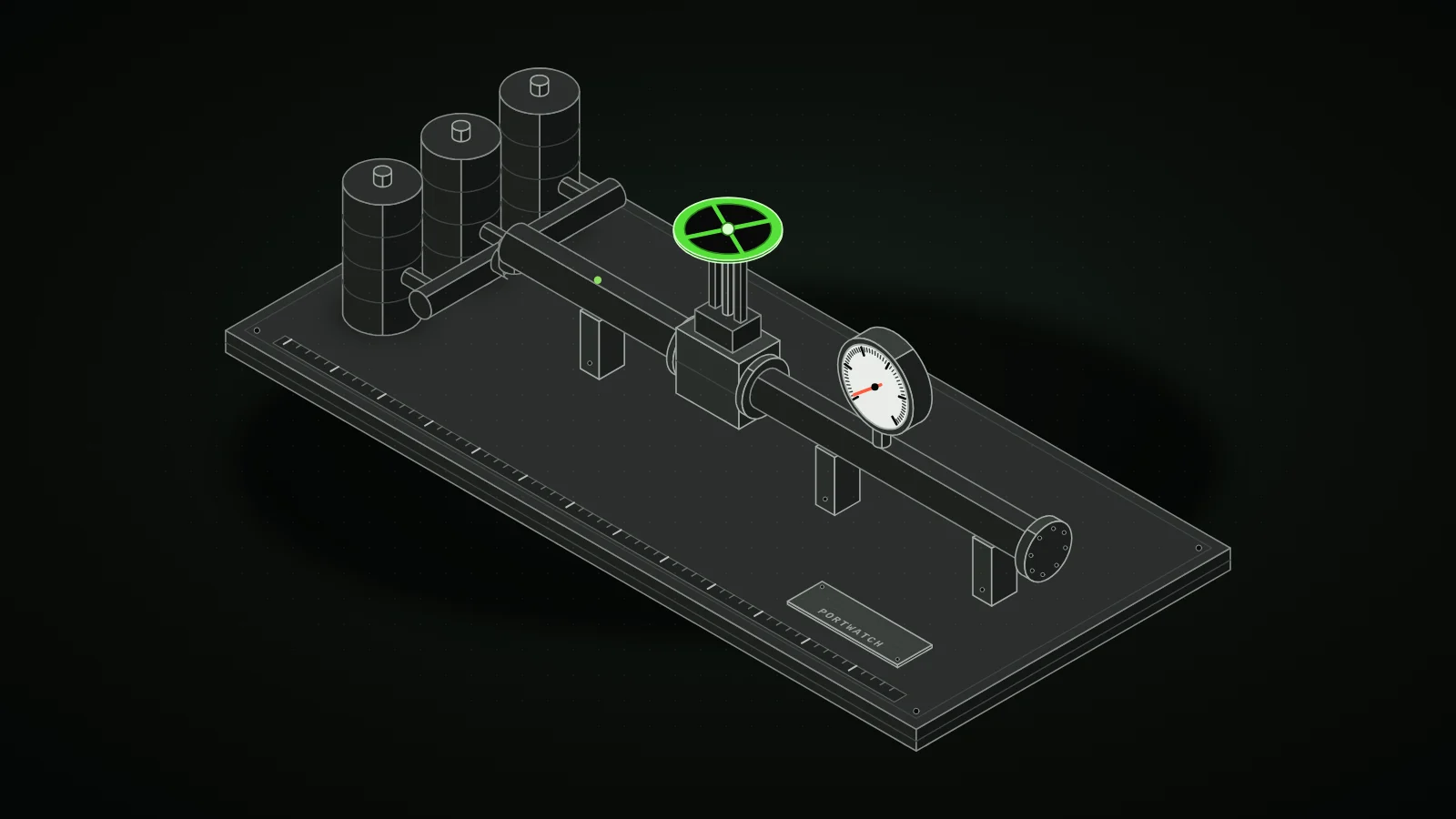
Start with the valve. Before the war, around 85 ships a day passed through the Strait of Hormuz. On 25 October, IMF PortWatch counted two. Trackers disagree on the detail (oil volumes have recovered faster than ship counts in some datasets, because they measure different things), but none of them describe a normal strait. Certain
Close the valve that carries most of a region’s exports and the rest follows. In October the IMF cut its forecasts for every Gulf economy. It now expects GCC output to fall 4.8% this year and rebound 9.1% in 2027, assuming the strait starts to reopen in March 2027 and returns to normal by October 2027. Press the buttons and watch what that means country by country.
The numbers hide the texture, so here is some of it.
- Hotels. Dubai averaged 84.8% occupancy in January and February. In the week ending 14 March it was 22.8%. Booking cancellations hit 60% within 48 hours of the first strikes.
- Airlines. At the peak, Middle East seat capacity sat 55 to 60% below schedule. Emirates, the strongest airline in the region, reported on 5 November that its half-year profit fell 66% and passengers fell 22%. It still made money, mostly thanks to fuel hedges.
- Events. LEAP in Riyadh moved from April to the end of August. Arabian Travel Market moved twice. Bahrain Comic Con was postponed. MDLBEAST Soundstorm was called off for 2026.
- Startups. MENA venture funding fell 22% in the first half to $1.35 billion, and the number of deals fell 41%. Saudi funding fell 74%. The UAE took two thirds of everything raised.
- Giga-projects. Saudi giga-project contract awards fell from $31.7 billion in 2023 to $13.6 billion in 2025 and $10.6 billion so far in 2026, mostly because NEOM postponed The Line and Trojena. Total Saudi awards fell to $76 billion through October, from $102 billion a year earlier.
- Security. Houthi strikes on King Khalid International Airport in Riyadh killed 13 people on 10 October. Eleven days later, Riyadh Season opened on schedule.
That last fact is the whole region in one sentence. The Gulf does not stop. It reroutes, delays, discounts, insures and carries on. That is real strength. It is also why outsiders keep underestimating the damage, because the lights stay on while the order books empty.
Bahrain, up close
Bahrain went into the war weaker than its neighbours, and it is honest to say so. Public debt was about 134% of GDP, the highest in the GCC. The budget needed oil at roughly $130 a barrel to balance. S&P and Fitch had already moved the kingdom to junk in November 2025. Then the refinery that supplies about 70% of government revenue was hit, aluminium output was cut, and the airport spent most of the spring closed. Certain
The response was fast and practical. The UAE central bank signed a currency swap worth about $5.4 billion. The Central Bank of Bahrain let banks defer loan and card payments for three months and opened about $18.6 billion in liquidity support. The Unemployment Insurance Fund covered April salaries for insured Bahraini workers, a tool first used in 2020. In June, Bahrain sold a $1 billion bond, the first from the region since the war began, and it was oversubscribed. In November, Exhibition World Bahrain was scheduled to host the 93rd UFI Global Congress, the exhibition industry’s own annual meeting, for the first time. Certain
What this means for anyone selling into Bahrain in 2026: budgets did not vanish, they froze. Decision makers moved from “what is new” to “what is safe, proven and measurable”. In our own conversations this year, the pitches that stalled stalled on certainty, not on price.
The paradox: the money for AI never stopped
One part does not fit the story of a region in retreat. While hotels emptied, the Gulf kept buying computing power. Saudi Arabia’s Humain, set up by the Public Investment Fund, is building data centres in Riyadh and Dammam. Its first Nvidia order was for 18,000 Blackwell chips, and it signed a $10 billion deal with AMD for 500 megawatts. In Abu Dhabi, G42’s Stargate site is planned to run its first stage on 400,000 Nvidia chips. Certain
Two honest caveats. First, announced gigawatts are not working capacity, and nobody publishes a clean figure for how much of this is switched on today. Second, every one of these chips needs a US export licence, and access depends on keeping Chinese hardware out. Even AI models themselves now sit inside that politics: in June the US Department of Commerce imposed export controls that briefly suspended access to two of Anthropic’s newest models, until the controls were lifted on 30 June. Certain
Inside companies, the picture is more modest than the headlines. McKinsey found that 84% of GCC organisations use AI in at least one function, up from 64% in 2023, but only 31% have scaled it beyond pilots. PwC’s survey of Middle East CEOs found GCC leaders are the most likely in the world to use AI in sales and marketing, 43% against 22% globally, yet only 16% say their AI tools can reach all the documents and data they need. Certain
Read that twice. Most Gulf firms have bought the tools. Few have connected them to their own data. That gap, not the model, is where most of the value is waiting.
What changed in AI this year
If you last looked closely at these tools a year ago, you are looking at a different industry. Three things moved.
The models kept leapfrogging each other, roughly monthly. Between February and September 2026, Anthropic, OpenAI, Google and DeepSeek between them shipped more than a dozen frontier releases. The direction was the same every time: longer, more reliable work on coding and research tasks, and agents that run for hours instead of answering one question. Certain
The price of intelligence fell through the floor. OpenAI’s GPT-6 Luna, released in September, costs ten cents per million input tokens through the API. For scale, a million tokens is several long novels. When something gets that cheap, it stops being a project and becomes a utility, like electricity or bandwidth. Certain
The assistant moved into the checkout and the search box. At Google I/O in May, Google announced Gemini Spark, a personal agent that runs in the background, a search box that builds interactive answers instead of a list of links, Gemini Omni for making and editing video, and a Universal Cart that follows a shopper across Search, YouTube and Gmail. Certain
Put those three together and you reach the uncomfortable conclusion for every marketer in the region: making content is no longer the hard part. Being chosen is.
Anatomy: how attention, algorithms and money connect
Most marketing advice in the Gulf still treats social, search, ads, events and data as separate departments with separate budgets. They are one machine. Tap each part of it below to see what it does and what feeds it.
In plain words, it works like this. Saudi Arabia has near total internet use (99%), and TikTok’s advertising tools can reach 38.6 million user identities there, with YouTube at 27.5 million and Snapchat at 25.3 million. Those platforms do not show you what is newest. They rank. A ranking system predicts, for each person and each post, how likely they are to watch to the end, share, save, reply or leave, and orders the feed by that prediction. Certain
Try it. The simulator below uses the same idea in miniature. Change what the system rewards and watch the order change.
Paid media sits on top of the same predictions. When you bid for an ad slot, you do not simply win by paying most. The platforms multiply your bid by how likely their model thinks people are to act on your ad, then add a score for quality and user experience. Meta calls the result “total value”. A small brand with an ad people actually want to watch can beat a big brand that bids more with a weak one, and pay less for the privilege. Certain
Two forecasts show where this machine is heading in our region. WPP Media expects the MENA advertising market to grow 7% to about $8.4 billion in 2026, with commerce media (ads sold by retailers and marketplaces, next to the buy button) growing fastest at 22%, and out-of-home falling 5%. It also expects answers written by AI to grow from 1% to 20% of search advertising by 2031. Certain When the answer is written for the customer, the brand that gets mentioned is the one with clear, consistent, verifiable facts about itself across the web. It is a new discipline, and very few Gulf brands have started on it. Likely
The cartoon retainer, and why faceless channels fail
A thread doing the rounds this autumn claims that, in 2026, one person with Claude can produce a whole animated series, from story to final caption, and sell it to app companies as a monthly “cartoon retainer” that drives sales. We could not read the original post, because X blocks automated readers, so we will not put words in its author’s mouth. But the claim is worth testing, because half of it is true and half of it is how people lose a year.
The true half: the tools can now do it. Script, storyboard, consistent characters, voice, edit and captions can be produced by a very small team in days rather than months. We do this ourselves for clients. Certain
The half that fails is the faceless channel built on volume. On 15 July 2025, YouTube updated its monetisation rules to target “mass-produced and repetitious” content: templated formats, lightly altered borrowed material, and channels that churn out AI videos with generic voices and scripts. Videos can be demonetised and whole channels removed from the Partner Programme. Content with a real point of view, commentary, education or a clear human voice is still welcome, faces or not. Certain
Look back at the ranking simulator. Volume channels lose because they are built to win the old signals (clicks, raw views), while the systems keep moving their weight towards satisfaction: did people finish, come back, share it with someone. A thousand forgettable episodes teach the algorithm that your channel is forgettable. Likely
The retainer half can work, if it is sold as an outcome rather than as output. In practice that means:
- One client, one character, one metric. A series for an app should be judged on installs or sign-ups per episode, with the tracking link agreed before episode one.
- Build the pilot with their real product. Nobody buys a retainer from a demo reel. They buy it from watching their own app inside a story that makes sense.
- Write the story bible before the first frame. Characters, voice, rules of the world, what the brand never says. Consistency is what turns episodes into a series.
- Keep a human in the edit. Every frame is checked by someone who would be embarrassed by a mistake. It also protects you from the platform rules above.
- Report honestly every month. If episode four flopped, say so and say why. A retainer survives on trust, not volume.
That is not a get-rich system. It is an agency, done properly, with better tools.
Trust became the scarce resource
The war came with a second front, on phones. In the first days, the UAE Ministry of Interior warned of fake “emergency registration” emails impersonating the government. Video from Bahrain was broadcast as a drone strike on Dubai. AI-made clips of a collapsing Burj Khalifa circulated widely. Dubai Police reminded residents that sharing unverified material can bring fines of at least AED 200,000. Certain
Cheap generation cuts both ways. When anyone can make anything look real, people stop believing what they see on a screen and start believing what they can touch, try, or hear from someone they know. So we think the value of physical, verifiable experience is going up, not down, as content gets cheaper. Likely
The Gulf in 2030: our honest forecast
Forecasting a region in the middle of a war is a humbling job, so this is how we built ours. We started from the IMF’s numbers, added what has already been committed and dated (Expo 2030 in Riyadh opens in October 2030, the 2034 World Cup is awarded, MEED expects the next wave of Saudi project awards from 2027), and then made judgement calls, each tagged. The IMF’s own regional director, Jihad Azour, said in October that Gulf output will still be below its pre-war path in 2030. We agree. Certain
Our base case, in eight lines:
- Bigger than 2026, smaller than promised. The 2027 rebound is mostly mechanical (oil flowing again). The lost years of tourism and investment do not come back. Likely
- Deadlines decide spending. Saudi money concentrates on things with a fixed date: Expo 2030, the World Cup, the new Riyadh airport, Qiddiya and Diriyah. Visionary projects without a date move slower. Likely
- Redundancy becomes a line item. Pipelines around Hormuz, backup data centres, duplicate suppliers and event cancellation cover become normal in budgets, and buyers ask for a plan B in every proposal. Likely
- The Gulf becomes a real compute region, later than announced. A meaningful share of the planned data centres switches on by 2030, gated by US licences and power. Guessing
- Agents sit between brands and buyers. A large share of product research and routine purchases starts in an assistant, not a search page. Brands that are easy for a machine to describe accurately win. Likely
- Content costs collapse, so proof gets expensive. Ads, videos and posts become almost free to make. Live experiences, demonstrations, samples and verified reviews take a larger share of what persuades people. Likely
- Events: fewer, larger, measured. Exhibitions and activations survive and grow in Riyadh, but buyers pay for outcomes (qualified leads, sign-ups, registrations) rather than square metres and screens. Likely
- Bahrain specialises or struggles. With high debt, Bahrain cannot outspend its neighbours. Its path is to be the efficient, nearby, trusted option: exhibitions, finance, services and talent for the Saudi market across the causeway. Guessing
What would prove us wrong: a fast, lasting reopening of Hormuz before spring 2027 would pull the whole timeline forward by about a year. A second shock, or a break in the US chip relationship, would push the compute and AI parts of this forecast well past 2030.
Where FAIM fits, and how we work
We are an event technology company in Bahrain. We build interactive exhibition stands, branded games, booth gamification and immersive experiences for exhibitions, launches and events in Bahrain and Saudi Arabia. We set out our strategy in the open, because clients deserve to know how a supplier thinks before they hire one.
We build products, not one-offs. Our experience catalogue holds 76 products, each one tested on a real floor or as a working prototype. When a client asks for something, we adapt a proven product to their brand instead of starting from zero. In a year like this, that matters: it is faster, cheaper and far less risky than a custom build that has never met a crowd.
We write the result down before we build. Every project starts with one agreed outcome: leads captured, delegates checked in, people who finished the experience. We explained why in our post on Results as a Service.
We let you play before you pay. Our live demo runs in a browser. Don’t read it. Play it. No brochures, no PDFs.
We use the new tools where they genuinely help. Intelligent engineering does the repetitive work: content variations, Arabic and English versions, live data and reporting. People do the parts that need judgement: the concept, the floor, the client, the final check.
We work with named partners. Media Craft is our media partner, GOamplify our social media partner and Adline Media our exhibition partner. They are listed with links on our site, so you always know who is involved.
Why we are this transparent
Because 2026 showed how wide the gap can be between an announcement and reality, and clients in this region have learnt to discount everything they are told. A supplier that tags its own claims, credits other people’s brands and admits what it does not know is easier to trust. When we built our Bahrain National Day experience, every page says plainly that the Celebrate Bahrain name, logo and identity belong to Celebrate Bahrain and that FAIM owns only the technology. We would rather lose a sentence of credit than a client’s trust.
And because our year was hard too. Projects stalled in the spring and summer for the same reason everyone else’s did. We are not writing this from a position of having escaped the market. We are writing it from inside, as people who intend to be here in 2030.
Next step
See it working before you decide
Completed works proven on real floors, and new ones you can try in one tap. 100% interactive, 1 tap to experience.
Explore the Live Demo Ask JARVIS to choose WhatsApp us
Joby Thuruthel / FAIM
Sources
- The National: IMF cuts 2026 growth forecasts for Gulf economies (country forecasts for 2026 and 2027, reopening assumptions, 13 October 2026)
- EnterpriseAM: IMF sees GCC non-oil economy shrinking 0.8% (GCC totals, Jihad Azour on 2030)
- Gulf News: ICAEW and Oxford Economics, Middle East Q2 2026 (tourism arrivals, Bahrain’s June bond)
- Straits daily brief, 6 November 2026 (IMF PortWatch transit counts, 85 a day baseline)
- Wikipedia: 2026 Iranian strikes on Bahrain (dated timeline, with its own references)
- Sky Sports: F1 cancels the Bahrain and Saudi Arabian Grands Prix
- HVS: Shock, divergence and recovery in GCC hospitality (Dubai occupancy, cancellations, airline capacity)
- The Star (Reuters): Emirates half-year profit down 66%
- Skift Meetings: Bahrain confirmed as host of the UFI Congress (LEAP and ATM date changes)
- DJ Mag: Soundstorm festival cancels 2026 edition
- Gulf News: Bahrain Comic Con 2026 postponed
- Arab News: MAGNiTT H1 2026, MENA startup funding down 22%
- Skift: Saudi giga-project spending shrinks (MEED data) (awards by year, NEOM, Riyadh airport strike)
- Saudi Press Agency: Riyadh Season 2026 launches 21 October
- AGBI: War intensifies economic realities putting Bahrain under strain (debt, breakeven, refinery share of revenue, ratings)
- Arab News: How Bahrain is supporting private sector workers (wage support, deferrals, liquidity, UAE swap)
- Rest of World: Why the Gulf’s billions can’t buy a way out of Nvidia (Humain, G42 Stargate, AMD deal, export conditions)
- Anthropic: statement on Fable and Mythos access (June 2026 export controls and restored access)
- Consultancy-me: McKinsey on GCC AI adoption (84% adoption, 31% scaled)
- PwC: 29th CEO Survey, Middle East findings
- Frontier AI models 2026, month by month and dutchstartup.ai on the late September releases (release dates and API prices)
- eWeek: Google I/O 2026, ten takeaways
- DataReportal: Digital 2026 Saudi Arabia (internet use and advertising reach, late 2025 data)
- Dotidot: How the Meta ads auction decides which ads win (total value as bid times estimated action rate plus ad quality)
- Communicate: WPP Media forecast, MENA advertising $8.4 billion in 2026
- Gulf News: YouTube’s inauthentic content rules from 15 July 2025
- SecurityMEA: Scams, deepfakes and fake footage during the conflict
- Bahrain iGA: National AI Policy and GCC ethics manual (July 2025)
Figures were checked on 7 November 2026. The conflict is ongoing and several of these numbers will change. Faisal, in the opening story, is a composite; every event around him is reported.
Found this useful?