The 93rd UFI Global Congress comes to Exhibition World Bahrain in Sakhir from 2 to 5 November 2026, the first time Bahrain has hosted it. When the people walking past your stand run exhibitions for a living, they notice everything. Plan for badge data you cannot see yet, coffee break surges, venue network quirks and late layout changes.
The call came on a Sunday morning, from an events director at an exhibition company in Manama.
She did not open with a budget or a mood board. She opened with a worry. Everyone who walked onto this stand would be someone who runs shows, she said. They would know within seconds if anything was held together with tape.
Her company had taken a stand at an industry gathering in Sakhir. It was the kind of week the UFI Global Congress brings to Exhibition World Bahrain this November: exhibition organisers and venue operators from around the world. People who have walked more halls than most of us have seen. People who look at the back of a stand before the front.
She had six weeks, and an idea she half apologised for.
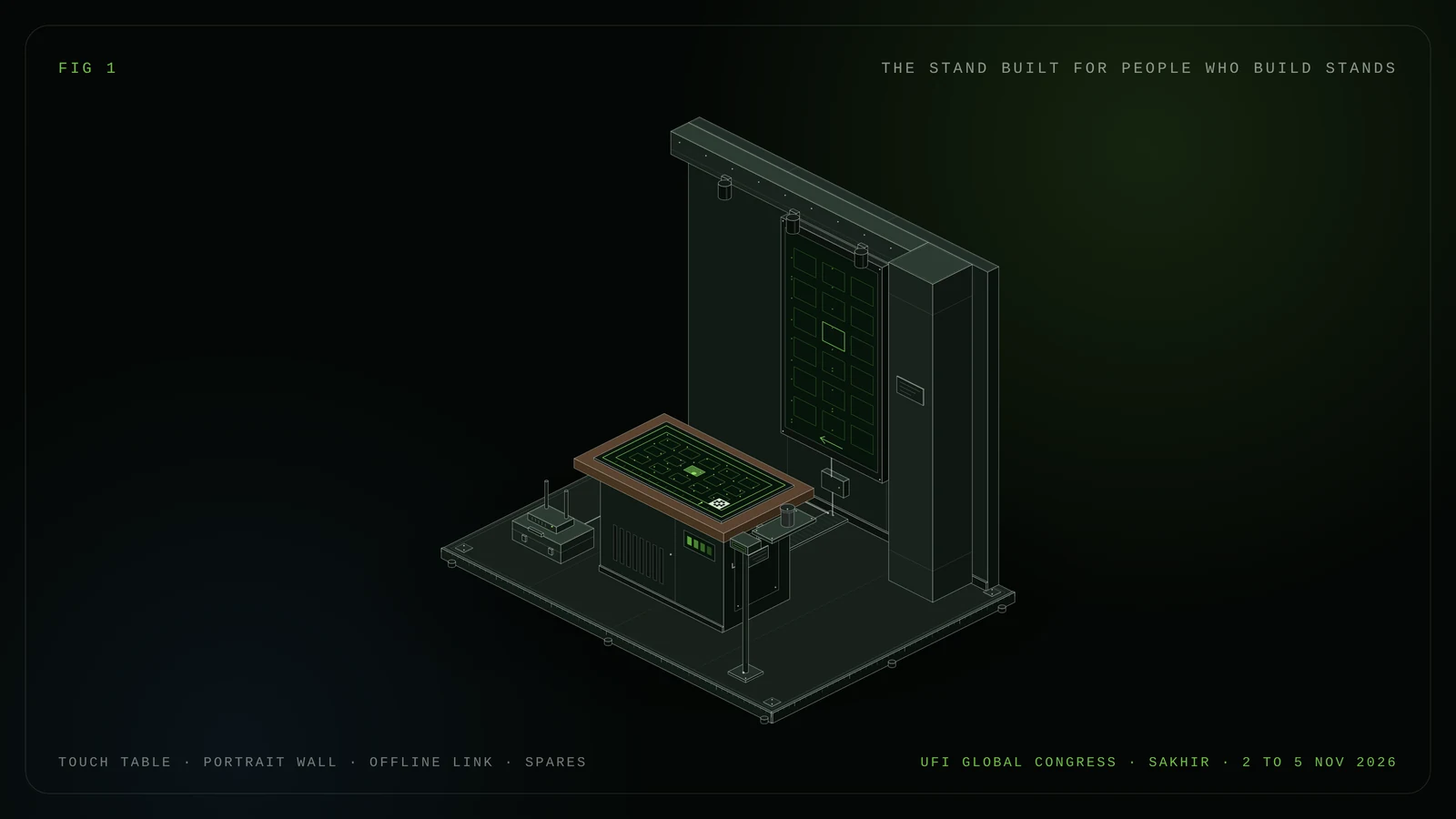
A touch table where a visiting organiser could plan a show in Bahrain in a couple of minutes. Pick a month and a hall, drag in a crowd, and watch the plan play out on a wall screen behind the table. At the end, a QR code with a one-page summary to take home.
We liked it straight away. It was useful, which is rarer on a stand than it should be.
Then we asked our usual questions, and the list of things that could go wrong grew longer than the list of features.
The badge nobody had seen
Her follow-up plan rested on scanning delegate badges. Fast, and nobody has to type.
The trouble was that nobody on her team had seen a badge. The barcode type, what the code actually carried, what exhibitors would be allowed to read: all of it would be confirmed by the organiser much closer to the date. We have watched stands build an entire lead flow around a scanner that, on the morning, read nothing but a registration number.
So we built two ways in. Scanning was one. The other was a short form on the table itself, three fields, with one plain sentence in Arabic and English explaining what would be sent and why. Nothing else was stored. The summary page worked either way.
Her legal team read the form against Bahrain’s Personal Data Protection Law before a single screen was designed around it. If the badge plan fell over in week six, the stand would still work. We have written about this in more detail in our post on lead capture architecture for exhibition stands.
The coffee break problem
A congress is not a trade show. Visitors do not drift past all day. They sit in sessions, then the doors open and everyone comes out at once, for coffee and corridor conversations, and then they are gone again.
We drew the expected traffic on a whiteboard. It looked like a heartbeat. Long quiet, then a sudden surge, then quiet again.
A couple of minutes per visitor sounded short in the office. In a surge it meant a line of senior people holding paper cups, watching a stranger drag hall icons around a table. Not the impression she wanted.
The table got a quick mode. Three taps, and the wall played a ready-made show plan for the month the visitor picked. The full planner stayed for anyone with time, and in practice that meant the quiet hours, when the serious conversations happen anyway. We also designed the wall to read from the aisle, so the people waiting had something worth watching.
Portrait, eight days out
Eight days before build-up, the stand designer sent a revised drawing. The wall screen had turned ninety degrees to fit a new column cover. Portrait now.
Every animation we had was widescreen.
This was the moment the director needed advice more than code. She could pay for a full re-render and gamble the timeline, or run the widescreen content inside a portrait frame with black bands top and bottom, which would look like exactly the kind of compromise her visitors would spot.
We suggested a third route. Recompose only the final reveal and the summary screen for portrait. Let the hall scenes become a slow vertical scroll, which suited the long shape of the floor plans better than the original did. She agreed within the hour, and we froze content that evening and did not reopen it.
Every frame was then checked on a portrait screen from our own studio, in both languages. That check caught the bug that would have hurt. In Arabic the layout mirrored correctly, but the swipe arrow still pointed right, so swiping through the plan felt backwards. On a desk monitor nobody had noticed. On a screen taller than a person it was obvious.
A login page at seven in the morning
Power reached the stand late on build-up day, which is normal and still makes everyone a little quiet. We commissioned close to midnight. Everything ran.
At seven the next morning, the wall was showing a hotel-style login page.
The venue network used a sign-in portal that expired overnight, and a media player the stand contractor had installed for a side screen had been set to open a browser at start-up. Not our player. Still our problem, because the login page was on our wall.
The planner itself never noticed. It is offline-first, so the table and the wall talk over their own local link and do not need the venue network to run. The only thing that needed the internet was sending summary emails, and those were waiting in a local queue. We moved that job onto a small 4G router we had packed as a spare, removed the browser from the contractor’s start-up list with his permission, and had the wall back on the opening loop before the doors opened.
The people who check the cables
First break, day one. The surge came exactly where the whiteboard said it would.
And the director’s worry came true in a way that made her laugh afterwards. The first visitor to the table, a venue operator, did not touch the screen. He crouched and looked at the cable run underneath. Then at the power protection tucked inside the plinth. Then he stood up and touched the screen.
Others tried to break it, politely and on purpose. Two fingers, three fingers, tapping hard in the middle of a transition, switching language halfway through a plan. That last one used to reset the session in early testing. We had fixed it so the plan kept its place and simply changed language. They were not being rude. Poking at things is their job.
In the middle of the afternoon the table stopped responding for a few seconds. Someone had rested a coffee cup on the bezel, and the touch frame read it as a finger that would not let go. Our technician moved the cup, smiled, and at the next quiet moment fitted a small ledge on the side of the table for cups. It was not in any drawing. By the evening break it was the busiest corner of the table.
Last session
On the final day the hall was quieter. You could hear the air handling, and somewhere behind a partition the rattle of a trolley as another stand began packing early.
During the last session, a woman who runs a trade show in another region sat at the table on her own and built a full plan, slowly, for an edition she was thinking of bringing to the Gulf. She took her summary, then walked over and asked the director for a meeting.
Our spare touch frame stayed in its hard case all week. The 4G router stayed switched on.
This story is a composite drawn from common situations we see on stands and events in Bahrain and Saudi Arabia, not a single client project.
Buyer checklist for a stand at an industry congress
- Ask the organiser early what the delegate badge holds and what exhibitors may read, and build a manual fallback either way.
- Plan for break time surges: a short path for the crowd and a longer one for the quiet hours.
- Fix screen size and orientation in writing before content production starts, and ask the stand builder to flag any change.
- Test Arabic and English on the real screen, including gestures and arrows, not only the text.
- Make sure the experience runs without venue Wi-Fi, and that anything online can wait in a local queue.
- Find out who controls the start-up settings of every player and screen on the stand.
- Have your legal team review what personal data you collect against Bahrain’s Personal Data Protection Law.
- Ask who from the supplier will be on the stand, and what spares they bring.
Taking a stand where the visitors are experts?
If you are planning event technology or an interactive exhibition stand in Bahrain or Saudi Arabia, tell us the venue, the dates and the idea, and we will tell you plainly what fits the time you have. A member of our team commissions and stands by every installation, on the ground in both countries.
Start the conversationWhatsApp us+973 3557 7062
Or email info@faimglobal.com.
Related reading: designing touchscreens for an exhibition floor, exhibition stand ideas that stop visitors walking past and a camera installation that had to ask first.
Questions buyers ask
When and where is the UFI Global Congress 2026?
The 93rd UFI Global Congress runs from 2 to 5 November 2026 at Exhibition World Bahrain in Sakhir. It is the first time Bahrain has hosted the congress.
How long does an interactive stand take to build?
Our interactive stand builds typically take four to six weeks. The minimum for one focused experience is five to ten working days from approval and advance payment.
What if the venue Wi-Fi fails during the event?
Our builds are offline-first, with redundant inputs and automatic recovery. Anything that needs the internet, such as sending emails, waits in a local queue until a connection is available.
Can we collect visitor details on an interactive stand in Bahrain?
Yes, with a clear purpose, only the fields you need and a plain explanation on screen. Have your legal team review the flow against Bahrain’s Personal Data Protection Law.
Will someone from FAIM be on site?
Yes. A member of FAIM commissions and stands by every installation we deliver, and we carry spares.
Is Arabic and English included?
Bilingual Arabic and English is standard across our interactive applications, and we test both on the real screen.
Sources
- UFI: 93rd UFI Global Congress 2026 in the Kingdom of Bahrain (2 to 5 November 2026, Exhibition World Bahrain, Sakhir)
- Trade Fairs International: EWB gears up to welcome 93rd UFI Global Congress (first time hosted in Bahrain, audience of organisers, venue operators and association leaders)
- Trowers & Hamlins: PDPL, Bahrain’s data protection regime (Law No. 30 of 2018)
Found this useful?