A mall roadshow across Saudi Arabia and Bahrain sounds like one stand built once and driven four times. In practice each city asks for its own version, and all four have to fit in the same crates. This is the story of a car launch that toured Riyadh, Jeddah, Al Khobar and Manama, with a camera that saw stripes, a cable that worked loose on the highway and a riyal sign that turned into an empty box. A buyer checklist follows.
The brief came in as a voice note. Two minutes forty, recorded in a car park, with a lot of wind in it.
The speaker was a marketing manager at a car distributor in Riyadh. They had a new family SUV arriving in the spring. Instead of one big launch night, the team wanted to go where families already are on a weekend: the malls.
Four stops. Riyadh, then Jeddah, then Al Khobar, then across the causeway to Manama. One long weekend in each city, about five weeks from the first stop to the last.
The car itself would sit on a turntable in the atrium. Their agency had that part handled. What they wanted from us was everything a family could touch.
She kept coming back to one idea. Build it once, then drive it everywhere.
One kit, four stands
We liked the plan. We were less sure about that idea.
Each mall has its own rules and its own build-up window. The light is different in every atrium, and so is the showroom phone number. Cross into Bahrain and the currency changes, the data protection law changes and even the electricity is different.
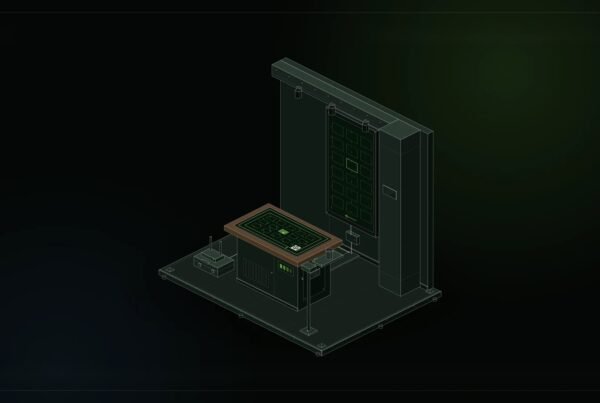
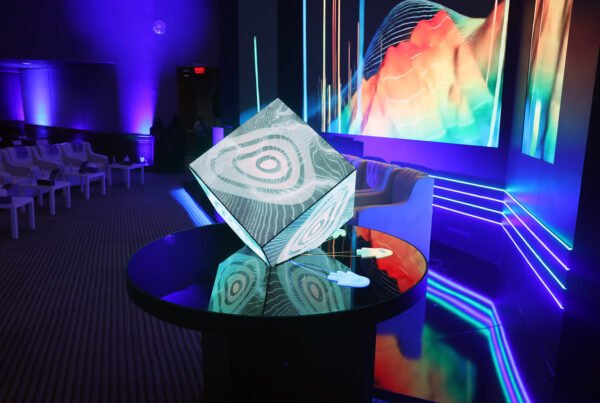
So we agreed the experience with her team first. A tall portrait touchscreen where a child could paint the SUV in any of its colours and turn it around. A tablet on a stand for booking a test drive at the nearest showroom. A large attract screen running a slow film of the car on desert roads.
Then we built it so one file controlled everything that changed between cities. City name, showroom details, currency, price line, consent wording, country. Swap the file, and the stand becomes the Jeddah stand. Everything in Arabic and English, because bilingual is standard in what we build.
The first stop was seven weeks away. Our interactive builds typically take four to six weeks, so there was room, but not much room to waste.
The car was rendered in every colour, from every angle, ahead of time. On a mall floor, a screen that thinks for two seconds before it shows you the red one feels broken. Ours just shows you the red one.
Riyadh, and the stripes on the monitor
Mall build-ups happen at night. The doors close, the cleaners come through, and you get a few hours before the morning shift opens the shutters.
Our engineer had everything running by two in the morning. Then the atrium went dark. Mall security switches some circuits off overnight, and nobody had told the agency.
That was fine. Our builds are offline-first with automatic recovery, so when the power came back at nine, every screen started up and went straight into the experience on its own. No one had to find a keyboard.
The second problem was quieter. The distributor had hired a videographer to film a short recap at every stop. He had flown in from Bahrain the day before.
Around four in the afternoon, our engineer walked past his monitor and stopped. Across the attract screen, slow dark bands were rolling upward, like a bad old television.
In the room, the screen looked perfect. On camera, it was ruined.
Saudi Arabia’s grid runs at 60 hertz. Bahrain’s runs at 50. Lights and some screens pulse in time with the mains, too fast for eyes to notice but not too fast for a camera. His camera was still set up for home, with a shutter speed matched to 50. Under Saudi power, the two rhythms fought each other and the bands appeared.
He changed the shutter to suit 60 hertz and the stripes disappeared. The rest of the tour footage was saved by a thirty-second conversation. We wrote a note on the run sheet for Manama, where he would need to switch back.
A long road to Jeddah
Everything went into padded flight cases and onto a truck heading west. Roughly nine hundred kilometres across the country, most of it highway.
In Jeddah, the big touchscreen powered up. The picture was fine. It did not respond to a single touch.
A screen that shows a picture but ignores fingers usually means the touch connection, not the screen. Our engineer opened the back panel. The cable that carries touch to the PC had worked half out of its socket somewhere on that highway. Hours of vibration will do that.
We carry spares. He swapped in a new cable from the case, locked it down with a clip, and taped every connector inside the cabinet before the next drive. Ten minutes, start to finish.
Then Jeddah gave us the sun.
The atrium had a glass roof. From about three in the afternoon, a hard patch of light moved across the floor and landed right on the touchscreen. The colours of the car went pale. A girl stood in front of it squinting, tapped twice, and walked back to her mother.
We could not move the sky, so we moved the screen. The agency’s crew helped us turn the whole unit to face away from the skylight and pull it a metre under the edge of the mezzanine. Our engineer raised the brightness for the afternoon and set it to drop back after sunset. It is now on our checklist for every mall: go and stand where the screen will stand, at the hour the crowd arrives.
Two days before Al Khobar, the riyal sign
On the Tuesday before the third stop, the marketing manager called. Head office wanted the launch price on the screen, using the new Saudi riyal symbol.
A small change. One line of text. We added it, then ran our usual check on the actual hardware that would travel.
On the laptop in our studio, the symbol looked right. On the kiosk PC, inside the Arabic layout, it showed as a small empty rectangle. Right where the currency should be.
The symbol only joined the Unicode standard in 2025, and plenty of fonts still do not include it. When a font has no drawing for a character, the screen shows a box. People who build interfaces call it tofu. The marketing manager had a less polite word for it.
We did not trust a font update to arrive in time. We placed the symbol as a small vector graphic inside both the Arabic and English price lines, sized to match the numbers. Then our Arabic-speaking producer checked the line on every screen, because mixing a symbol, numbers and right-to-left text is exactly where order goes wrong. The symbol sat on the correct side, at the correct height, in both languages.
Khobar, Thursday night, and the Wi-Fi
Thursday evening in Al Khobar was the busiest night of the tour. Families everywhere, a queue at the paint screen, children giving their fathers instructions.
At around nine the mall’s public Wi-Fi gave up. Too many phones in one atrium.
The paint screen did not notice, because nothing it showed came from the internet. The test-drive tablet did notice. The bookings were meant to go straight to the showroom.
It had been built to store each booking on the tablet first and send it when it could. We had also packed a small mobile data router as a second route. The bookings waited on the device for a few minutes, then went through over the router. The showroom team in Khobar had every one of them by the morning.
Across the causeway
The last stop brought the changes people forget. The kit crossed into Bahrain with its paperwork arranged in advance. Then we swapped the city file.
The price line switched to Bahraini dinars and the showroom numbers to the Bahrain distributor. The consent screen changed too, because Saudi Arabia and Bahrain each have their own personal data protection law.
The tablet’s consent box had started unticked in every city, in both languages. For Manama, the wording pointed to the right law and the right company. The distributor’s legal adviser had approved both versions weeks earlier, so the swap took one file, not one meeting.
The videographer flipped his camera back to suit 50 hertz before he hit record. Nobody had to remind him.
The last Saturday
Close to ten on the final night, a boy of about eight stood at the touchscreen for a long time. He painted the SUV orange. Then green. Then orange again, and spun it slowly to look at the back.
His father watched, then walked to the tablet and booked a test drive at a showroom fifteen minutes from their house. The tablet showed him the date in Arabic, the address in English, and asked first if he would like to be contacted.
Same crates as Riyadh. Fourth stand.
This story is a composite drawn from common situations on mall roadshows in Saudi Arabia and Bahrain, not a single client project.
Before you book a mall roadshow in Saudi Arabia and Bahrain
- Is there one settings file for each city, covering showroom details, currency, price line and consent wording?
- Does every screen restart into the experience by itself if the mall switches power off overnight?
- Has your videographer set the camera for 60 hertz in Saudi Arabia and 50 hertz in Bahrain?
- Has someone stood on each site at the busiest hour to check for skylights and glare?
- Are spare cables and a spare PC travelling with the kit, and are connectors secured for long drives?
- Has every late text change, especially currency symbols, been tested on the actual kiosk hardware in Arabic and English?
- If the mall Wi-Fi fails on a Thursday night, where do your test-drive bookings or leads wait?
- Has a legal adviser approved consent wording for each country on the route?
Planning a roadshow through Saudi and Bahraini malls?
Tell us the cities, the dates and what visitors should be able to do. Interactive builds typically take four to six weeks, and simpler builds need a minimum of five to ten working days from approval and advance payment. Our team is on the ground in Saudi Arabia and Bahrain, bilingual Arabic and English is standard, and a member of FAIM commissions and stands by every installation we deliver.
Start the conversationWhatsApp us+973 3557 7062
Or email info@faimglobal.com.
Related reading: the mall stand that kept going when the lights went out, why event apps should work offline first, designing touchscreens for busy floors and lead capture that survives a busy night.
Questions buyers ask
Can one interactive kit tour several malls in Saudi Arabia and Bahrain?
Yes, if it is built for it. Keep everything that changes by city (showroom details, currency, consent wording) in one settings file, pack the hardware in padded flight cases, and travel with spares.
Why do screens look striped on video in Saudi Arabia but not in Bahrain?
Saudi Arabia’s grid runs at 60 hertz and Bahrain’s at 50 hertz. Lights and some screens pulse with the mains, so a camera shutter set for one country can show rolling bands in the other. Set the camera to suit the local frequency.
Why does the new Saudi riyal symbol show as a box on some screens?
The symbol was added to Unicode in 2025 and many fonts do not include it yet. Test it on the actual display hardware, or place it as a small graphic so it shows correctly in Arabic and English.
What happens if the mall Wi-Fi fails?
Our builds are offline-first, with redundant inputs and automatic recovery. Content lives on the stand, and bookings or leads are stored on the device until a connection returns.
How early should we book a roadshow?
Interactive builds typically take four to six weeks, and simpler builds need a minimum of five to ten working days from approval and advance payment. Add time for city-specific content and legal review of consent wording.
Sources
- Unicode Consortium: Support for the new Saudi riyal currency symbol (encoding timeline and font support)
- World Standards: Saudi Arabia voltage and frequency (60 hertz in Saudi Arabia, 50 hertz in neighbouring countries)
- DLA Piper: Data protection laws of the world, Bahrain (Law No. 30 of 2018 and consent)
- Al Tamimi & Company: An overview of Saudi Arabia’s Personal Data Protection Law (consent requirements)
- FAIM FAQ (offline-first builds, spares, on-site commissioning, lead times)
Found this useful?